County Donegal Ireland · Co. Donegal · Kilcar Save · Share
POSTED FROM
KILCAR
CO. DONEGAL · IE

Kilcar
Cill Charthaigh

The Wild Atlantic Way
Wild Atlantic Way
Cill Charthaigh · Co. Donegal

Weaving village where tweed looms hum and Slieve League's cliffs rise straight from the coast.

Kilcar sits on a promontory above Donegal Bay, between Glencolmcille to the west and Killybegs to the east. Population about 300. Elevation enough that you see weather coming across the Atlantic. The village is Gaeltacht—Irish-speaking by law and by living practice.

The weaving tradition here dates back centuries. Studio Donegal, founded in 1976, revived the craft when it was nearly gone. The studio sits in the village. You can visit, watch weavers at work, buy a scarf made that morning. It's not a gift shop; it's a working mill with a sales front.

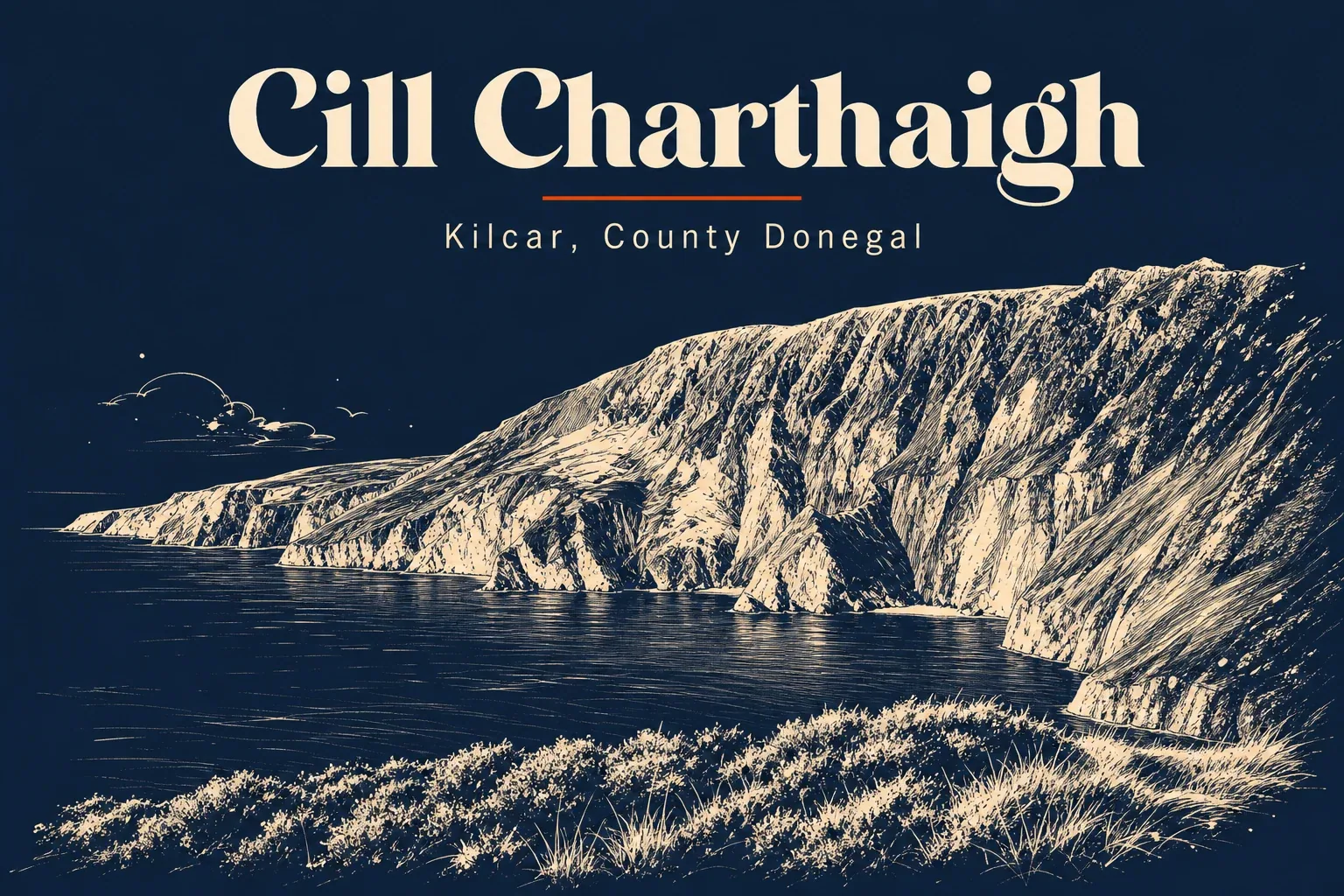
North of the village, Slieve League rises 600 metres straight from the sea. The Bunglass cliffs are the access point. A short drive gets you to the carpark. The walk along the ridge is exposed, undefended, and one of the finest coastal hikes in Ireland. On clear days you see the Aran Islands. On windy days you feel the Atlantic.

Come for Slieve League and the Studio. Stay because the village is small enough to know itself and honest enough not to pretend otherwise. There's no restaurant culture, no boutique hotels. There are two pubs, a handful of B&Bs, and a coast that holds weather like a bowl holds water.

Population
~300
Pubs
2and counting
Walk score
Village in 10 minutes
Founded
6th century (monastery)
Coords
54.6500° N, 8.7167° W
01 / 09

At a glance.

Three things every local will eventually mention. Read these and you've already understood more than most day-trippers do.

02 / 09

The pubs.

None of these are themed Irish pubs, because they don't need to be. A few that earn the trip:

John Joe's

Locals, quiet
Local pub

The village pub. Simple, unpretentious, the sort of place where conversations happen without agenda. Sessions when there are musicians in town, but not scheduled or performed.

The Rusty Mackerel

Harbour views, occasional music
Pub & bar

Closer to the water, views of the bay when the weather clears. Food is available. Trad happens occasionally but this is not a music venue first—it's a pub that happens to host sessions.

03 / 09

Where to eat.

PlaceTypeLocal note
Harbour View Cafe Café Coffee, sandwiches, soup. Open mornings and early afternoon. Not fancy. Adequate and honest.
Village shop & deli Takeaway Sandwiches made to order. Basics for self-catering. The backbone of village eating.
Pub food Bar meals €–€€ Both pubs serve food. Simple fare—stew, sandwiches, fish. Not destination dining, but real food for real hunger.
04 / 09

Where to sleep.

PlaceTypeLocal note
Derrylahan Hostel Hostel Cheap beds, clean rooms, friendly staff who know the area. The kind of place where backpackers meet locals. Good base for Slieve League.
Tara House Guesthouse En-suite rooms, simple breakfast, walking distance to everything. The sort of place that's been welcoming visitors for decades without fanfare.
Local B&Bs B&B Several family-run guesthouses throughout the village. Quality is consistent. Book ahead in summer.
Self-catering cottages Holiday let Scattered around the surrounding hills. Prices are reasonable. Independence for a week or longer.
05 / 09

Stories & lore.

The reason to come back. The things every local will eventually tell you about, usually after the second pint.

When weaving nearly died and then didn't

Studio Donegal

The hand-weaving tradition in Kilcar goes back generations. By the 1970s, it was nearly extinct—young people had emigrated, looms sat silent. Studio Donegal opened in 1976 as a collective cooperative. Weavers on the payroll. Traditional methods on the looms. Scarves and blankets made to order. The studio became proof that traditional craft could sustain real people with real income. It still does. Each piece is identifiably different—no two scarves are identical because they're made by human hands, not machines. The prices reflect that. A Studio Donegal scarf at €300 sounds expensive until you realize it will outlast the person who buys it.

The cliffs that are older than the Atlantic

Slieve League

Slieve League—or Sliabh Liag, "The Mountain of Flagstones"—rises 600 metres from the sea at Bunglass. The cliffs are among the highest in Europe. What makes them extraordinary is their accessibility: a short drive to a carpark, then a walk along the clifftop ridge. On one side, open Atlantic. On the other, vertical stone. The path is exposed, windy, often misty. The views span the coast for kilometres. On clear days, you see the Aran Islands off County Galway. In cloud, you see nothing—you just hear the wind and the ocean 600 metres below. The ridge walk is five kilometres. It takes three to four hours. It's the kind of walk where the landscape transforms how you think.

A language that refused to become a relic

The Gaeltacht

Kilcar is Gaeltacht. That means Irish is the official community language, protected by government designation, taught in schools, spoken naturally at the bar. This is not romantic nostalgia—it's a working language used by living people every day. Children here grow up bilingual, not by choice but by living. The shop signs are in Irish first, English second—if English appears at all. The road signs have used both names since independence, though the Irish name was officially primary before the English version was even accepted. What's remarkable is that the language survived when every force—emigration, economics, English dominance—was engineered to kill it. Kilcar is part of that survival.

Making a living from rock and wind

Coastal farming

The landscape around Kilcar is not generous. Stone walls divide fields the size of living rooms. Sheep graze hillsides steep enough to make you question their footing. Dairy farmers in the valley deal with Atlantic weather that can turn in minutes. The houses are built solid—thick walls, small windows, roofs pitched to shed storms. Farming here was never about abundance; it was about survival with dignity. What remains is a landscape shaped by generations of people finding ways to live on land that insists on humility.

06 / 09

Things to do outside.

Wear waterproofs. Bring a sandwich. Tell someone where you're going if it's the mountain.

Slieve League ridge (via Bunglass) Drive to the Bunglass carpark (10 minutes north). The walk climbs steadily to the ridge, then follows the clifftop. Exposed, windy, genuinely thrilling. The views span the entire coast on clear days. Bring waterproofs. Proper boots essential. Do not walk it in mist unless you're confident with navigation.
5 km loopdistance
3–4 hourstime
One Man's Pass descent Advanced walk. Descends the narrow stone path between two cliff faces—genuinely vertiginous. Views into the abyss. Not for the nervous or vertigo-prone. Clear weather required.
6 kmdistance
3–4 hourstime
Coastal path to Glencolmcille Follows the coast southward. Paths can be muddy and indistinct in places. Landscape is raw—cliffs, Atlantic swell, wind. Bring a map. Do this in good visibility.
12 km one-waydistance
4–5 hourstime
Valley walks Walking the quiet roads and farm tracks reveals hidden beaches, stone circles, and views that are yours alone. No formal routes—just exploration.
Variousdistance
Your timetime
07 / 09

When to go.

There is no bad time. There are different times.

Spring
Mar–May

Quiet, light is extraordinary, weather is unpredictable but often clear enough for Slieve League. Lambs in the fields.

◉ Go
Summer
Jun–Aug

Busier. Slieve League carpark can be full by mid-morning. Book accommodation early. Long days for walking. Weather is most stable.

◐ Mind yourself
Autumn
Sep–Oct

The locals' favourite. Fewer tourists, dramatic Atlantic storms building, the light is golden and slanting. The village feels most itself.

◉ Go
Winter
Nov–Feb

Slieve League can be closed by wind and weather. Roads get icy. Some services reduce hours. But the storms are spectacular and the pubs are warm.

◐ Mind yourself
08 / 09

What to skip.

Honestly? Don't bother.

If a local was sitting beside you, this is the bit where they'd lean in.

×
Expecting village nightlife or restaurant culture

This is a small Gaeltacht village of 300 people. There are two pubs, not a restaurant row. Plan to cook or eat early. Come for what's here, not what you wish was here.

×
Visiting Slieve League in mist without a map and compass

The ridge walk is genuinely exposed. Cloud cover removes all landmarks and all horizons. If you can't navigate by compass in zero visibility, wait for clear weather. The cliffs will still be there tomorrow.

×
Driving to Kilcar expecting dramatic weather to feel dramatic

Atlantic storms here are genuinely serious. Waves move in as walls. Wind gusts knock unsuspecting tourists sideways. Rain comes horizontal. It's beautiful, but it's not romantic—it's weather that demands respect. Dress accordingly.

×
Ignoring the Gaeltacht designation as "just a label"

The Gaeltacht status is real law with real consequences. Irish language education is mandatory. English speakers are the visitors here, not the main audience. That's the whole point.

+

Getting there.

By car

From Ardara via the Glengesh Pass (R230), about 35 km and 45 minutes. From Glencolmcille southward (R263), about 15 km and 20 minutes. From Donegal Town via Killybegs, about 50 km and 1 hour. The roads are narrow and winding but well-maintained.

By bus

Bus Éireann operates limited services in summer. Frequency is low. A car gives vastly more freedom.

By train

Nearest station is Donegal Town. Then bus.

By air

Nearest airport is Donegal (50 km). Cork and Shannon are 2+ hours.