County Donegal Ireland · Co. Donegal · Rossnowlagh Save · Share
POSTED FROM
ROSSNOWLAGH
CO. DONEGAL · IE

Rossnowlagh
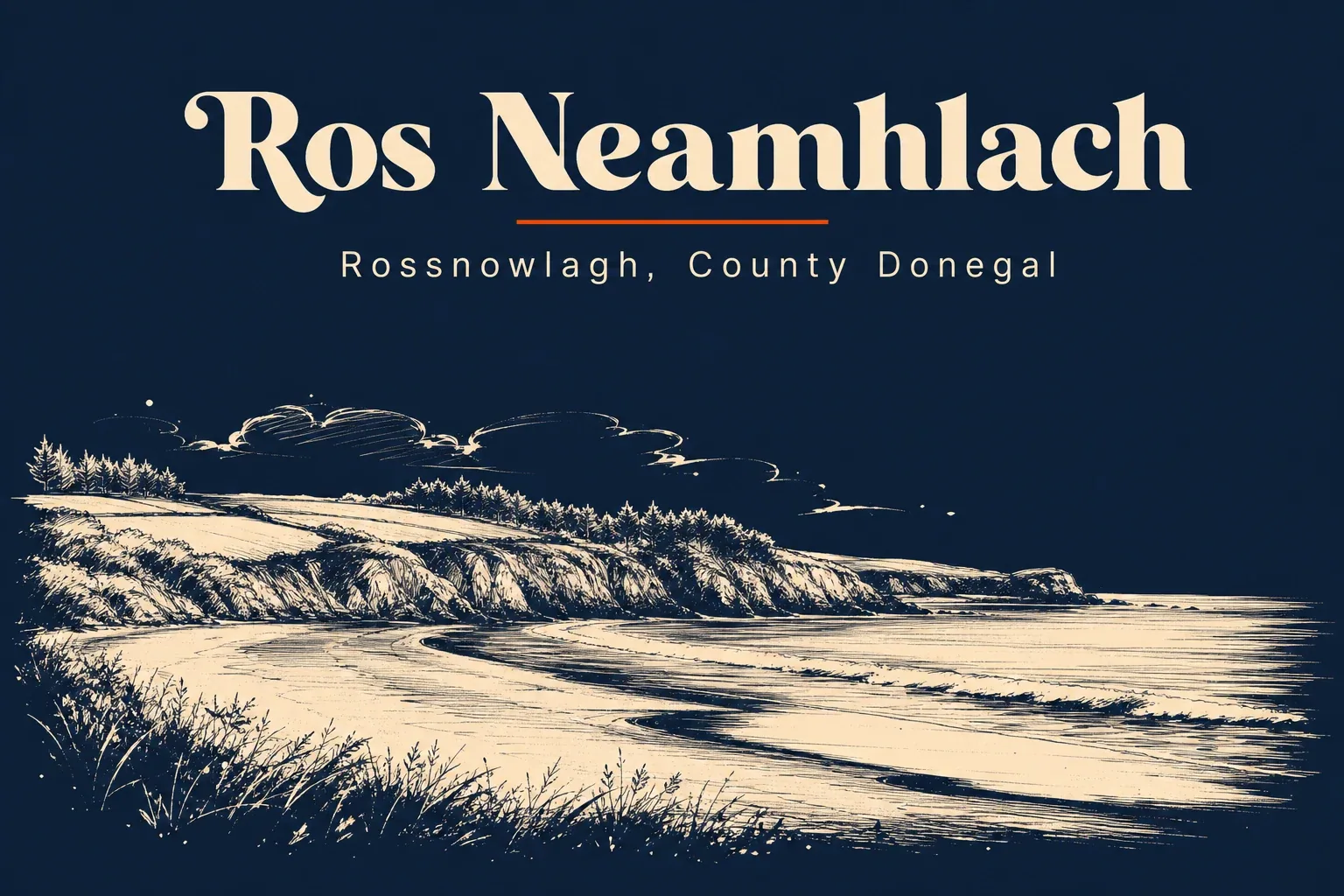
Ros Neamhlach

The Wild Atlantic Way
STOP 07 / 07
Ros Neamhlach · Co. Donegal

A three-kilometre beach. Waves in winter up to seven metres. A friary looking down on both.

Rossnowlagh is a surf village. Not a resort that happens to have waves. The beach is why people come, and the beach is what they find. Three kilometres of sand facing into the Atlantic, shaped by the Donegal Bay funnel into some of Europe's best winter swells. In summer it is quiet and beautiful. In winter it becomes something else.

The friary sits on the headland above the beach. You cannot walk the strand without seeing it. The Franciscans came back to Donegal in the 1940s after a century away, and they chose this place. The modern building does not hide. It sits there like a statement. Inside, there is a visitor centre, a museum, gardens open to the public. Most people come for the waves. Some come for the friary. Most come for both.

This is a working beach. Surfers, windsurfers, kite-surfers, swimmers, walkers. No theme park. No postcard language. Just a strand that works when the Atlantic is speaking and is quietly beautiful when it is not.
Population
Very small
Founded
Friary 1946 (re-established), opened 1952
Coords
54.567° N, 8.217° W
01 / 07

At a glance.

Three things every local will eventually mention. Read these and you've already understood more than most day-trippers do.

02 / 07

Where to sleep.

PlaceTypeLocal note
The Sandhouse Hotel Luxury 4-star hotel Overlooks the beach. Marine therapies spa. Surfers bar. Rooms with sea views. Book months ahead in summer. This is the place in Rossnowlagh if you have the budget.
03 / 07

Stories & lore.

The reason to come back. The things every local will eventually tell you about, usually after the second pint.

A hundred years away, back in 1946

The Franciscans' return

The Franciscan order had been in Donegal for five centuries until the mid-1800s. Then they were gone — forced out, starved out, or just absent, nobody quite remembers. In 1946 they came back. They chose a headland in Rossnowlagh, overlooking the Atlantic. Between 1950 and 1952 they built a modern L-shaped friary with a chapel. They opened it on June 29, 1952. It has never closed.

Ireland's longest-running competitive surfing event

Inter-Counties surfing since 1969

Since 1969, the Inter-Counties Surfing contest has been held annually in the Rossnowlagh area. The beach works. In winter, when the Donegal Bay funnel pushes Atlantic swells into seven-metre rollers, the contest is serious. The Irish National Junior Surfing Championships came here in 2007 with 113 young surfers competing in bodyboard and longboard. This is where Irish surfers learn to compete.

The official name, and a beach that is slowly washing away

Belalt Strand and the dunes

The beach's official name is Belalt Strand. In the twentieth century, soil erosion studies found the central dune front eroding at up to 0.6 metres per year. Between 1951 and 1977 it was worst. Starting in 1972, rock armour was built in front of what is now the Sandhouse Hotel and along the shoreline. It stopped the erosion in those protected parts. In the unprotected stretches, the dunes still look ragged—sometimes 35 metres of erosion where the sand has no wall to hold it back.

04 / 07

Things to do outside.

Wear waterproofs. Bring a sandwich. Tell someone where you're going if it's the mountain.

The strand Accessible by car via three ramps. Wide sand. In summer, you can walk from Rossnowlagh all the way to Murvagh Beach. Watch the tide.
3 km of main beach, more if you keep goingdistance
1 hour minimum, longer if you exploretime
The cliff path towards Kilbarron Castle Walk the southern end of the beach, then climb to the cliff path. In the distance stands ruined Kilbarron Castle, accessible via Creevy. Views back across Donegal Bay.
Variable, 2–3 km one way to Creevydistance
1–2 hourstime
05 / 07

When to go.

There is no bad time. There are different times.

Spring
Mar–May

Water cold, waves inconsistent, but the beach is quiet. Walk in good light. No crowds.

◉ Go
Summer
Jun–Aug

Warm, flat water, families on the beach. Swimmers and walkers own the strand. The Feis in July or August. Peaceful.

◉ Go
Autumn
Sep–Oct

Swells begin. The Inter-Counties contest happens. The water is still swimmable. The beach still quiet if you go on weekdays.

◉ Go
Winter
Nov–Feb

Waves. The Donegal Bay funnel fills with Atlantic swells. Winter surfers arrive. The beach transforms. Cold water, serious conditions, stunning light on bad-weather days.

◉ Go
06 / 07

What to skip.

Honestly? Don't bother.

If a local was sitting beside you, this is the bit where they'd lean in.

×
Visiting on a summer weekend without a place to sleep

The Sandhouse Hotel will be booked. Camping spots limited. Arrive with a bed secured, or come on a weekday.

×
The beach in flat, grey calm when you were hoping for waves

The Atlantic can be flat for a week. Check the swell forecast before committing. Winter gives the best odds. Summer is beautiful but lifeless.

+

Getting there.

By car

Ballyshannon is 8 km south (10 minutes). Donegal Town is 16 km north (20 minutes). From Dublin, 3.5 hours via N3/N15.

By bus

TFI Local Link route 292 from Donegal Town to Ballyshannon serves Rossnowlagh daily.

By train

Nearest working station is Sligo, 45 minutes away. Historic note: Rossnowlagh railway station closed in 1960. The line ran to Ballyshannon and Donegal Town.

By air

Donegal Airport 35 km. Cork 2 hours. Shannon 3 hours.