County Donegal Ireland · Co. Donegal · St Johnston Save · Share
POSTED FROM
ST JOHNSTON
CO. DONEGAL · IE

St Johnston
Baile Suingean, Co. Donegal

The Ireland's Ancient East
STOP 07 / 07
Baile Suingean · Co. Donegal

A Plantation borough on the Foyle, twelve kilometres from Derry, with a ruined O'Donnell castle a mile downriver.

St Johnston does not ask for your attention and does not particularly need it. It is a Laggan village on the west bank of the Foyle, in the prosperous farming strip of east Donegal that has been drained, ditched and worked since Scots settlers came over in the Plantation. The country is flat and green and quietly well-off. The accent is closer to Derry than to Donegal town.

The place was built to order. James I granted the lands to Louis Stewart, Duke of Lennox, around 1610, on condition he settle thirteen families of English or Scottish artisans here. By 1622 it was thirty thatched houses and cabins. It was made a borough and sent two members to the Irish Parliament for nearly two centuries, which says more about how seats were handed out before 1800 than about the size of the village.

There is more history than there looks. A mile downriver stands Mongavlin Castle, a ruined O'Donnell stronghold; James II made it his headquarters in 1690 on his way to the Siege of Derry, and sent a surrender letter from here that the city threw back at him. The parish takes its name from Taughboyne, the house of Baithin, a cousin of Colmcille who founded a monastery in the Laggan around 560AD. The Catholic church in the village was designed by E. W. Godwin, an architect better known for Aesthetic-movement furniture than for rural Donegal chapels.

Come for an afternoon, not a holiday. A pint in Maggies, a look at the two churches, a walk down to the river and the castle ruin, and you have taken the measure of the place. It works best as a stop on the way between Derry and the rest of Donegal, which is what it has always been.
Population
571 (2022)
Founded
Plantation borough, granted 1610-1618 to the Duke of Lennox
Coords
54.9306° N, 7.5625° W
01 / 07

At a glance.

Three things every local will eventually mention. Read these and you've already understood more than most day-trippers do.

02 / 07

The pubs.

None of these are themed Irish pubs, because they don't need to be. A few that earn the trip:

Maggies Tavern

Family pub, since 1919
Pub & restaurant, village street

The pub in St Johnston. Started in 1919 by a farming family and still going, with a renovated bar and a kitchen doing bar food and a Sunday roast - beef, turkey and ham, the local vegetables. It takes bookings for family lunches and christenings, which tells you what kind of room it is. If you stop in the village for one thing, stop here.

The Fisherman's Inn

Small local
Bar, village

The other bar in the village, named for the Foyle salmon trade that ran through here. A plain local rather than a destination. Between it and Maggies, that is the drinking in St Johnston - this is a village of a few hundred people, and it does not pretend otherwise.

03 / 07

Stories & lore.

The reason to come back. The things every local will eventually tell you about, usually after the second pint.

Thirteen families and two seats in Parliament

The Plantation borough

James I granted the lands of Dromtoolan and Gollanogh to Louis Stewart, Duke of Lennox, around 1610, on condition that he plant thirteen families of English or Scottish artisans on them. By 1622 St Johnston was recorded as thirty thatched houses and cabins inhabited by British settlers. It was incorporated as the Borough and Town of St Johnstown and returned two members to the Irish House of Commons until the Act of Union in 1800. It was, plainly, a rotten borough - a village with a parliamentary title out of all proportion to its size - but the Plantation map it was drawn on still runs under the fields today.

The black-haired queen of Donegal, and James II's surrender note

Mongavlin Castle

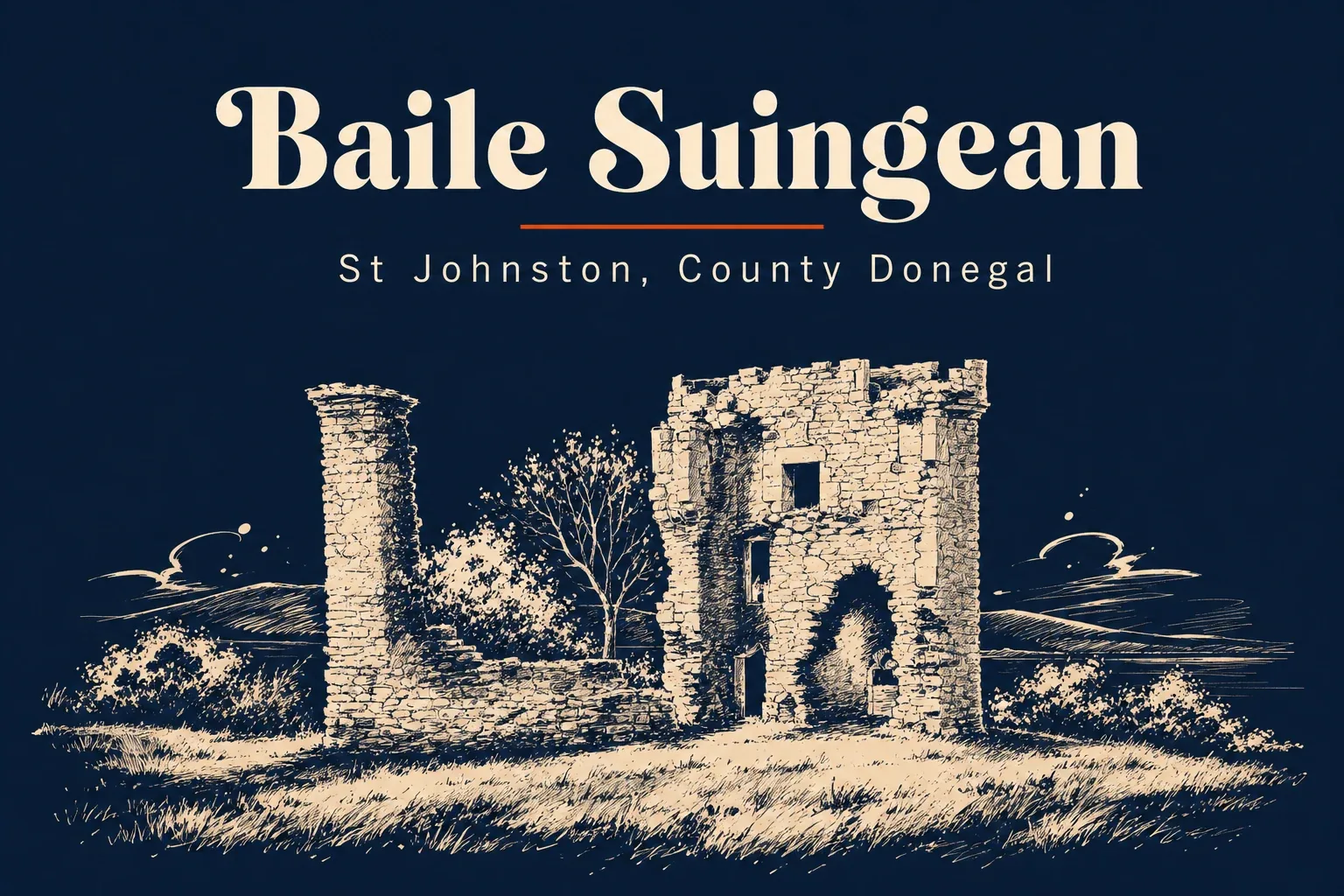
A mile downriver toward Derry stand the remains of Mongavlin Castle, once an O'Donnell stronghold on the Foyle. In the sixteenth century it housed Finola MacDonnell, the Scots wife of Sir Hugh O'Donnell and mother of Red Hugh, who is said to have brought a hundred of the tallest, fiercest men she could find in Scotland as a bodyguard. The Crawfords among them settled locally and their descendants are in the parish still. The castle was rebuilt in stone by the Stewarts around 1619 after the Plantation. James II made it his headquarters in 1690 during the Siege of Derry and sent his rejected surrender letter to the city from here. Only a fragment of wall now stands.

The house of Baithin, c. 560AD

Taughboyne and St Baithin

The parish is Taughboyne - from Teach Baithin, the house of Baithin - after a cousin of Colmcille who founded a monastery in the Laggan valley around 560AD. The medieval church at Taughboyne, long a ruin, was restored in 1627. In the village itself, St Baithin's Catholic church, known locally as the Chapel, was built between 1857 and 1860 to a design by E. W. Godwin, the Victorian architect more famous for Aesthetic-movement furniture and his association with Whistler than for parish chapels in east Donegal. The Presbyterian church on its site above the Foyle was rebuilt with its neo-Gothic tower in 1849, marking one of the older Presbyterian congregations in the country.

04 / 07

Things to do outside.

Wear waterproofs. Bring a sandwich. Tell someone where you're going if it's the mountain.

The two churches and the village street St Baithin's Catholic church (Godwin, 1857-1860) and the Presbyterian church with its 1849 tower above the Foyle are the two set pieces, a short walk apart on the village street. Add the riverside and you have seen St Johnston properly in half an hour.
1.5 km loopdistance
30 minutestime
Down to Mongavlin Castle A mile downriver toward Derry, the ruin of Mongavlin Castle on the Foyle. Only a fragment stands and it is on private farmland, so view it from the road and the riverbank rather than tramping into the field. The walk down along the water is the better half of the outing.
3 km returndistance
45 minutestime
05 / 07

When to go.

There is no bad time. There are different times.

Spring
Mar-May

The Laggan greens up and the Foyle light is good. Quiet, dry-footed, the right time for the short heritage walk.

◉ Go
Summer
Jun-Aug

Long evenings on the river, Maggies busy at weekends. The easiest season to fold the village into a Derry-to-Donegal run.

◉ Go
Autumn
Sep-Oct

Soft light on the Foyle and the harvested Laggan fields. Few visitors, which suits the place.

◉ Go
Winter
Nov-Feb

Short days and damp river weather. The pub keeps going; the walks turn muddy. Pass through rather than linger.

◐ Mind yourself
06 / 07

What to skip.

Honestly? Don't bother.

If a local was sitting beside you, this is the bit where they'd lean in.

×
Treating it as a destination

St Johnston is a small Laggan village of a few hundred people, not a day out. There is no hotel, no row of cafes, no visitor centre. Come for an hour on the way between Derry and Donegal and you will have it right.

×
Walking into Mongavlin Castle

The ruin is a fragment on private farmland, not a managed heritage site. View it from the road and the riverbank. Do not climb a farmer's fence for a wall and a story.

+

Getting there.

By car

On the N14 corridor between Letterkenny and Derry. Letterkenny is about twenty minutes south-west, Derry city about a quarter of an hour north-east. The village sits just off the main road on the Foyle side.

By bus

TFI Local Link runs between St Johnston and Letterkenny Bus Station, roughly a 33-minute trip, with stops in the village. Bus Eireann services on the Letterkenny-Derry corridor pass nearby.

By train

No station - the Great Northern Railway line closed in 1965. The nearest train is from Derry (Londonderry) on the Belfast line, about fifteen minutes away by road.

By air

City of Derry Airport (LDY) is about half an hour north-east. Belfast International (BFS) is roughly an hour and a half; Dublin (DUB) about three hours by road.