County Down Ireland · Co. Down · Groomsport Save · Share
POSTED FROM
GROOMSPORT
CO. DOWN · IE

Groomsport
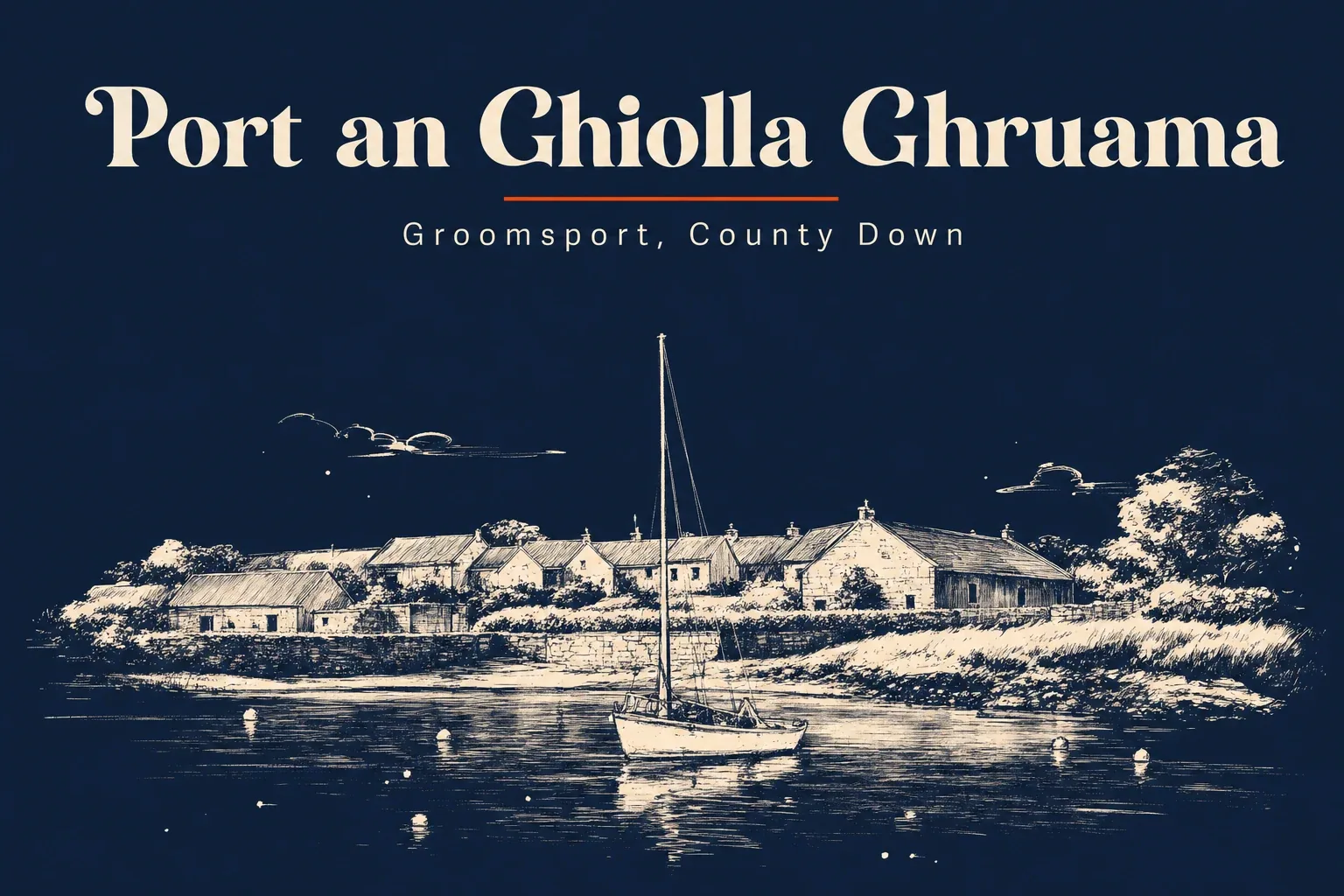
Port an Ghiolla Ghruama

The Ards and North Down
STOP 06 / 06
Port an Ghiolla Ghruama · Co. Down

The harbour the first emigrant ship left from, and turned back to.

Groomsport is what's left of a fishing village after Bangor swallowed everything around it. Two miles east of the city, a little harbour, a pair of thatched cottages on the quay, a green in front of the church, and the North Down Coastal Path running straight through. You can park, walk the whole place, read every plaque and be back in the car inside forty minutes. The interesting part is what happened here, not what is here now.

What happened here was the Eagle Wing. On 9 September 1636 a ship built in Groomsport sailed from this harbour with a hundred and forty Ulster-Scots Presbyterians on board, bound for the Massachusetts Bay Colony — the first organised emigration from Ireland to America, fifty-four years before the better-known waves. Four ministers led it, John Livingstone of Killinchy among them. Two months out they hit Atlantic storms that broke the rudder and stove the deck. They turned back. Most of the passengers settled in Down and Antrim and kept their heads down through the rebellion of 1641. The descendants who eventually made the crossing did it the next century, the next, the next.

Come for the cottages, the harbour wall, and a walk. Cockle Row is free and small and the volunteers know more than you will ever ask. Walk west around Ballymacormick Point and into Ballyholme; walk east toward Orlock and the cliffs that go up the hill. Bring a coffee from the village; come back for a pint somewhere in Bangor. The village is honest about being a chapter in a longer story.

Population
~2,800
Walk score
Harbour to Ballymacormick gate in ten minutes
Founded
Eagle Wing sailed from here 9 September 1636
Coords
54.6789° N, 5.6128° W
01 / 06

At a glance.

Three things every local will eventually mention. Read these and you've already understood more than most day-trippers do.

02 / 06

Stories & lore.

The reason to come back. The things every local will eventually tell you about, usually after the second pint.

9 September 1636 — the ship that turned back

The Eagle Wing

A hundred and fifty tons, built at Groomsport by a consortium of Ulster Presbyterian landowners — James Hamilton among them — who had run out of patience with the Church of Ireland's drive to silence non-conforming ministers. Four ministers sailed: John Livingstone from Killinchy, Robert Blair from Bangor, John McClelland and James Hamilton (a different one). A hundred and forty passengers in total, bound for the Massachusetts Bay Colony. They were two months at sea and roughly halfway across when North Atlantic storms broke the rudder. They put back into Loch Fergus in November. Some of the passengers tried again, individually, over the next thirty years. The bulk of Ulster-Scots emigration to America did not start in earnest until the 1710s. The Eagle Wing was the first attempt, and it failed honestly.

The cottages that didn't fall down

Cockle Row

Two single-storey thatched fishermen's cottages on the harbour, dating to the 17th century, when Groomsport was a working herring port. The whole row used to run further along the quay. The two that survived were restored by the council in the 1990s and opened as a small heritage centre — one cottage furnished as it would have been around 1910, the other a craft shop and exhibition space. Open at weekends in summer, manned by volunteers, free. The thatch is real, the half-doors open, and the chimney still works on the rare days they light the fire.

The tern colony in the harbour

Cockle Island

The little rock off the end of the pier is Cockle Island and in summer it is one of the larger Sandwich tern breeding colonies on the east coast of Ireland. Arctic and common terns nest there too. You can hear them long before you see them. The island is off-limits to landing during the nesting season, which is the whole point. Watch from the harbour wall with whatever lens you brought.

Why the village stopped fishing

The herring went

Groomsport was a herring port from the 18th century through to the early 20th, when the shoals in Belfast Lough moved further offshore and the bigger boats out of Bangor and Ardglass took what was left. The wee yawls that used to land their catch on the strand below the cottages stopped coming back. The harbour the council maintains today is recreational. The last commercial fisherman from the village hung up the nets within living memory and the cottages are now the memorial.

03 / 06

Things to do outside.

Wear waterproofs. Bring a sandwich. Tell someone where you're going if it's the mountain.

Ballymacormick Point loop West out of the harbour, through the gate onto National Trust land, around the headland and back via the road. Whin and gorse, no fence between you and the rocks, the Copelands sitting off to the north on a clear day. The Trust has held the point since 1979.
3 km loopdistance
1 hourtime
Groomsport to Bangor West along the North Down Coastal Path to Ballyholme Beach and on into Bangor Marina. Bus 3 back when you've had enough. Quieter than the western half of the path from Bangor to Holywood.
5 km one waydistance
1.5 hourstime
Groomsport to Orlock Point East from the harbour along the cliff path, past the old coastguard cottages and out to Orlock — the eastern tip of the North Down coast, where the path looks across to the Copeland Islands and on to the Mull of Galloway on a clear day. The least walked stretch of the coastal path.
6 km returndistance
2 hourstime
The harbour and Cockle Row Round the harbour wall to the cottages, up to the green in front of the parish church, back along the front. The whole village in one short walk. Best at the top of the tide.
1 kmdistance
20 mintime
04 / 06

When to go.

There is no bad time. There are different times.

Spring
Mar–May

Terns coming back to Cockle Island, gorse out on Ballymacormick, the coastal path dry and quiet. Cockle Row opens for the season.

◉ Go
Summer
Jun–Aug

Bangor day-trippers do come out for the harbour and the cottages, but Groomsport is small enough that "busy" still means parking on the green. The terns are loud.

◉ Go
Autumn
Sep–Oct

The Eagle Wing anniversary is 9 September. The local history society sometimes marks it. Storms rolling in off the Irish Sea, harbour quiet again, Cockle Row closing up for the year.

◉ Go
Winter
Nov–Feb

Cockle Row is shut. The village is back to being the dozen houses on the green and the harbour wall in the rain. If that sounds appealing — and on the right kind of grey afternoon it really does — come anyway.

◐ Mind yourself
05 / 06

What to skip.

Honestly? Don't bother.

If a local was sitting beside you, this is the bit where they'd lean in.

×
Looking for a pub crawl

Groomsport is not a pub village. The drinking happens in Bangor, two miles west. Come here to walk and to read the plaques; have the pint in Jenny Watts or one of the others on Bangor's High Street afterwards.

×
Landing on Cockle Island

It is a tern breeding colony. The signs are clear and the wardens take it seriously. Watch from the harbour with a long lens and let the birds get on with it.

×
A day-trip built around Cockle Row alone

It's two cottages and it takes twenty minutes. Combine it with the walk to Ballymacormick or the coastal path back to Bangor and you have an afternoon. On its own it is a single stop.

×
Coming out of season expecting it open

Cockle Row runs from about Easter to September, weekends mainly, and the whole village quietens right down outside that. Off-season is a fine walk; it is not a fine museum visit.

+

Getting there.

By car

Belfast city centre to Groomsport is 25 km on the A2 via Holywood and Bangor — around 40 minutes outside rush hour. From Bangor it is 5 minutes. Park at the harbour or on the green by the church; both are free.

By bus

Translink bus 3 runs Bangor–Groomsport regularly through the day, taking around 15 minutes. From Belfast take the train to Bangor and pick up the bus there.

By train

No station in Groomsport. Nearest is Bangor, 5 km west, on the half-hourly Belfast–Bangor line.

By air

Belfast City (BHD) is 22 km, around 35 minutes by car. Belfast International (BFS) is 50 km, around an hour. Dublin (DUB) is 170 km, two hours on the motorway.