An Ballán · Co. Galway
An Iron Age carved stone, a one-star restaurant in an old stable, and a name that means a hollow in a rock.
Bullaun is a small parish village six kilometres northeast of Loughrea, in the farmland east of the lake. The name itself is the most honest thing about it: a ballan, or bullaun, is a cup-shaped hollow worn into a stone, and local tradition says there was one in the rock where the graveyard now stands, holding water that never dried up and was reckoned a cure for warts and skin trouble. People came from far and near to try it. That is the whole village in one sentence - a hollow in a stone, and the people who kept coming back to it.
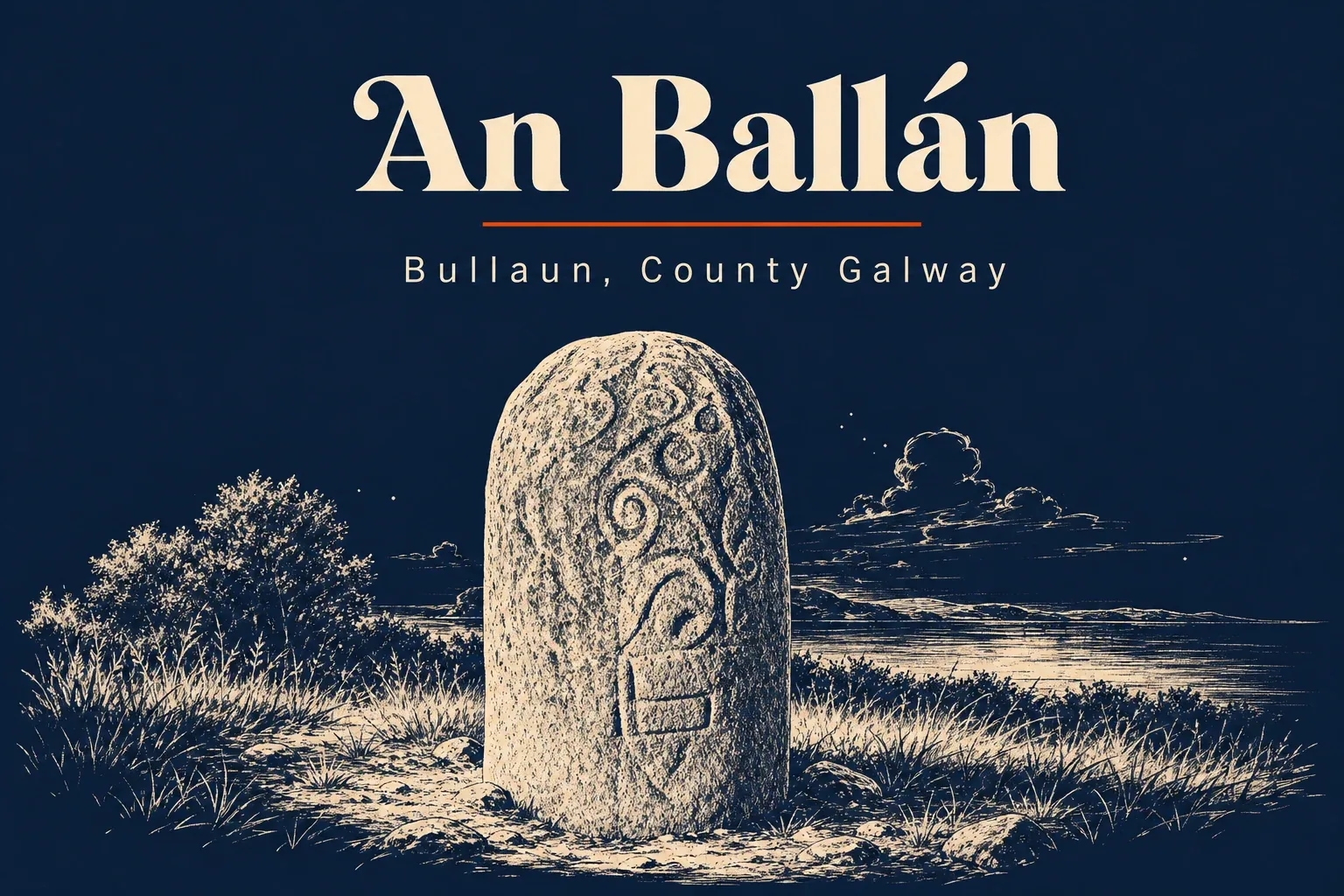
The bigger stone is up the road. The Turoe Stone, a granite block a little over a metre and a half tall, carved around two thousand years ago in the flowing curvilinear La Tene style, is one of the finest pieces of Iron Age Celtic art in Ireland. It originally stood at the rath of Feerwore and was moved in the late 19th century to the lawn of Turoe House outside the village. A fair warning before you set off: as of 2025 it had been taken to an Office of Public Works depot in Athenry for conservation, so it may not be standing where the maps still put it. Ring ahead.
Then there is Lignum, which is the reason Bullaun turns up in newspapers. Danny Africano took a derelict stable on the edge of the village, brought in Italian builders, and opened a restaurant in 2019 that cooks almost everything over an open fire of local ash, birch and oak - lignum is Latin for wood. It won a Michelin star in the 2025 guide. It is a serious, booked-ahead, destination dinner in the middle of fields, and it is the most surprising thing in any east-Galway village its size.
Beyond the stone and the table there is not much, and that is fine. St Patrick's church, a pub, the Sarsfields GAA ground, and the roads home. Use Loughrea as your base for beds and shops, drive out for the stone and the dinner, and treat the rest of Bullaun as the quiet it advertises.