County Galway Ireland · Co. Galway · Claddaghduff Save · Share
POSTED FROM
CLADDAGHDUFF
CO. GALWAY · IE

Claddaghduff
Cladach Dubh

The Connemara
STOP 04 / 04
Cladach Dubh · Co. Galway

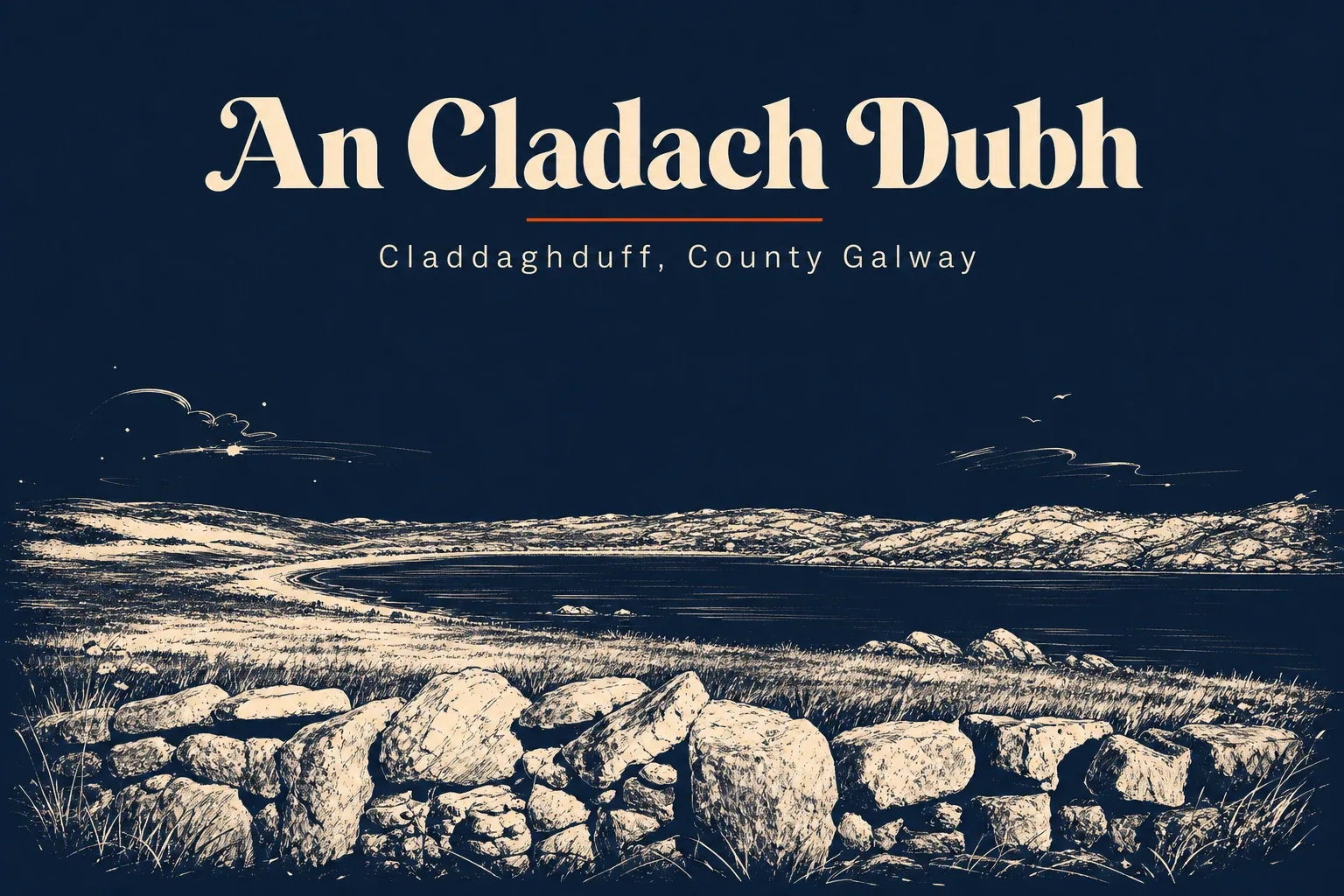
A tidal island with a 7th-century church, reached on foot across the strand. The rest of the year, it sits in the water.

Claddaghduff is the kind of place where you arrive because you heard about the island, not because you were passing through. It sits on the north Connemara coast, a scatter of houses above a rocky beach, and the reason you came — Omey Island — lies 1 km offshore.

At low tide, the island is connected. The strand uncovered by water becomes a quarter-hour walk to Tempall Fheichin, a ruined church from the 7th century, and the holy well beside it. The island has been inhabited since prehistoric times. A few people still live there — houses perched above the rocks, a handful of permanent residents whose neighbour is the Atlantic.

In August, the horse race takes over. Riders line up on the strand and run the beach, the way they have for generations. It is not a formal event with grandstands. It is riders, horses, a beach and wind.

The scenery is the point. Rocky coastline, bog inland, the Atlantic as the third element. Come at low tide, walk the strand, sit at the church and look west. There is nothing to buy here, nowhere to eat. That is the whole appeal.

Population
~100–150
Walk score
Village to island at low tide: 20 minutes
Coords
53.5800° N, 9.9500° W
01 / 04

Stories & lore.

The reason to come back. The things every local will eventually tell you about, usually after the second pint.

The tidal walk

Omey Island

Low tide drops 2–3 metres, uncovering the strand that connects Claddaghduff to Omey Island. The crossing takes fifteen to twenty minutes depending on your pace. Tempall Fheichin — the ruins of a 7th-century church — sits on the island above the water line. The holy well is nearby. In high tide, the island is an island again, cut off and complete. The island has continuous habitation from prehistoric times; a few permanent residents live there still, some year-round.

August on the strand

The horse race

Every August, riders gather on the strand at low tide and race across the packed sand. The tradition stretches back generations. There is no formal event structure, no announcements, just horses and riders and the Atlantic as witness. It is local, unhurried, and does not exist for spectators.

The island's oldest story

Prehistoric settlement

Omey Island has been lived on since prehistoric times. The landscape shows ring forts, old field systems, traces of people who chose this exposed piece of rock as a place to belong. It is one of Ireland's oldest inhabited places.

02 / 04

Things to do outside.

Wear waterproofs. Bring a sandwich. Tell someone where you're going if it's the mountain.

Omey Island strand walk Low tide only. The strand uncovered between Claddaghduff and Omey Island is safe to walk, packed hard enough for easy footing. Head straight out until the island rises in front of you. Tempall Fheichin and the holy well are the destination. Check tide times before you go — six hours either side of low water is safe, but closer to the turn is easier walking.
2 km returndistance
40 min to 1 hourtime
Coastal headland walk Starting from the village, follow the track north along the coast. The headland gives views out to Inishbofin and back down the Galway coast. The bog and the rocks are the whole walk. No named features. Just light, wind and water.
3–5 km loopdistance
1.5–2 hourstime
03 / 04

When to go.

There is no bad time. There are different times.

Spring
Mar–May

The island is quieter, the weather is milder than you'd expect, and you can time the walk without summer crowds.

◉ Go
Summer
Jun–Aug

August brings the horse race. Book a bed if you want to stay through it. Otherwise summer is fine, just windier and wetter.

◐ Mind yourself
Autumn
Sep–Oct

The shoulder. The light is clear, the water is more reflective, and the wind gives the bog-walk teeth.

◉ Go
Winter
Nov–Feb

The weather is serious. The strand walk is still possible, but the conditions change fast. Come prepared.

◐ Mind yourself
+

Getting there.

By car

From Galway, take the R336 to Spiddal, then the R342 northwest to Claddaghduff. About 1h 15m. The last stretch narrows considerably.

By bus

Bus Éireann route 423 runs Galway–Carna and stops at Claddaghduff. Roughly 1h 20m. Infrequent — check ahead.

By train

No train service. Rail ends at Galway.

By air

Ireland West Airport (Knock) is about 1h 45m by road. Galway is the nearest regional hub.