County Galway Ireland · Co. Galway · Clonfert Save · Share
POSTED FROM
CLONFERT
CO. GALWAY · IE

Clonfert
Cluain Fearta

The Ireland's Ancient East
STOP 06 / 06
Cluain Fearta · Co. Galway

A 6th-century monastery. A 12th-century doorway carved in stone. Nothing else needs to happen here.

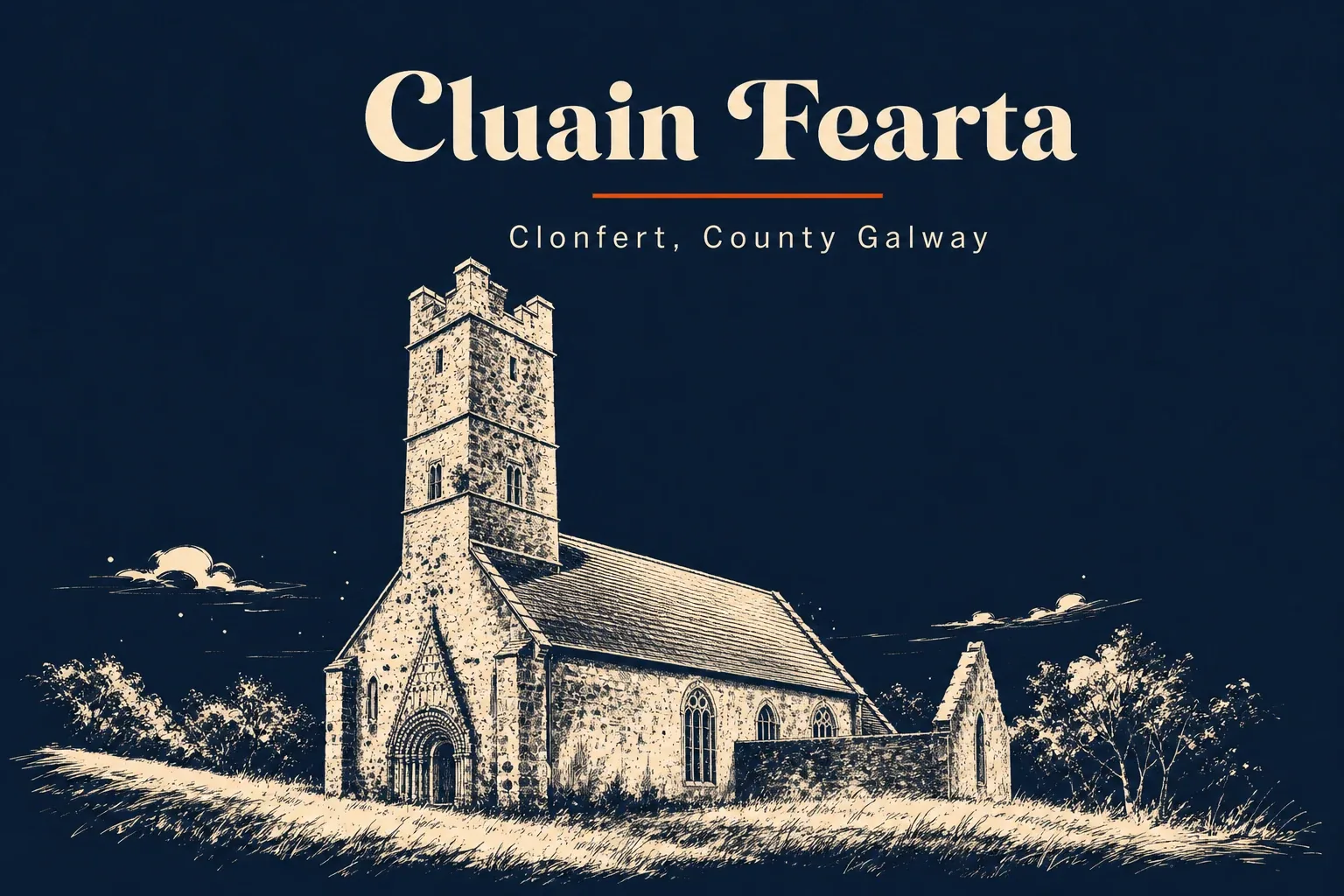
Clonfert is small, empty, and correct. Twelve hundred years ago—no, thirteen hundred—St Brendan established a monastery here on the slopes of a valley in east Galway. The details are gone. The man is legend. What remains is stone and the shape of ground where buildings once stood.

The cathedral doorway is the masterwork. Romanesque, meaning the carvers were thinking about light, curve, the behaviour of weight. Seven concentric arches frame the opening. The stone tells you how and why. This isn't ornament. It's engineering wearing the clothes of beauty. Walk in close. Run your hand over the weathered face. The carving is still accurate after eight centuries.

The site is now what monastic sites become: a cathedral ruin, a round tower base, a graveyard where new graves sit among stones from the 1200s. A small stone church from the 1800s—the modern one—marks the parish shift. Nothing is hidden. Everything is visible. You stand at the intersection of four centuries of death and prayer in one small field.
Population
~300
Walk score
Cathedral and grounds in 30 minutes
Founded
559 AD (monastery by St Brendan)
Coords
53.3194° N, 8.2219° W
01 / 06

At a glance.

Three things every local will eventually mention. Read these and you've already understood more than most day-trippers do.

02 / 06

Stories & lore.

The reason to come back. The things every local will eventually tell you about, usually after the second pint.

Founder, c. 486–575

St Brendan the Navigator

Brendan of Clonfert—if he was a single man—was born around 486 and died around 575. He founded the monastery here circa 559 AD. The later legend—Brendan sailing west in a leather boat, searching for an earthly paradise, an island in the Atlantic—is medieval invention. But something drives a man to found a place like this. The monastery became a centre of learning. Monks from here travelled. Books from here travelled. The legend was built on a foundation of real work.

Circa 1100–1150

The Romanesque doorway

The cathedral doorway is carved from sandstone in the Romanesque style. Seven concentric arches frame the entrance, each one slightly set back from the last, creating a tunnel of stone for the light to pass through. The arches are decorated with geometric patterns—dog-tooth, chevron, simple interlocking lines—every pattern chosen for how it sits in stone and carries shadow. The carving is exact. The mason knew what he was doing. The door itself is long gone. The stone work remains. This is among the finest examples of Irish Romanesque architecture. Not the largest. Finest.

Medieval foundations

The cathedral complex

What stands is the cathedral ruin—roofless, open to the sky, built on the site of earlier structures. The ground holds a round tower base, indicating very early monastic occupation. Later stone additions suggest rebuilding, expansion, maintenance. Medieval graveslabs lie flat in the grass. The 1800s brought a small new stone church, marking the shift from cathedral to parish building. The old cemetery is still in use. The graveyard holds recent interments alongside 900-year-old slabs. The living are buried where the medieval dead have turned to soil.

03 / 06

Things to do outside.

Wear waterproofs. Bring a sandwich. Tell someone where you're going if it's the mountain.

Cathedral circuit The entire monastic ground loop—around the cathedral, past the round tower base, through the graveyard, back past the newer church. The path is clear. The story is written in stone and ground level. This is the walk that matters.
1 kmdistance
30 minutestime
04 / 06

When to go.

There is no bad time. There are different times.

Spring
Mar–May

Grass green, light bright, the stone glows with surface detail. This is when you see the carving most clearly.

◉ Go
Summer
Jun–Aug

Warm, long light in the evening. The graveyard is a working space. You share it with mourners and maintenance. The site is busier but still quiet.

◉ Go
Autumn
Sep–Oct

Low sun brings shadow and detail to the Romanesque work. The stone shows colour—orange, grey, the weathering of time. Clean days, cold air.

◉ Go
Winter
Nov–Feb

Bare, wet, the site is most itself. Rain will highlight the carved work. The graveyard is at rest. Few visitors. The weight of history sits heavy.

◉ Go
05 / 06

What to skip.

Honestly? Don't bother.

If a local was sitting beside you, this is the bit where they'd lean in.

×
Expecting a full church service or a functioning monastery

This is a ruin and an active graveyard. It is a historical site, not a working religious space. The newer stone church is the parish church. The ruin is the past.

×
Rushing through to the Romanesque doorway

The doorway is one element in a landscape of time. Walk the whole circuit. Look at the ground. The history is written in what remains and what doesn't.

×
Coming without light to see the carving

The Romanesque detail is shadow and surface. Overcast, grey days flatten it. Come midday or late afternoon when the sun shows what the stone does.

+

Getting there.

By car

From Ballinasloe, 15 km north on the R446 toward Banagher. From Portumna, 20 km west on the R446. The village is signposted; the cathedral site is in the village centre.

By bus

Bus Éireann services to nearby Ballinasloe; then taxi or car. Rural access is limited.

By train

Nearest station is Ballinasloe. Then taxi or organised visit.