County Galway Ireland · Co. Galway · Menlough Save · Share
POSTED FROM
MENLOUGH
CO. GALWAY · IE

Menlough
Mionlach, Co. Galway

The Ireland's Ancient East
STOP 02 / 02
Mionlach · Co. Galway

A quiet northeast Galway village in old O'Mannion country, with a ruined clan castle behind the grotto and a War of Independence story in its stones.

Menlough sits in northeast County Galway, roughly 35 kilometres from Galway city, 27 from Tuam and 20 from Athenry, in flat inland farming country well off the tourist trail. It is a small village and a half-parish within the larger parish of Killascobe, in the Roman Catholic Archdiocese of Tuam. This is the Menlough near Mountbellew - not to be confused with Menlo, the Mionlach village on the edge of Galway city, which is a different place with a confusingly similar name.

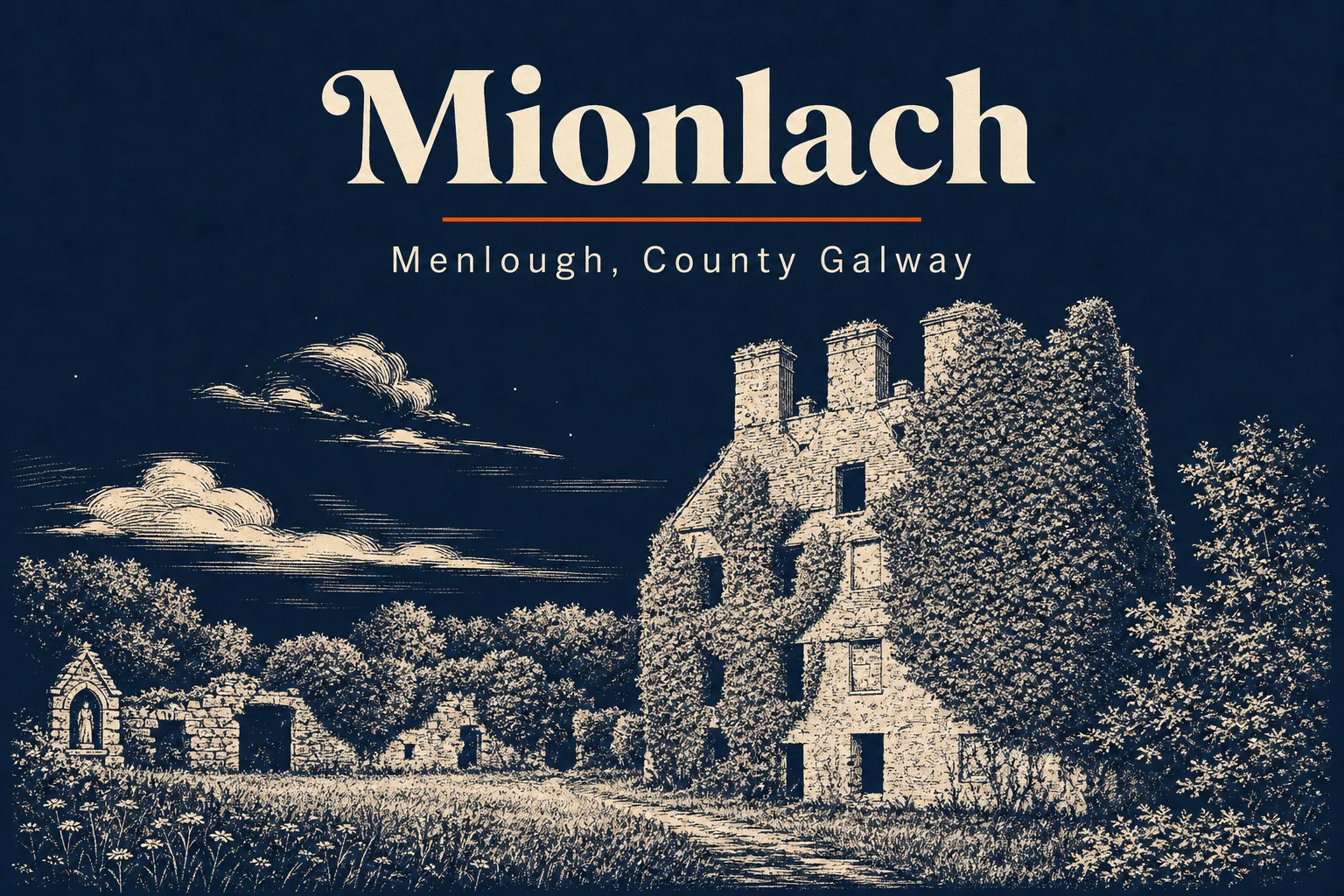
This was O'Mannion country for centuries. The clan held the land here, and you can still find the ruin of one of their castles in the fields behind the village grotto. A second O'Mannion castle in the parish, Garbally Castle, has more to see of it. By the 17th century the Ffrench family, one of the 14 Tribes of Galway, were the local landlords, and it was on Ffrench land that the mid-19th-century Catholic church of St Mary's was built. The church anchors the village still.

Beside the church stands a building that carries the harder 20th-century history. It was a Royal Irish Constabulary barracks, damaged by fire in 1922 during the War of Independence, and later served as a Garda station before becoming a private house. In the 1980s the village put up a monument to the Menlough battalion of the old IRA. For a small place, the past is close to the surface here.

There is no tourist infrastructure to speak of - no heritage centre, no visitor trail. What Menlough has is a parish, a church, two national schools, a GAA club that plays in the Galway football championship, and a long memory. Come if you have roots here, or if you want to see ordinary inland Galway getting on with its life.
Coords
53.4214° N, 8.5761° W
01 / 02

Stories & lore.

The reason to come back. The things every local will eventually tell you about, usually after the second pint.

The clan and the castle behind the grotto

O'Mannion country

Long before the Tribes of Galway, this corner of the county was the territory of the O'Mannion (O Mainnin) clan. The signs of old settlement are scattered across the area - ringforts, a souterrain, castle sites. The ruin of one O'Mannion castle stands in the fields behind the village grotto, weathered down but still there. A second clan castle in the parish, known as Garbally Castle, has more substantial remains. They are the physical record of a Gaelic lordship that held this ground for generations.

War of Independence in a small village

The barracks and the battalion

Beside St Mary's church stands a building that was once a Royal Irish Constabulary barracks. It was damaged by fire in 1922, during the War of Independence, and afterwards it became a Garda station before passing into private hands as a house. In the 1980s the village erected a monument to the Menlough battalion of the old IRA. Menlough was also the birthplace of Padraig Gearr O Mannin, a member of the United Irishmen around 1798 - so the appetite for resistance here ran back well over a century before the barracks burned.

St Mary's, on landlord's land

The Ffrench church

By the 17th century the Ffrench family, one of the 14 Tribes of Galway, were the landowners around Menlough. When the Catholic church of St Mary's was built in the middle of the 19th century, it went up on land granted by the Ffrenches. It remains the heart of the village and of the half-parish of Killascobe. The parish runs two national schools - one at Garbally, beside the castle, and Menlough National School (Scoil Mhuire Naofa) in the village itself.

+

Getting there.

By car

Menlough is inland northeast Galway, roughly 35 km from Galway city, 27 km from Tuam, 30 km from Ballinasloe and 20 km from Athenry, reached on local and regional roads. Driving is the practical way in; there is no significant public parking infrastructure, just the village itself.

By bus

No useful direct village bus service. Treat Athenry, Tuam or Ballinasloe as your transport hubs and drive or taxi the final stretch.

By train

No railway station. The nearest mainline stops are at Athenry and Ballinasloe on the Dublin to Galway line; from there you drive the rest.