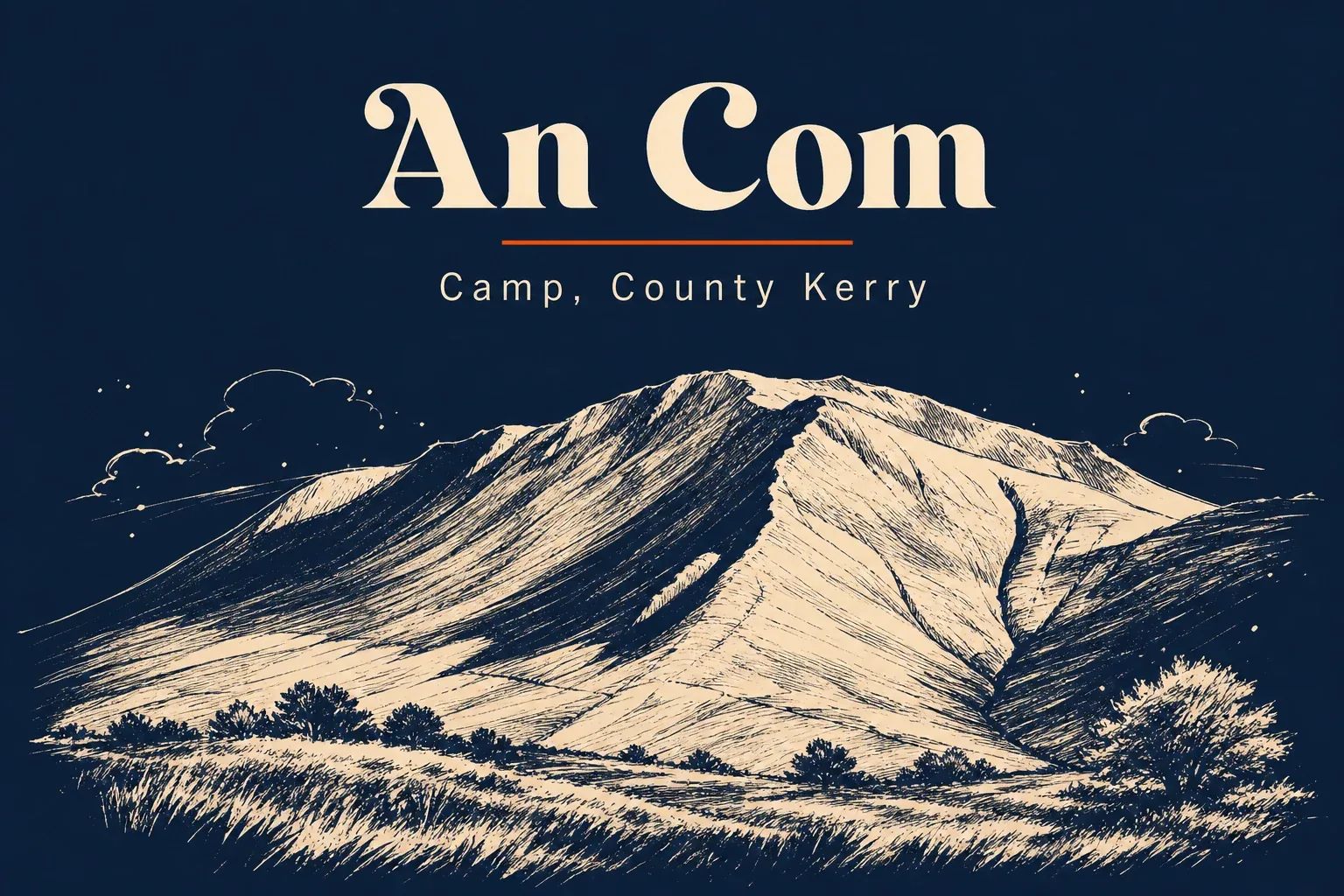
An Com · Co. Kerry
Where the Dingle road climbs onto Slieve Mish and the old railway used to fork in two.
Camp is a small village strung along the N86 where the road from Tralee climbs onto the foot of the Slieve Mish mountains. About 250 people, three pubs, a national school, a church from around 1830, and the rest is mountain on one side and Tralee Bay on the other. The Irish name is An Com - the hollow - which is what the village sits in. Stradbally, the next village west, shares the parish.
The thing to know about Camp is that it used to be a railway junction. From 1891 until 1953 the Tralee and Dingle Light Railway came through here on its way west, and a branch line peeled off north to Castlegregory. It was a three-foot-gauge, properly Victorian piece of engineering - gradients of one in twenty-nine, sharp curves, a viaduct over the Finglas river just east of the village at Curraduff. It was also one of the most accident-prone railways in Ireland. On the 22nd of May 1893 a cattle train ran away on the descent, derailed at the Curraduff curve, hit the bridge parapet and went into the river. Three men were killed, thirteen hurt. The Board of Trade inquiry was held in Tralee a fortnight later. Camp has never quite forgotten.
Below the village to the south sits Glenagalt - Gleann na nGealt, the Valley of the Mad. There is a holy well there, Tobar na nGealt, where for centuries people brought relatives suffering from mental illness to drink the water and eat the watercress that grew around it. When the spring was tested in the 2010s the water came back with unusually high lithium content. The folk memory was telling the truth. You can find the well off a small road south of Camp; it is not signposted in the way most things on the peninsula are signposted, which is part of the point.