County Kerry Ireland · Co. Kerry · Dunquin Save · Share
POSTED FROM
DUNQUIN
CO. KERRY · IE

Dunquin
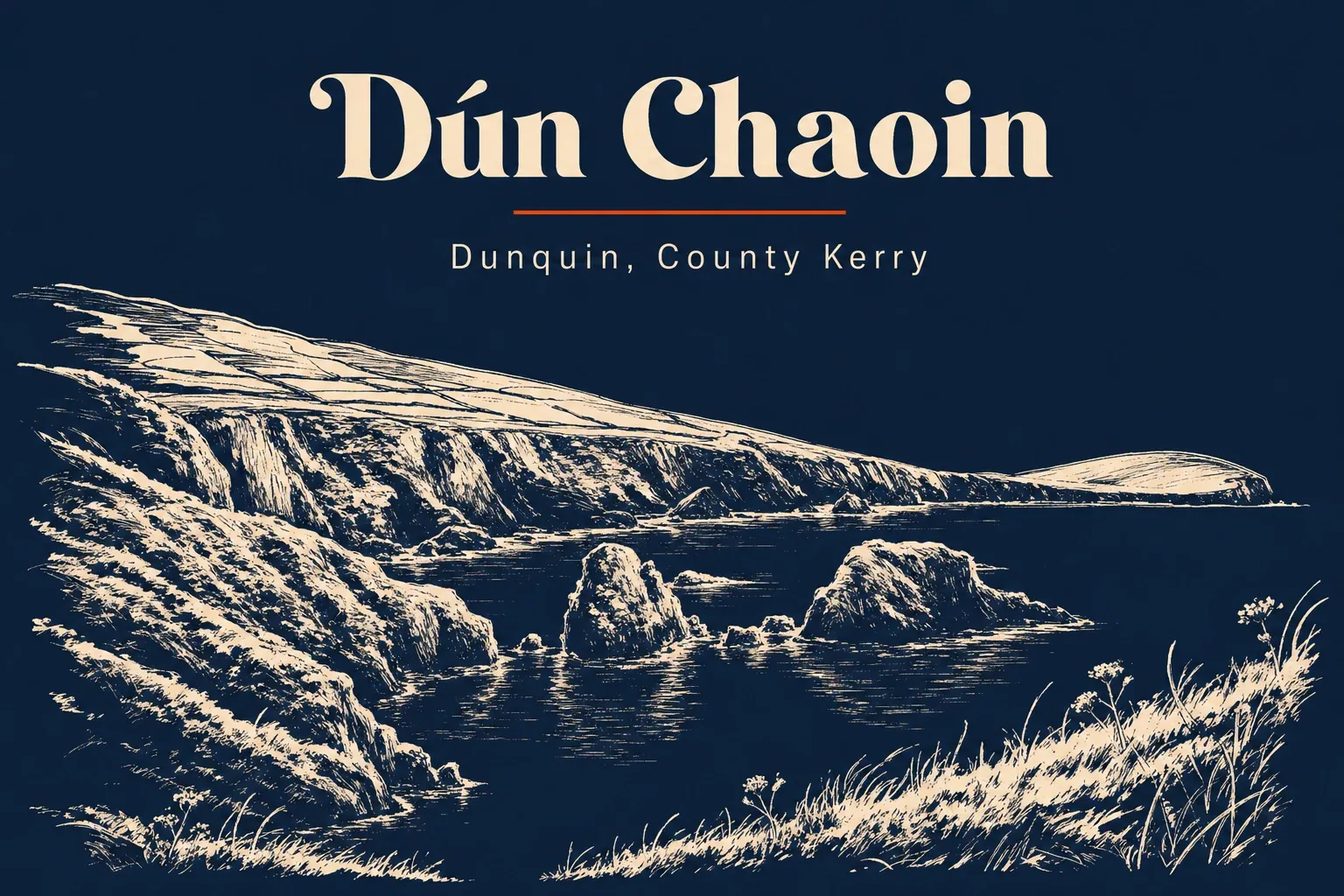
Dún Chaoin

The Wild Atlantic Way
STOP 10 / 10
Dún Chaoin · Co. Kerry

The last parish in Europe before America. The Blaskets are the back garden.

Dún Chaoin is what is left when the road has run out of reasons. Drive west from Dingle on the R559, past Ventry, around Slea Head, down the long slope to Coumeenoole, and the road turns north along a sheer cliff that becomes Dunquin. Population about 150. Irish first; English on request. The signs are bilingual and the locals are not.

The pier is the picture you have already seen — a zigzag of concrete steps cut into a cliff down to a slip the size of a kitchen floor. It was built for the islanders to land their currachs. Today it is the most photographed pier in Ireland and, on a swell, the most closed. Boats to the Blaskets run from here in summer when the sea agrees. Often it does not. Plan around that.

What makes Dún Chaoin matter is what is no longer here. The Great Blasket — three kilometres offshore — was abandoned in November 1953 when the population could no longer support itself through a winter. Before they left, three of those islanders, none of them schooled past national level, dictated or wrote the books that are still on every Irish-literature syllabus. The Blasket Centre across the road from the pier is the proper place to grasp it. Then come outside, look at the island, and notice that the windows of the abandoned houses are still catching the afternoon light.
Population
~150
Walk score
A scattered parish — five minutes by car, an hour on foot
Coords
52.1336° N, 10.4544° W
01 / 10

At a glance.

Three things every local will eventually mention. Read these and you've already understood more than most day-trippers do.

02 / 10

The pubs.

None of these are themed Irish pubs, because they don't need to be. A few that earn the trip:

Krugers

Westernmost, eccentric
Pub & guesthouse

The most westerly pub in Europe and it knows. Founded by Muiris 'Kruger' Kavanagh on his return from Hollywood, where he had worked as a stuntman and PR man. CAMRA — the British Campaign for Real Ale — was founded on a stool here in 1971 by four English journalists on holiday. A pint, a turf fire, and a wall of yellowing photographs of the Ryan's Daughter shoot.

Tig Bhric

Quiet, beer-led
Pub & microbrewery

On the road between Ballyferriter and Dunquin. Adrienne Heslin brews the West Kerry Brewery beers on site — Cúl Dorcha, Béal Bán, Carraig Dubh — and serves them across the bar. Food is simple, the room is small, and the beer is the reason. Hours are honest about the time of year.

03 / 10

Where to eat.

PlaceTypeLocal note
Krugers kitchen Pub food €€ Chowder, fish, a stew that does the job. Not the reason you stop, but it will keep you from driving back to Dingle hungry. Hours wind down out of season; ring ahead in winter.
Café at the Blasket Centre Day café Inside Ionad an Bhlascaoid Mhóir, with the floor-to-ceiling window pointed at the islands. Soup, brown bread, a slice of cake. Day hours only — the Centre closes its doors and the café goes with them. Easter to October is the safe window.
04 / 10

Where to sleep.

PlaceTypeLocal note
An Portán Guesthouse & restaurant Family-run, Irish-speaking, fourteen rooms a short drive from the pier. The dining room does an honest dinner and the breakfasts are made for a day on a hill. A practical base for walking the parish.
Krugers Guesthouse rooms A handful of rooms above and beside the pub. Plain, warm, walk to your own pint. Book directly; the place is small and word travels.
A self-catering cottage on the R559 Self-catering A cluster of holiday cottages along the road between Slea Head and the pier. Drive on past the layby and the prices ease. Wake up to nothing but the Blaskets and the wind.
05 / 10

Stories & lore.

The reason to come back. The things every local will eventually tell you about, usually after the second pint.

Three books from a rock

The island writers

Tomás Ó Criomhthain — fisherman, born on the Blasket in 1855 — wrote An tOileánach ("The Islandman") in his sixties, in Irish, in a copybook, by the light of an oil lamp. Muiris Ó Súilleabháin, two generations younger, wrote Fiche Blian ag Fás ("Twenty Years A-Growing") before he was thirty. Peig Sayers, who came to the island as a young bride from Dunquin and never learned to write, dictated her autobiography to her son Mícheál in the 1930s. Three illiterate or barely-schooled native Irish speakers from a community of about 150 produced three of the foundational works of modern Irish literature. There is no comparable parish in Europe.

17 November 1953

The evacuation

By the early 1950s the population of the Great Blasket had collapsed below the level needed to crew a currach in a winter sea. After a young man, Seán Ó Cearnaigh, died of meningitis in January 1947 because no boat could land a doctor, the islanders began petitioning the government to take them off. On 17 November 1953 the last 22 islanders were resettled in cottages built for them at Dún Chaoin and Muirríoch, three kilometres in from the cliff they had been able to see all their lives. Most of them lived out their days within sight of the empty island. A few of their houses are still standing on it.

David Lean's lost village

Ryan's Daughter

Lean shot Ryan's Daughter here for the best part of a year in 1969. The production built an entire fictional 1916 village — Kirrary — on the slopes above Coumeenoole, then dismantled it when filming was done. The picture won two Oscars and was kicked from one end of the critical pages to the other; Lean did not direct again for fourteen years. For Dún Chaoin the wages were the point. The parish was draining of its young people; for one season everyone with a back and a wheelbarrow had work. The footings of Kirrary are still legible if you know where to look on the hillside above the strand.

Steps cut into a cliff

The pier

The pier at Dún Chaoin is not really a pier — it is a slipway at the bottom of a near-vertical cliff, reached by a zigzag of concrete ramps the islanders walked up and down with sacks of flour and the post for a hundred years. It was built so they could land currachs in any swell that allowed it. Today coaches stop at the top, a few hundred people walk down for a photograph, and a few of them realise that getting back up is half the trip. The slipway has been intermittently closed in recent years for safety; the boats to the Great Blasket sometimes leave from Dingle instead. Check before you drive.

06 / 10

Things to do outside.

Wear waterproofs. Bring a sandwich. Tell someone where you're going if it's the mountain.

Dunquin Pier descent Down the zigzag, around the slip, back up. It is steeper than the photographs make it look and the climb back is honest work. Do not attempt in a hard south-westerly. Mind your footing if the concrete is wet.
400 m down, 400 m backdistance
20 mintime
Slea Head Drive — the western arc The most dramatic stretch of the R559. Dunbeg Fort, the beehive huts at Fahan, Slea Head itself, the long sweep down to Coumeenoole, and the climb up to Dunquin. Drive it clockwise, against the coaches, and stop where there is a layby and not where there isn't.
20 km from Ventry to Dunquindistance
Half day with stopstime
Coumeenoole Strand & Dunmore Head Down to the small beach where the Ryan's Daughter scenes were shot, then up onto Dunmore Head — the actual westernmost tip of the Irish mainland. The view across the Sound to the Great Blasket is the one the islanders had every morning. Watch the swell at the strand: there is no lifeguard and the rip is real.
5 km loopdistance
1.5–2 hourstime
Mount Eagle The long whaleback hill that closes the south side of the parish. 516 metres. From the summit on a clear day you see the Skelligs across Dingle Bay and the full chain of the Blaskets. Boggy underfoot after rain. Boots, not trainers.
8 km returndistance
3–4 hourstime
Blasket viewpoints from the cliff path From the car park at the Blasket Centre, walk north along the cliff edge. The line of the islands sharpens as you go — Beginish, Inis Tuaisceart ("the dead man"), and the Great Blasket itself with its abandoned village still legible on the eastern slope.
2 kmdistance
45 mintime
07 / 10

Tours, if you want one.

The ones below are bookable through our partners — pick one that suits, or skip the lot and just turn up.

We earn a small commission when you book through our tour pages. It costs you nothing extra and keeps the village hubs free. All Co. Kerry tours →

08 / 10

When to go.

There is no bad time. There are different times.

Spring
Mar–May

Quiet and clean-aired but the Blasket Centre and the ferries are not properly open until Easter. Krugers ticks over. The walks are at their best.

◐ Mind yourself
Summer
Jun–Aug

The window for the Great Blasket. Ferries run from the pier (or Dingle, depending on conditions), the Centre is open seven days, and the long evenings give you a full afternoon on the island and a pint back on the mainland.

◉ Go
Autumn
Sep–Oct

The locals' season. Boats still going on a calm week, coach traffic dropping off, and the parish recovers its own pace. Storms will close the pier without warning. Have a backup.

◉ Go
Winter
Nov–Feb

The Blasket Centre and the ferries shut down. The pier stops being a destination. Krugers stays open on shorter hours. If you come now, come for the silence and not the itinerary.

◐ Mind yourself
09 / 10

What to skip.

Honestly? Don't bother.

If a local was sitting beside you, this is the bit where they'd lean in.

×
The fifteen-minute coach stop at the pier

Coaches pull in, passengers file down for a photograph, file back up, and roll on. The pier is a working slipway with literary weight, not a viewpoint. Either give it the hour the descent and climb actually take, or skip it and stand at the cliff above instead.

×
Booking a Blasket boat in any swell

The crossings are weather-cancelled often, sometimes hours before sailing, sometimes on the slip. Do not build the trip around an island day; build the day around the parish, and treat the boat as a bonus if it runs.

×
Reading Peig in school translation and skipping the Centre

A generation of Irish students were taught Peig Sayers as a misery memoir and left the country hating her. The Blasket Centre puts her back in the company of Ó Criomhthain and Ó Súilleabháin and makes the case the school books did not. An hour inside it changes the view across the water.

×
Driving on past Krugers because it is not in your guidebook

It is the westernmost pub in Europe, the founding room of British real-ale activism, and the place every Ryan's Daughter cast member ended up. A pint here is part of the parish, not a tourist trick.

+

Getting there.

By car

From Dingle, take the R559 — Slea Head Drive — west through Ventry and around the head. About 25 km, 40–50 minutes if the road is empty, longer behind a coach. The pier is signed; the Blasket Centre is across the road from it.

By bus

No regular public service. Local Link 275A runs Dingle–Ventry–Dunquin several times a day in summer, sparingly in winter. Outside that, it is a car or a hired driver.

By air

Kerry Airport (KIR) is about 90 km — 1h 45m by road. Cork and Shannon are both around three hours.