The poet who held the line
Piaras Feiritéar
Pierce Ferriter — Piaras Feiritéar — was the last chief of the Norman-Irish Feiritéar family who had ruled this corner of the peninsula for four centuries and gone fully Gaelic somewhere along the way. He wrote bardic laments, love poetry to a woman whose name is still argued about, and verse in the high European style alongside Irish in the strict old metres. When the wars came he led the local resistance against the Cromwellians. He held Tralee Castle from 1641. He was the last Gaelic chieftain in Kerry to surrender, in 1653, and he did it on a written promise of safe passage from Brigadier Nelson. They took him at Castlemaine on the way home, walked him to Killarney, and hanged him on the 15th of October. Three hundred and seventy years on, the village still carries his name.
Six hundred men, three days, no quarter
The Smerwick Massacre, 1580
In September 1580, six hundred Papal soldiers — Spanish, Italian, a handful of Irish — landed at Smerwick Harbour to support the Second Desmond Rebellion. They built a small fort on the headland called Dún an Óir, the Fort of Gold. Lord Grey de Wilton arrived with English forces by land in early November. The garrison surrendered on the 10th, on what they understood to be terms. Grey gave the order. Captain Walter Raleigh led the execution bands. Edmund Spenser, the poet of The Faerie Queene, was secretary to the Lord Deputy and was almost certainly present. About six hundred soldiers were killed over the three days that followed. Twenty years later in London, when Raleigh was on trial for his life, the Smerwick killings were still being held against him. He could not explain them away. The headland is grass and rabbit-holes now. There is no plaque. The village does not need one.
The early Christian quarter
Riasc and Gallarus
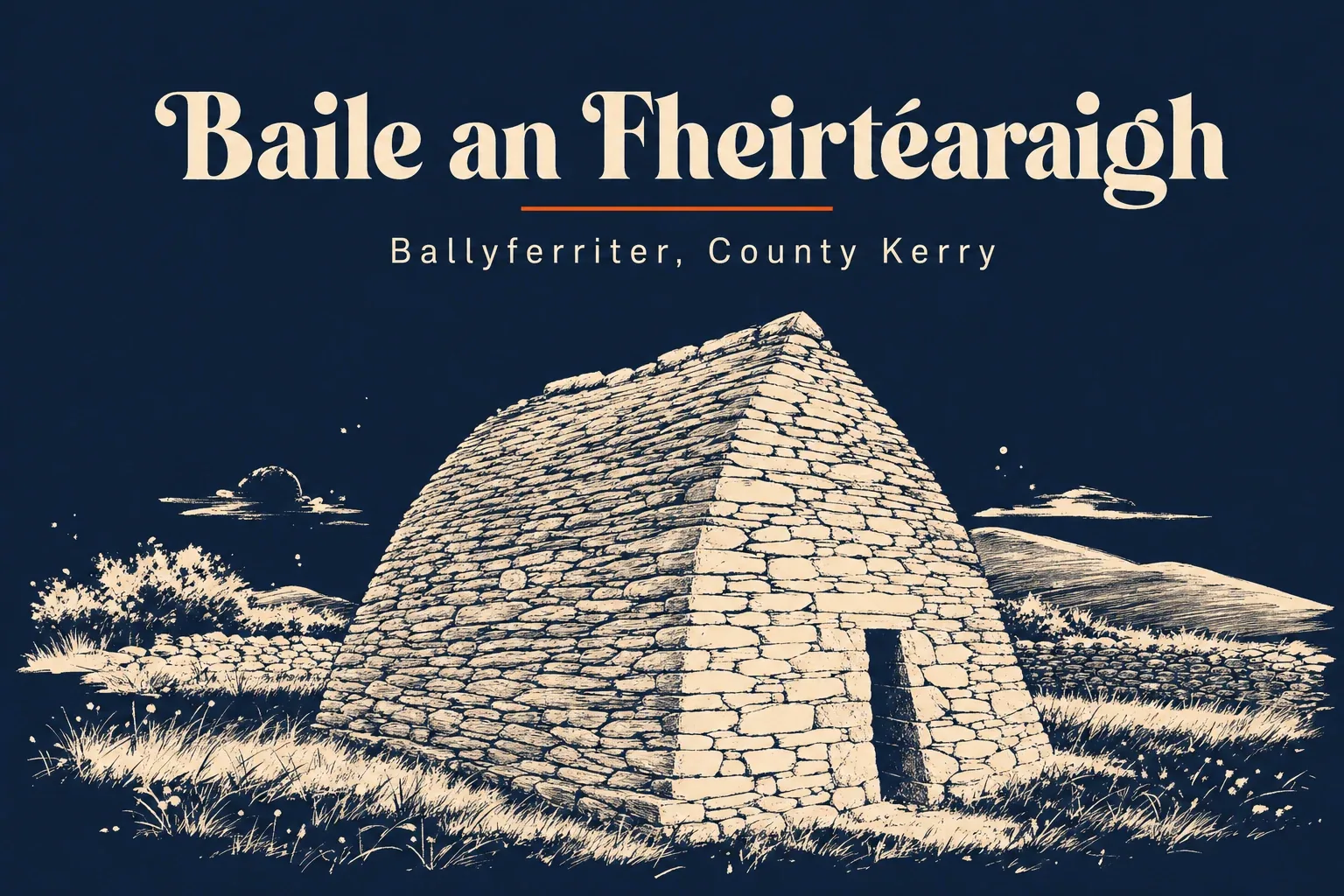
Two of the most important early monastic sites in Ireland sit within walking distance of the village. Riasc, two kilometres east, is the foundations of a sixth-to-twelfth century monastery — beehive cells, an enclosure wall, cross-slabs and a famous pillar carved with spirals and a Greek alphabet that is still arguing with archaeologists. Gallarus Oratory, another two kilometres on, is the only intact dry-stone oratory left standing on the island — corbel-vaulted sandstone, no mortar, no roof timber, watertight after a thousand winters. Both are unfenced, free, and quiet most days outside July and August. Go early. Listen.
The living language
An Ghaeltacht bheo
Around three quarters of the parish use Irish as the daily working language of the home, the school, the bar and the shop. Oidhreacht Chorca Dhuibhne — the local Irish-language education centre — runs courses out of the village all year, and University College Cork keeps a house here for an academic-year immersion course. Students drift in for a fortnight and stay for a summer. The pubs run set-dancing nights in Irish. The school is a Gaelscoil. None of this is performed for visitors. The village simply happens to be Irish-speaking and has gone on being so through every decade that told it not to. Speak a few words back when you are spoken to. Everyone here has English. Almost nobody chooses to start with it.