County Kerry Ireland · Co. Kerry · Ballydavid Save · Share
POSTED FROM
BALLYDAVID
CO. KERRY · IE

Ballydavid
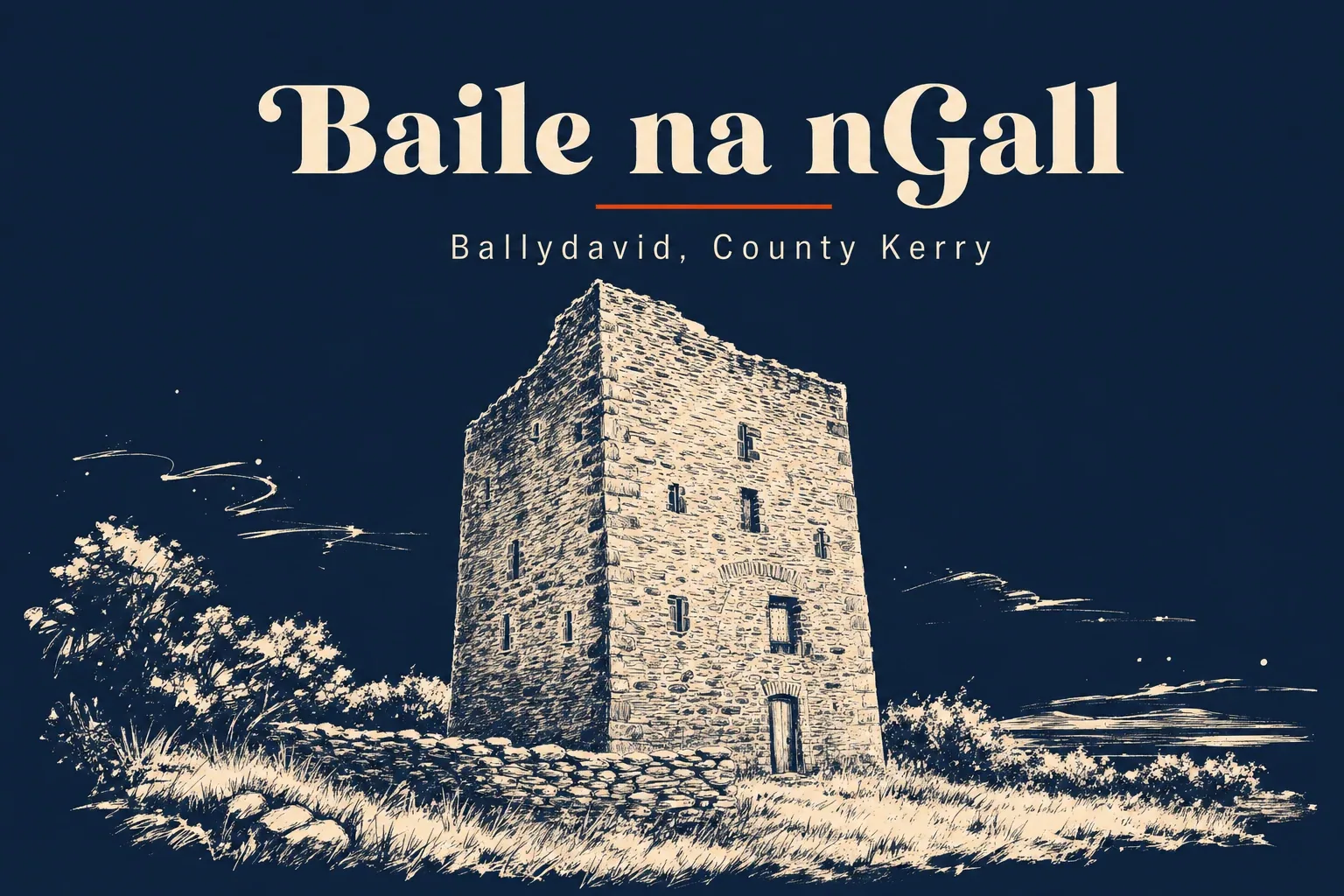
Baile na nGall

The Wild Atlantic Way
STOP 02 / 04
Baile na nGall · Co. Kerry

A Gaeltacht pier looking straight across the bay at a 1580 massacre.

Baile na nGall means "the village of the foreigners." The story is that foreign sailors landed here often enough — Norse, Spanish, French, who knows by now — that the village got named after them rather than for any Irish family. It is a small, sea-facing huddle of houses on the north shore of the Dingle peninsula, on Smerwick Harbour, fifteen minutes' drive from Dingle town and a long way from anywhere else.

Two things make Ballydavid more than a wide spot in the road. The first is that it is a working Gaeltacht — a real one, where the language is the everyday language of the bar and the shop and the football pitch. The second is the view. Stand on the pier and look across the bay. That low headland on the far side is Dún an Óir, the Iron Age fort where in November 1580 the English crown executed six hundred surrendered Italian and Spanish mercenaries and the Irish women and children with them. Walter Raleigh swung a sword that day. Edmund Spenser, the poet, watched and wrote it up. The water in front of you remembers.

Don't come for entertainment. Come for one good evening in Tig Bhric with a pint of the West Kerry beer brewed in the shed out the back, a session if there's one going, and a walk on Smerwick Strand the next morning before anybody else has thought to. Two kilometres up the road sits Gallarus Oratory — the most perfect dry-stone church in Europe, still standing watertight after a thousand-odd years. Most days you'll have it to yourself.
Population
~250
Pubs
2and counting
Walk score
Pier to the next house in five minutes
Coords
52.2200° N, 10.3608° W
01 / 09

At a glance.

Three things every local will eventually mention. Read these and you've already understood more than most day-trippers do.

02 / 09

The pubs.

None of these are themed Irish pubs, because they don't need to be. A few that earn the trip:

Tig Bhric

Gaeltacht local, brewery out the back
Pub & West Kerry Brewery, since the 1890s

Adrienne Heslin runs Ireland's first cask-conditioned brewery from a shed behind the pub — Beoir Chorca Dhuibhne, hand-pumped at the bar. The same family has had the licence since the 1890s. Open sessions, jazz nights, dance nights, whatever's on. Four ensuite rooms upstairs and a self-catering lodge if you want to stay where you drink.

Tigh TP

Quiet, local, sea-view
Pier-side pub

On the road down to the pier, looking out over the harbour and the small beach. The kind of pub where the pier outside fills up for the regatta in August and empties again the next morning. Pints, a fire, a few words in Irish if you have them.

03 / 09

Where to eat.

PlaceTypeLocal note
Tig Bhric Pub food €€ Honest, hot, locally-sourced — chowder, bowls of mussels from the harbour, a burger if you need one. The point is the brewery, but the kitchen is not an afterthought.
Gorman's Clifftop Restaurant, dinner only €€€ Vincent and Síle Gorman cook out of one of the most westerly restaurants in Europe. Local seafood, Kerry beef, a wine list that reads like someone cared. Book ahead — non-residents have to and there are not many tables.
The shop in An Mhuiríoch Provisions There is no supermarket. The local shop a kilometre up the road does the brown bread, the milk, the rashers, the paper. Bring cash for the small things.
04 / 09

Where to sleep.

PlaceTypeLocal note
Gorman's Clifftop House Guesthouse & restaurant Nine rooms on the cliff above Smerwick Harbour with Sybil Head out the front and Mount Brandon at the back. The view from the breakfast room is famous and earned. Book months ahead in summer.
Tig Bhric Rooms Pub rooms & lodge Four ensuite rooms above the pub with a shared kitchen and an open fire in the sitting room. The Brewer's Lodge next door is a three-bedroom self-catering for families. Either way, you are sleeping above the brewery.
A B&B above Feohanagh B&B There are a handful of small farmhouse B&Bs scattered between Ballydavid and Feohanagh on the road around the headland. None of them have signs you can read from a hire car. Phone the tourist office in Dingle and ask which one is taking guests this week.
05 / 09

Stories & lore.

The reason to come back. The things every local will eventually tell you about, usually after the second pint.

November 1580, across the bay

The Smerwick Massacre

Six hundred soldiers — mostly Italian, some Spanish, some Irish — landed at Smerwick in September 1580 to support the Second Desmond Rebellion against Elizabeth I. They dug into Dún an Óir, an Iron Age promontory fort on the south side of the harbour. Lord Grey de Wilton arrived with an army and three days of cannon. Their commander, Sebastiano di San Giuseppe, surrendered. Grey hanged the officers, took the rest out in pairs, and had them put to the sword. Walter Raleigh and his cousin captained the killing parties. Edmund Spenser, the poet of The Faerie Queene, was Grey's secretary and watched the whole thing. The fort is a grass mound now, on the headland you can see clearly from Ballydavid pier. There is a small monument. Most people drive past it.

2km up the road

Gallarus Oratory

Two kilometres east of the village, in a small field off the back road to Dingle, stands the most perfect dry-stone church in Europe. Gallarus Oratory is built of cut sandstone with no mortar on the outside, shaped like an upturned boat, and it has been standing watertight for somewhere between eight hundred and twelve hundred years — the scholars argue. The interior is dark, low, four metres by three. There is one tiny round window in the east wall. Walk in, stand still for a minute, and the village outside stops mattering for a bit. Free to visit. The visitor centre next door wants a fiver for a film. Skip the film.

Why the road signs are Irish-only

The Gaeltacht voice

Ballydavid sits in the Corca Dhuibhne Gaeltacht — one of the few places in Ireland where Irish is still the working language of the home. RTÉ Raidió na Gaeltachta broadcasts from a studio outside the village. The local primary school teaches through Irish. The Gaeltacht boundary was redrawn in 1956 and again in 1974, and Baile na nGall stayed inside both times because the language stayed. If you have a few words — even a 'go raibh maith agat' — use them. If you don't, an honest 'sorry, I haven't got the Irish' goes further than pretending.

Where the pilgrim path comes through

Saint Brendan's road

Mount Brandon is named for Saint Brendan the Navigator, the sixth-century Kerry monk who supposedly sailed to America in a leather boat thirteen hundred years before anyone else thought of it. The summit was a Christian pilgrimage site by the early medieval period and probably a pre-Christian one before that. Cosán na Naomh — the Saint's Road — runs eighteen kilometres from Ventry to the foot of Mount Brandon and passes within sight of Ballydavid. You can walk a section from the village past Gallarus Oratory and on toward the mountain. People have been doing it for fifteen hundred years.

06 / 09

Things to do outside.

Wear waterproofs. Bring a sandwich. Tell someone where you're going if it's the mountain.

Smerwick Strand The big curving beach on the south side of the harbour. Flat sand, surfable on the right swell, and you'll often have it to yourself outside July and August. The Dún an Óir massacre site is at the far end of the beach — a low grassy headland with a small monument.
3 km of beachdistance
However long you havetime
Sybil Head Loop Out west of the village past Ballydavid Head and around Sybil Head — Ceann Sibéal — where they filmed parts of The Last Jedi. Sea cliffs, fulmars, the Three Sisters as a back-drop. Boggy in places. Wear boots.
7 km loopdistance
2.5 hourstime
Wine Strand A small sheltered cove a few kilometres east of the village, named for the Spanish wine ships that used to put in here. Good for a swim if the wind is from the west and the strand is in shadow.
500m of beachdistance
20 minutestime
Cosán na Naomh — to Gallarus Pick up the Saint's Road on the back lane out of the village and follow it east to Gallarus Oratory. A piece of a fifteen-hundred-year-old pilgrim path with the harbour on your left and Mount Brandon ahead. The full Cosán na Naomh runs 18km from Ventry — this is the easy section.
4 km returndistance
1.5 hourstime
07 / 09

When to go.

There is no bad time. There are different times.

Spring
Mar–May

Quiet, the light is unreal off the harbour, lambs in the fields, and Tig Bhric reopens fully by Easter.

◉ Go
Summer
Jun–Aug

The Slea Head coaches don't come this far, so it stays calmer than Dingle. Book Gorman's well ahead. The August regatta is worth a day if you can time it.

◐ Mind yourself
Autumn
Sep–Oct

Storms rolling into Smerwick Harbour, sessions back to themselves, and the cliffs at their loneliest.

◉ Go
Winter
Nov–Feb

Most of the village shuts down. Tig Bhric pares back to weekends. If you don't mind a short trip, it's the most honest the place ever is.

◐ Mind yourself
08 / 09

What to skip.

Honestly? Don't bother.

If a local was sitting beside you, this is the bit where they'd lean in.

×
The Gallarus Oratory "Visitor Experience" film

The oratory is free, in a field, two kilometres up the road. The film and the car park are a fiver. The oratory itself does all the work.

×
Driving here in a 4x4 with the windows up

It is a Gaeltacht village. Get out, walk the pier, go into Tig Bhric, try a 'dia duit' on the barman. The whole point is the place, not the car-window version of it.

×
Surf lessons from the wrong end of the beach

Smerwick is an Atlantic-facing bay and the swell is unpredictable. If the surf school in Castlegregory or Brandon Bay is open, go there. The local beach is for swimmers, walkers and people who already know what they're doing.

×
Looking for a restaurant on a Monday in February

There isn't one. Bring a sandwich, a flask, and a book. The point of coming here off-season is that there is no point.

+

Getting there.

By car

From Dingle town, the R549 north then the local road around the headland — 15 minutes, signposted in Irish (Baile na nGall / An Mhuiríoch). It's the quieter alternative to the Slea Head Drive — the same peninsula, the back side of it, with no coaches.

By bus

Local Link 275A runs Dingle to Ballydavid a few times a day in summer, less in winter. Check the timetable the night before. Driver speaks Irish if you fancy practising.

By air

Kerry Airport (KIR) is about 90 minutes away. Cork is 2.5 hours. Shannon is 3.