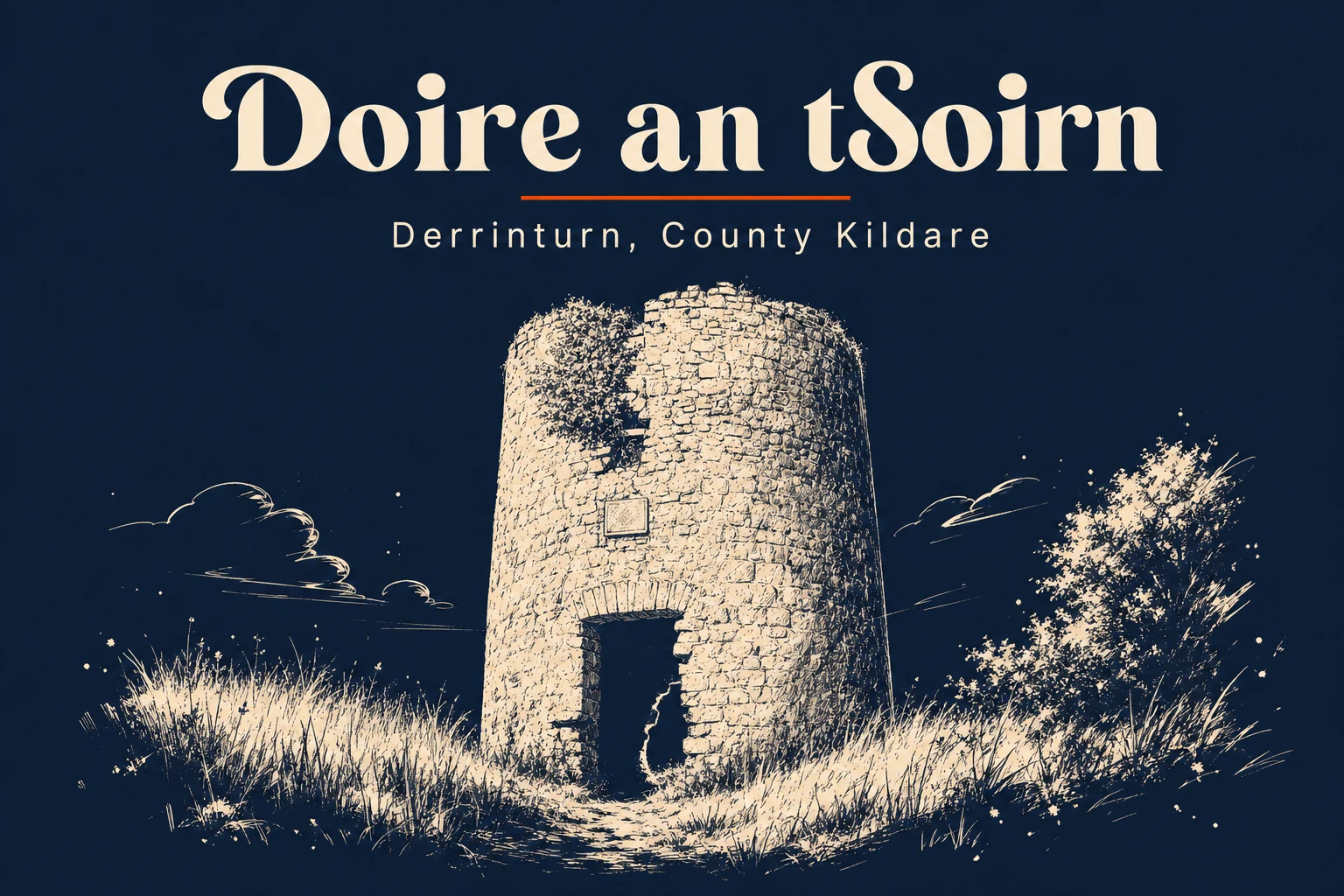
Doire an tSoirn · Co. Kildare
Oak wood, furnace smoke, bog earth. The name says it all.
Derrinturn is a north Kildare village that spent most of the twentieth century quiet and spent the last thirty years making up for it. In 1961 the population was 183. By 2022 it was 1,837. That tenfold jump happened because Dublin is an hour down the R403, the M4 is fourteen kilometres south, and the land here is flat and buildable and cheaper than anywhere nearer the city. What it produced was a working village with a school of 325 children, a church that turned two hundred years old in 2009, a Centra, a butcher, a filling station, and a pub that the third generation of the same family still runs. Not every fast-growing Irish village manages to stay a village. Derrinturn mostly has.
The landscape does the explaining. Drive out the road west of the village and the ground opens out into the Bog of Allen - 958 square kilometres of raised bog across five counties, the flattest country in Ireland, the sky enormous. Bord na Móna worked the bogs around here from the middle of the twentieth century and stopped harvesting in 2020 after decades of cuts. The rehabilitation process is ongoing: rewetting cutover ground, restoring the carbon sink, returning the surface to what it was before the machines came. The bog at the field margins is already changing. It is worth going slowly.
The Grand Canal runs through Ticknevin, the townland immediately east, where the 20th lock still operates. That canal corridor - Allenwood one direction, Robertstown the other - is the best walking country close to the village. Three kilometres northwest, Carbury Castle crowns its hill above the plain, Norman stonework on a Bronze Age mound above a landscape that has been occupied and argued over for four thousand years. The village between these things is modest and honest about what it is: a place where people live, where the school runs well, and where the bog is still the biggest thing in the view.