County Kilkenny Ireland · Co. Kilkenny · Knocktopher Save · Share
POSTED FROM
KNOCKTOPHER
CO. KILKENNY · IE

Knocktopher
Cnoc an Tóchair

STOP 03 / 03
Cnoc an Tóchair · Co. Kilkenny

A small village built around a medieval abbey that never quite closed. The Carmelites came in 1356 and are still here.

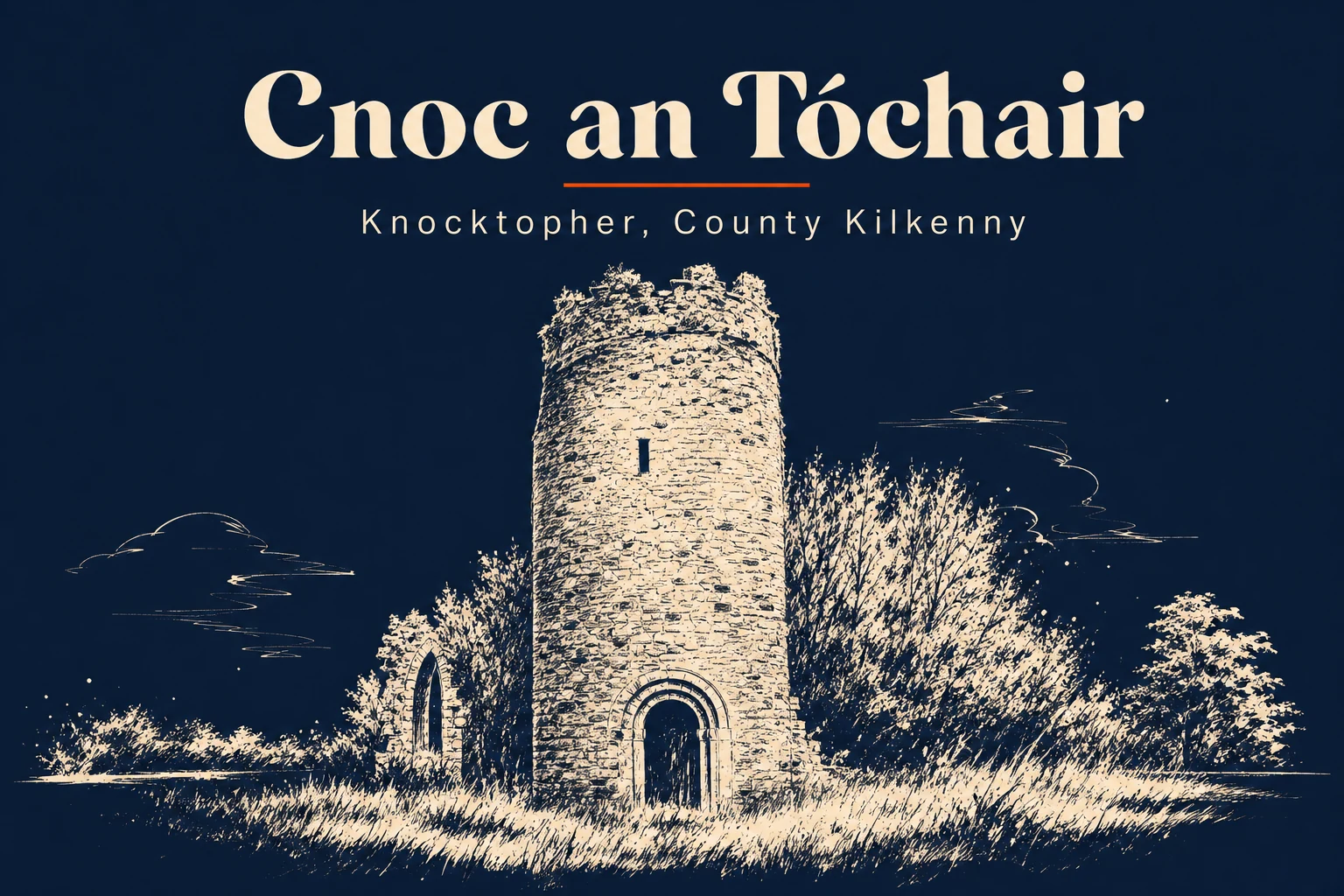
Knocktopher is a village that doesn't try very hard. Population 174. Two pubs. No tourism machinery. The abbey sits at its heart, not as a ruin but as a living community of Carmelite friars who've been here, with one interruption, since the medieval period.

What makes it worth the drive: you're standing in a place that watched the Norman conquest, the Dissolution, Cromwell, independence, all of it. The same order has been saying prayers in the same place through famine, war, and revolution. The abbey is a working friary, not a museum. That's rare. That means something.

Population
174
Pubs
2and counting
Founded
1356
Coords
52.4833° N, 7.2167° W
01 / 03

At a glance.

Three things every local will eventually mention. Read these and you've already understood more than most day-trippers do.

02 / 03

Stories & lore.

The reason to come back. The things every local will eventually tell you about, usually after the second pint.

White Friars, since 1356

The Carmelites

In 1356, James Butler, the 2nd Earl of Ormond, founded a monastery here for the Carmelite Order—the White Friars. They stayed until Henry VIII's Dissolution in 1542. For nearly 200 years, the site passed through lay hands, including the Barnewall family and the Kingsland branch. Then, in 1735, the Carmelites came back. They've been here ever since, running a continuous community of prayer in a place designed for exactly that purpose. It's the kind of story you only see in old countries.

Knocktopher and its lands

A medieval barony

In the Norman period, Knocktopher was the seat of a barony—a held of land with real power. The Barony of Knocktopher included lands and castles across what is now south Kilkenny: Ballyhale, Earlsrath, Manselscourt, and a dozen others, with parishes running to Aghaviller and Listerlin. By the time the Irish Parliament met here in 1801, it was dying. Now it's a village with two pubs. History moves fast, then stays still for centuries.

A working friary

The abbey today

The abbey that stands here now dates from the 18th century rebuilding and later additions. It's not open to the public as a tourist site—it's a friary, still used by the Carmelites for prayer, study, and community. Part of the medieval friary site is now a private residence. But the order is here, the prayers still happen, and the continuity is unbroken. It's the rarest kind of Irish monument: one that's still alive and doing what it was built for.

+

Getting there.

By car

Knocktopher is on the R713, between Stoneyford (north) and Ballyhale (south). From Kilkenny city, take the N10 south and follow signs for the M9; exit at Junction 10 and head north. About 25km, 30 minutes.

By bus

Bus Éireann route 365 serves Knocktopher on Thursday only, Thomastown to Waterford. For daily services, Ballyhale (2km north) has multiple daily coaches to Dublin, Waterford, Kilkenny, Thomastown, and Athlone.

By train

Nearest station is Thomastown, about 9km north. From there, connecting buses or a taxi into Knocktopher.

By air

Cork Airport (90km) is the nearest international airport. Shannon (150km) is an option. Both feed into Dublin or Kilkenny by road.