County Leitrim Ireland · Co. Leitrim · Carrigallen Save · Share
POSTED FROM
CARRIGALLEN
CO. LEITRIM · IE

Carrigallen
Carraig Álainn, Co. Leitrim

The East Leitrim
STOP 07 / 07
Carraig Álainn · Co. Leitrim

A small market village in east Leitrim near the Cavan border, with a famous little theatre, a deep fiddle tradition, and the birthplace of New Orleans' Margaret Haughery a field outside town.

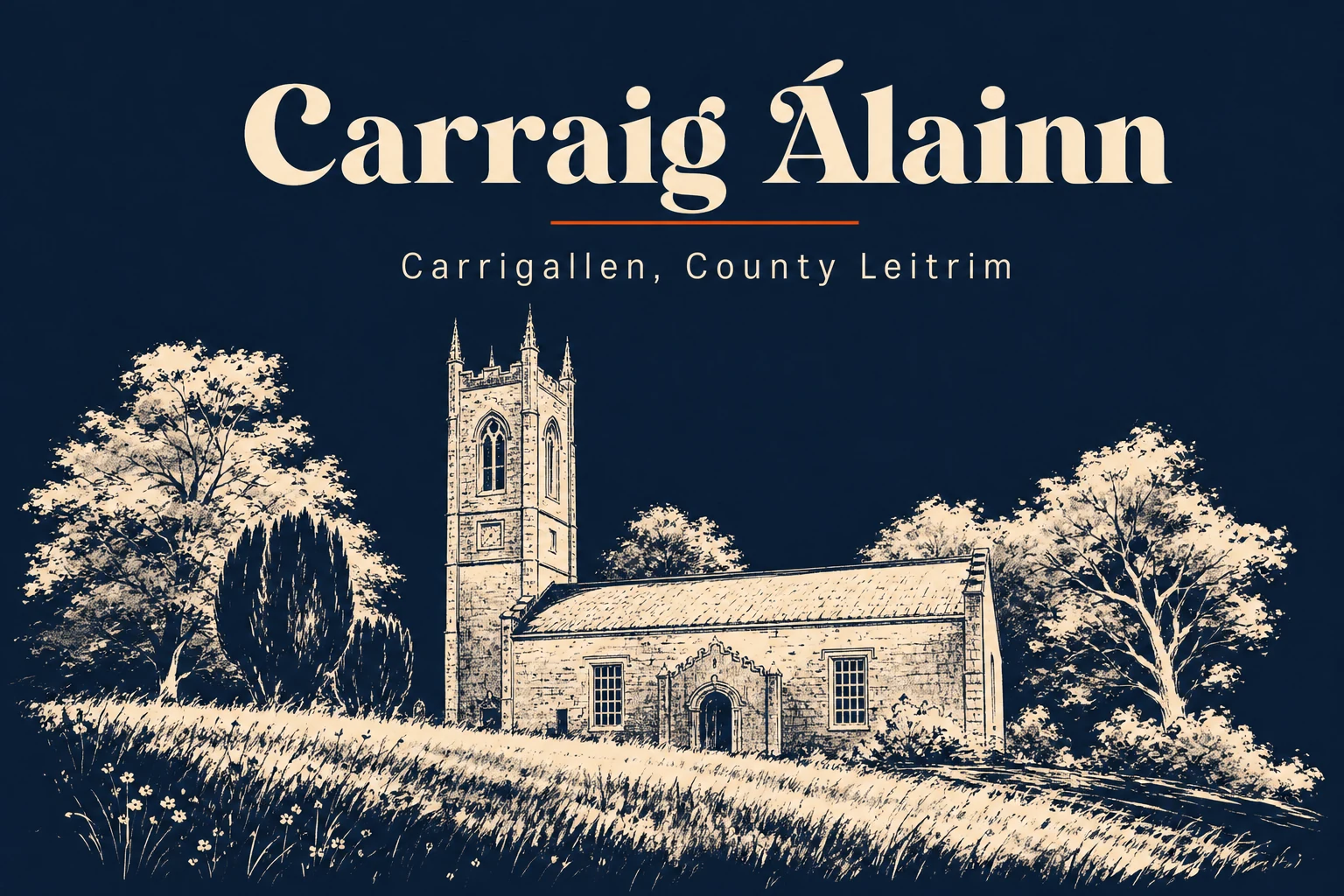
Carrigallen is a small market village in the east of Leitrim, hard against the Cavan border, in the kind of soft lake-and-drumlin country that most people drive straight through on their way to somewhere louder. Carraig Álainn means 'beautiful rock'. Under 500 people live here. There is a Main Street, two churches, a theatre that punches far above the village's weight, and the quiet rhythm of a farming place that has never been on a tourist trail and is not pretending otherwise.

The history runs deep for somewhere so small. There is a portal dolmen at Clooncorrick from the Stone Age, a scatter of Iron Age ringforts in the townlands around the village - the Killahurk fort, two kilometres out, is the best preserved - and the O'Rourke chieftains held this corner of Leitrim from medieval times, with a stronghold on Cherry Island in Garadice Lake, until the Plantation broke their power in the early 1600s. The village you see today was laid out by the Morgan landlords in the 18th century.

Two things give Carrigallen its character. The first is the Corn Mill Theatre - a 170-seat arts centre that came out of a community drama group started in 1963, and which still runs a genuine programme of plays, music and poetry. The second is the music: this is fiddle country, part of a stretch of south-and-east Leitrim where traditional playing has stayed in the community rather than being staged for visitors. Charley Farrelly's bar on Main Street runs a folk club on the first Friday of the month.

Don't come expecting attractions in the brochure sense. Come for a quiet pint, a play if the theatre has one on, the loughs for fishing, and the strange pleasure of standing in a tiny Leitrim village that sent a girl to New Orleans who ended up with a marble statue. Carrigallen is a place to pass a slow evening, not to fill a day.
Population
481 (2022)
Pubs
2and counting
Walk score
Main Street end to end in five minutes
Founded
Village laid out by the Morgan family in the 18th century
01 / 07

At a glance.

Three things every local will eventually mention. Read these and you've already understood more than most day-trippers do.

02 / 07

The pubs.

None of these are themed Irish pubs, because they don't need to be. A few that earn the trip:

Charley Farrelly's Bar

Old-school village local
Traditional bar, Main Street

On Main Street, billed locally as one of the oldest original pubs in the area. The draw is the folk club on the first Friday of the month - this is fiddle and song country, and the music here is for the regulars, not a tourist turn. The rest of the time it is what a village bar should be: a pint, a fire, and whoever is in.

Village pubs on Main Street

Local, quiet midweek
A small handful of bars

Carrigallen has a couple of pubs along the Main Street, some of which serve food. This is a village of under 500 people - do not expect a strip. One good evening in Charley Farrelly's is the measure of a night out here.

03 / 07

Stories & lore.

The reason to come back. The things every local will eventually tell you about, usually after the second pint.

Born at Tully, 1813

Margaret of New Orleans

Margaret Gaffney was born in the townland of Tully just outside Carrigallen in 1813. She emigrated to America as a small child, lost both parents to yellow fever in Baltimore, and as a young widow in New Orleans - her husband and infant daughter both dead within a couple of years - she rebuilt her life from nothing. She bought two cows, turned them into a dairy of forty, opened one of the first steam bakeries in the American South, and gave most of what she earned to the city's orphanages. New Orleans knew her as the Bread Woman and the Mother of the Orphans. When she died in 1882 the city commissioned a marble statue, unveiled in 1884 at the corner of Prytania and Clio Streets - one of the earliest public statues of a woman anywhere in the United States. It still stands. The girl came from a field outside Carrigallen.

A community drama group, since 1963

The Corn Mill Theatre

The Carrigallen Community Players started putting on plays in 1963. By 1989 they had a building - the Corn Mill Theatre & Arts Centre on Main Street, a 170-seat venue that runs amateur and professional drama, music, variety and poetry through the year. An arts centre of this scale in a village of under 500 people is unusual in rural Ireland, and it is the thing locals will point you to first. Check what is on before you assume there is nothing to do in Carrigallen.

Chieftains, ringforts and a dolmen

O'Rourke country

The land around Carrigallen has been worked and fought over for thousands of years. There is a portal dolmen at Clooncorrick raised in the Stone Age, and the parish holds a scatter of Iron Age ringforts - circular farmstead enclosures - of which the Killahurk fort, two kilometres from the village, is a good surviving example. From the medieval period the O'Rourkes, a branch tied to the old kings of Connacht, ruled this part of Leitrim, holding a stronghold on Cherry Island in Garadice Lake until the Plantation of Leitrim shattered Gaelic power here in the early 1600s. None of this is signposted as an attraction. It is simply in the ground.

04 / 07

Things to do outside.

Wear waterproofs. Bring a sandwich. Tell someone where you're going if it's the mountain.

Main Street and the two churches Carrigallen is a walk of minutes, not miles. Main Street, St Mary's Catholic church (built 1846), the Church of Ireland (1814), the Corn Mill Theatre, and back. A short, honest turn around a working village. The point is to slow down, not to clock distance.
1 kmdistance
30 minutestime
Lough shore and fishing waters Carrigallen Lough is on the edge of the village and Rockfield Lake lies about four kilometres east. This is coarse-fishing country - the loughs of east Leitrim are known for pike and perch. Bring a rod or just walk the shore. Quiet, low-key, nobody about.
Variesdistance
A morningtime
05 / 07

When to go.

There is no bad time. There are different times.

Spring
Mar-May

The drumlin country greens up and the loughs settle. The theatre tends to have a spring programme on. A good quiet time.

◉ Go
Summer
Jun-Aug

Long evenings, the fishing at its best, and the best odds of catching a music night in the village. Still nowhere near busy.

◉ Go
Autumn
Sep-Oct

The arts-centre season picks back up after the summer. Soft light over the lakes. Carrigallen is at its most itself out of season.

◉ Go
Winter
Nov-Feb

Short days and little daylight to fill. The pubs and the theatre carry the place. Come for a play and a pint, not for the landscape.

◐ Mind yourself
06 / 07

What to skip.

Honestly? Don't bother.

If a local was sitting beside you, this is the bit where they'd lean in.

×
Treating it as a day out

Carrigallen is a village of under 500 people. You can see the whole of it in twenty minutes. It is an evening, a pint, maybe a play - not a day's itinerary. Scale your expectations to the place and it rewards you.

×
Expecting a tourist village

There is no heritage trail, no visitor centre, no rank of cafes. The dolmen and the ringforts are in working fields, not behind ticket barriers. This is a real farming village, and that honesty is the appeal.

×
Big-hotel comfort

There is no hotel in the village. For a proper bed and a restaurant you are looking at Ballinamore, Mohill, or Cavan town. Plan your sleep elsewhere and use Carrigallen for the evening.

+

Getting there.

By car

Carrigallen sits on the R201 and R203 in east Leitrim, about 19 km west of Cavan town and roughly 25 km south-east of Carrick-on-Shannon. A car is the sensible way to get here and to reach the loughs and townlands around it.

By bus

TFI Local Link route 573 runs twice daily (a third service on Fridays) to Ballinamore, one service a day extending to Drumshanbo. Bus Éireann routes also connect Carrigallen toward Cavan, Longford and, on Thursdays, Enniskillen. Services are sparse - check timetables before relying on them.

By train

No railway. The nearest useful station is in Cavan or further afield; for most visitors the practical option is a car or the Dublin-Cavan bus and a connection.