County Leitrim Ireland · Co. Leitrim · Drumsna Save · Share
POSTED FROM
DRUMSNA
CO. LEITRIM · IE

Drumsna
Droim ar Snámh, Co. Leitrim

The South Leitrim
STOP 07 / 07
Droim ar Snámh · Co. Leitrim

A loop of the Shannon that was once Leitrim's busiest trading town, where Anthony Trollope found his first novel and an Iron Age army dug a frontier across the river.

Drumsna is small now - 268 people at the last count - but it was not always a backwater. In the nineteenth century this was the main trading town in Leitrim, with its own jail and courthouse, a harbour full of boats, and the stopping point for the horse-drawn carriages on the road west. The 1817 harbour was the engine of it. Then in 1850 the Jamestown Canal opened a straighter line of navigation north to Carrick, the trade moved with it, and Drumsna began the long slide into quiet.

The river is still the whole point. The Shannon makes a long lazy loop here, wide and slow, good for coarse fishing - bream, roach, rudd, tench, pike, perch - and the harbour jetty still takes the cruisers in summer. Lough Aduff and Headford Lake are minutes away for the anglers. There is a Roman Catholic church from 1845 that is said to hold one of the largest church bells in the country, a handful of houses, and the village pub. That is the village, plainly.

The reason most people who have heard of Drumsna have heard of it is Anthony Trollope. He arrived in 1843 to sort out a postmaster's accounts, hated the job, doubted he could write, and then walked out one evening to the ruin of a tumbledown house above the village. He decided on the spot it would be the setting of a novel. The Macdermots of Ballycloran (1847) was the result - a dark story of a Leitrim family's ruin, set in and around this exact place. It sold almost nothing, but he had become a writer, and he never stopped after that.

There is older history in the ground here too. The Doon of Drumsna, an enormous Iron Age earthwork, cuts off a hundred hectares of land in a bend of the Shannon just across the river in Roscommon. And Drumsna gave the world the man who arguably brought Methodism to America, Robert Strawbridge, born in the townland of Gortconnellan around 1732. For a village this size, that is a long way to have reached.
Population
268 (2022)
Pubs
1and counting
Founded
Recorded as Snámh-Rathainn in the Irish Annals at 1148 AD; harbour built 1817
Coords
53.9258° N, 8.0094° W
01 / 07

At a glance.

Three things every local will eventually mention. Read these and you've already understood more than most day-trippers do.

02 / 07

The pubs.

None of these are themed Irish pubs, because they don't need to be. A few that earn the trip:

The village pub

Quiet, local
Village bar, main street

Drumsna is a one-pub village now. In 1925 the place had thirty-five houses and five of them were licensed to sell drink, which tells you how much busier it once was. Today expect a quiet local bar - a pint, a chat, and not much of a crowd on an ordinary evening. For anything more, Carrick-on-Shannon is six kilometres up the road.

03 / 07

Stories & lore.

The reason to come back. The things every local will eventually tell you about, usually after the second pint.

The novel that began on a walk in 1843

Trollope and The Macdermots of Ballycloran

Anthony Trollope came to Drumsna in 1843, a 27-year-old Post Office surveyor sent to untangle the financial affairs of a local postmaster. He disliked the work and, by his own account, had no great faith in himself as a writer. One evening, walking with a friend on the edge of the village, he found the ruin of a house - roof gone, walls standing, the whole place sliding into the bog. He decided then and there that it would be the setting of a story. The Macdermots of Ballycloran, published in 1847, is the result: a bleak account of the decline and ruin of a Catholic landowning family, set squarely in and around Drumsna. It sold poorly and made him no money. But Trollope had found the habit, and he went on to write the Barchester and Palliser novels that made his name. He always traced the start of it to this small Leitrim village. President Mary McAleese launched the Trollope Trail here in September 2008, marking the route through the village and out toward the ruins that started it all.

An Iron Age wall across the Shannon

The Doon of Drumsna

Sometime between 338 BC and 44 BC, somebody mobilised a great deal of labour to throw a rampart across the narrow neck of a Shannon loop near Drumsna. The Doon, as the Ordnance Survey maps it, runs roughly 1.6 km east to west, was up to 30 m wide and 6 m high, and seals off about a hundred hectares of land where the river bends back on itself. It is one of the largest and earliest artificial structures of its kind in Ireland. Archaeologists read it as a frontier fortification, built to control the multiple fording points where the rocky riverbed let people cross - a defended boundary, perhaps between Connacht and the lands to the north. The bulk of the earthwork lies on the Roscommon bank, but it carries the Drumsna name, and it is the reason this stretch of the river turns up in serious archaeology. It is not a manicured visitor site; it is a long green ridge in farmland, best appreciated knowing what it is.

Born at Gortconnellan, c. 1732

Robert Strawbridge, who carried Methodism to America

Robert Strawbridge was born in the townland of Gortconnellan, Drumsna, around 1732. He emigrated to the American colonies in the early 1760s and settled in Maryland, where he became one of the founding figures of American Methodism - preaching, building one of the first Methodist meeting houses in the colonies, and organising congregations before the movement had any formal structure there. He died in Maryland in 1781. The Wesleyan historical society erected a memorial to him in Drumsna in 1992. It is a remarkable export for a village this small: a man born in a Leitrim townland who helped plant a denomination that would number in the millions across the Atlantic.

04 / 07

Things to do outside.

Wear waterproofs. Bring a sandwich. Tell someone where you're going if it's the mountain.

The Anthony Trollope Trail A marked walking trail through the village and its surroundings, launched by President Mary McAleese in 2008, tracing Trollope's time here and the landscape behind The Macdermots of Ballycloran. It is a modest village trail rather than a hike - good for an hour of slow walking with the story in your head. Information boards set the scene.
Short village traildistance
45 minutes to 1 hourtime
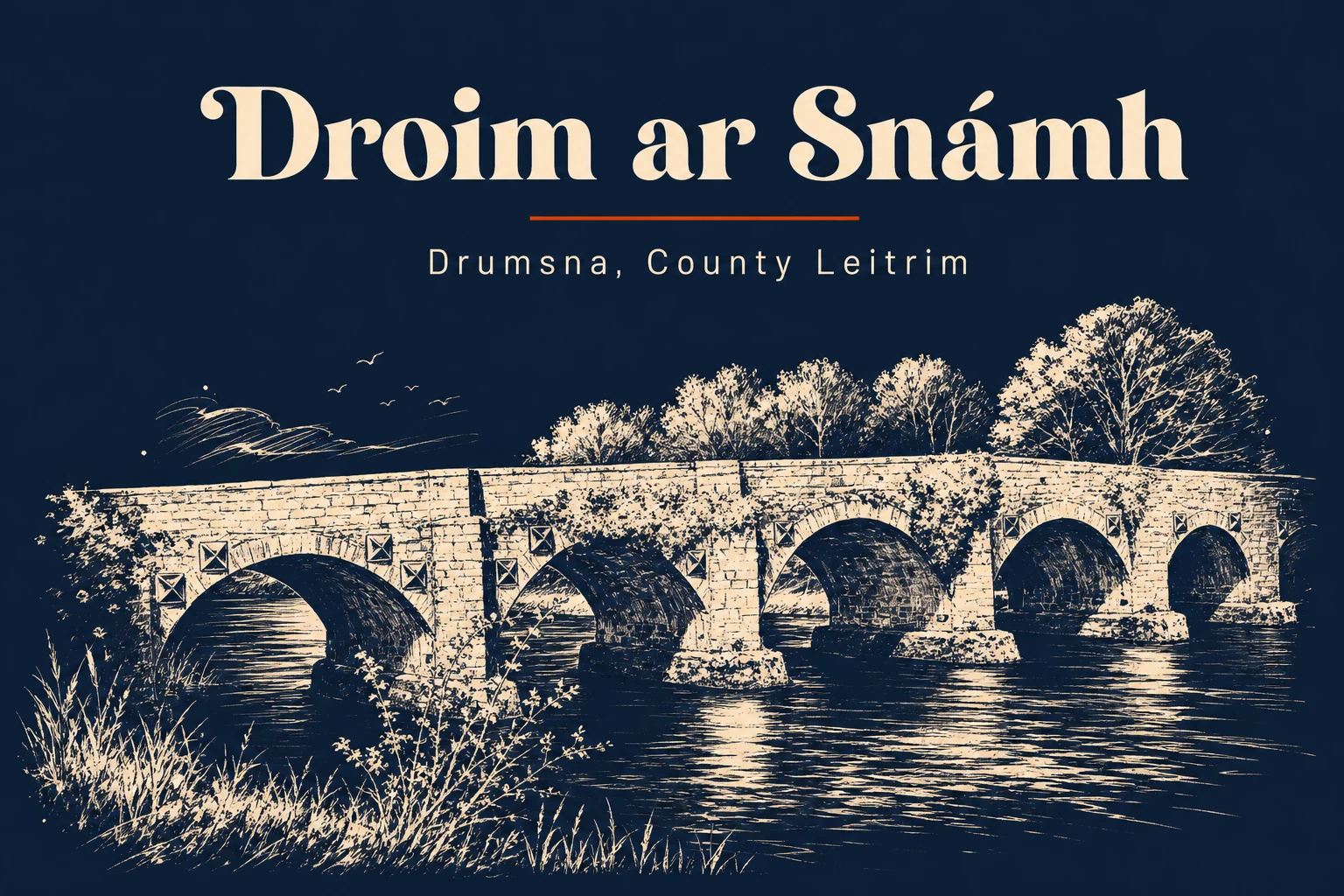
The harbour and riverside Down to the 1817 harbour and along the Shannon where it loops past the village. The jetty still takes cruisers in summer. Quiet water, good light in the evening, and the bridge where, the story goes, the skull of an ancient Irish elk was once found. A short, easy wander rather than a destination walk.
Short strolldistance
20 to 30 minutestime
05 / 07

When to go.

There is no bad time. There are different times.

Spring
Mar-May

The river comes back to life, the angling picks up, and the village is at its quietest and greenest. A good time for the Trollope trail before the summer boats arrive.

◉ Go
Summer
Jun-Aug

Cruiser season on the Shannon. The harbour sees boats, the fishing is at its best, and the longer evenings suit a riverside walk. Still a quiet village - this is not a place that gets crowded.

◉ Go
Autumn
Sep-Oct

Soft light on the water and the coarse fishing still strong. The boats thin out and the village settles back to itself.

◉ Go
Winter
Nov-Feb

Short days and a damp river valley. The pub keeps going and the walks are still there, but there is little laid on. Carrick-on-Shannon is the better winter base.

◐ Mind yourself
06 / 07

What to skip.

Honestly? Don't bother.

If a local was sitting beside you, this is the bit where they'd lean in.

×
Expecting a tourist machine

Drumsna is a genuinely small village - one pub, a church, a harbour. The history is real and worth knowing, but there is no visitor centre, no row of cafes, no crowd. Come for the river, the Trollope story, and the quiet. If you want amenities, base yourself in Carrick-on-Shannon and come out for the afternoon.

×
A signposted Doon of Drumsna attraction

The Doon is a major Iron Age earthwork, but it is a green ridge running through working farmland, mostly on the Roscommon side of the river. It is not a developed site with a car park and a path. Appreciate it for what it is - one of the oldest big structures in the country - rather than as a day out.

+

Getting there.

By car

On the old N4 corridor 6 km east of Carrick-on-Shannon; the village was bypassed by the new N4 (Dublin to Sligo) in 1996, so it is a short signposted detour off the main road. About 2 hours from Dublin, 30 minutes from Sligo direction.

By bus

No scheduled service through the village itself. Bus Éireann and Local Link services run on the N4 corridor; Carrick-on-Shannon, 6 km west, is the practical bus hub.

By train

No station. Drumsna's own station on the Dublin to Sligo line opened in 1863 and closed in 1963. The nearest working station is Carrick-on-Shannon (6 km) on the Dublin Connolly to Sligo line, with Dromod also on the line to the south.