County Leitrim Ireland · Co. Leitrim · Jamestown Save · Share
POSTED FROM
JAMESTOWN
CO. LEITRIM · IE

Jamestown
Baile Shemais, Co. Leitrim

The South Leitrim
STOP 08 / 08
Baile Shemais · Co. Leitrim

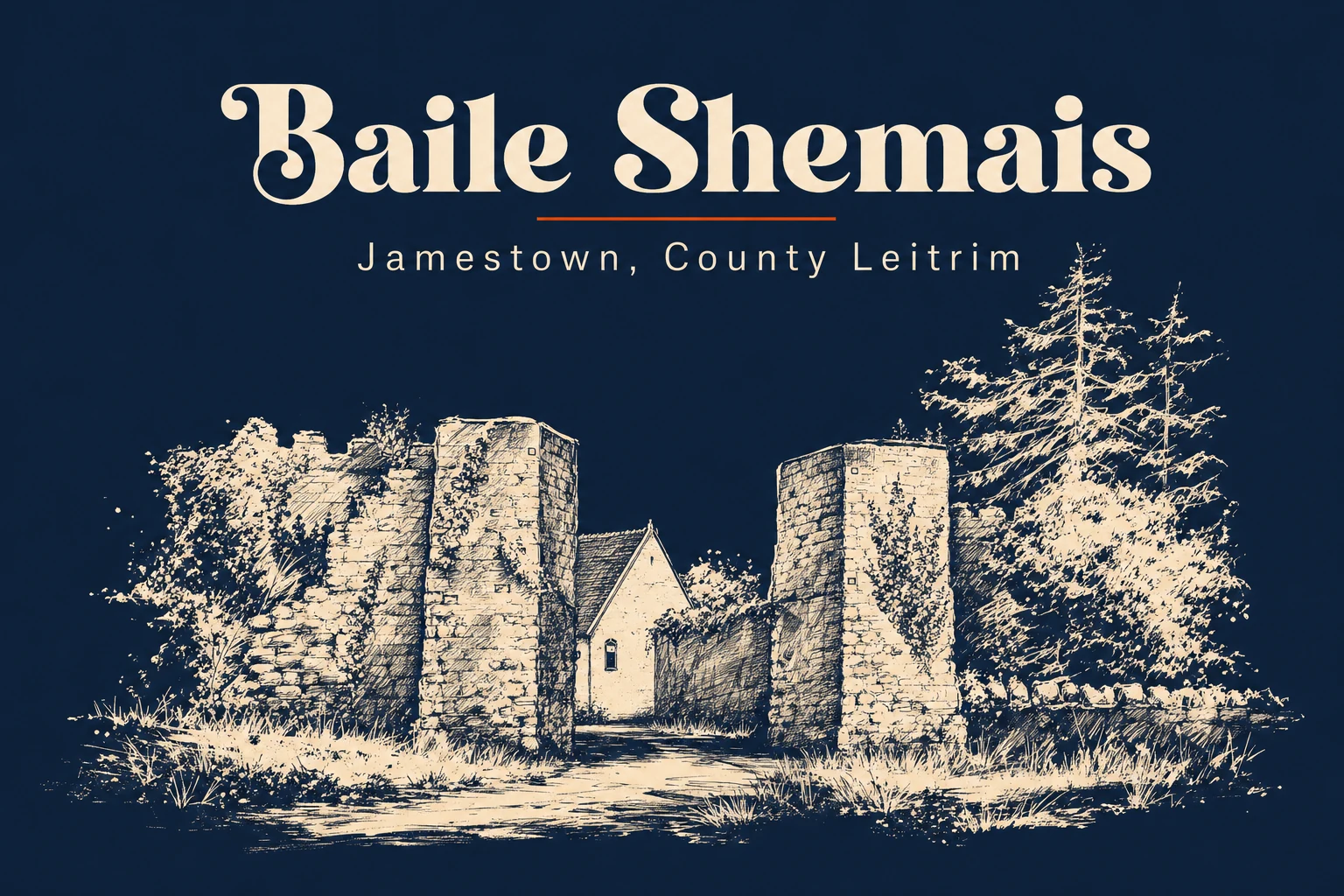
A walled plantation town from 1622 on the Shannon, with a stone arch over the road and not much else - which is most of the charm.

Jamestown is small - a couple of hundred people, one bar, a restaurant, a stone arch over the old road and a quay on the Shannon. It sits about five kilometres south-east of Carrick-on-Shannon, and for most of the twentieth century the N4 Dublin to Sligo road ran straight through the middle of it. A bypass took that traffic away in the late 1990s, and the village has been quiet ever since. That quiet is the point.

What makes it matter is the wall. James I chartered Jamestown in 1621 and it was founded the following year as a plantation town - one of the new settlements meant to plant Leitrim with loyal English settlers after the Flight of the Earls. Sir Charles Coote, a Devonshire planter, got the grant and walled the place: twenty feet high, six feet thick, enclosing about four acres with a castle inside. Walled towns are rare in Ireland and rarer still in the west. Jamestown is one of the few, and the line of the wall plus the arch over the road are what survive.

Beyond the wall there is a Franciscan friary from 1642, a heritage trail with brass markers, good Shannon angling, and the Cottage Restaurant - a thatched cottage doing Asian-Irish fusion that has built a reputation well beyond Leitrim. That is genuinely the lot. If you want shops, hotels and a night out, Carrick-on-Shannon is ten minutes up the road. Jamestown is a stop, a stretch of the legs, and a look at the arch. Take it for what it is.

Population
~229 (2002 census)
Pubs
1and counting
Founded
Walled plantation town by Royal Charter of James I, 1621-22 (Sir Charles Coote)
01 / 08

At a glance.

Three things every local will eventually mention. Read these and you've already understood more than most day-trippers do.

02 / 08

The pubs.

None of these are themed Irish pubs, because they don't need to be. A few that earn the trip:

The Arch Bar (Mulvey's)

Quiet midweek, lively at the weekend
Village bar, main street

The one pub in Jamestown, on the main street by the arch. A friendly welcome, a proper pint, and busy at the weekend when the locals come in. Midweek it is as quiet as the village. This is the social centre of Jamestown and pretty much the whole of it - if you want more bars, Carrick-on-Shannon is ten minutes away.

03 / 08

Where to eat.

PlaceTypeLocal note
The Cottage Restaurant Asian-Irish fusion in a thatched cottage €€€ Chef Sham Hanifa runs the kitchen in a traditional thatched cottage just outside the arch. The cooking is a fusion of Asian and Irish - local Leitrim produce through the lens of the chef's Malaysian family kitchen. It has been talked up as one of the most promising restaurants in the country, and it is the reason a lot of people drive to Jamestown at all. Dinner Thursday to Sunday, lunch on Sunday; closed early in the week. Book ahead - the room is small and the reputation is not.
04 / 08

Stories & lore.

The reason to come back. The things every local will eventually tell you about, usually after the second pint.

James I, 1621-22, and Sir Charles Coote

The walled plantation town

After the Plantation of Leitrim was decided in 1620, James I issued a Royal Charter in 1621 and the town was founded in 1622, named for the king himself. The grant went to Sir Charles Coote, a Devonshire planter, who fortified it with walls reported at twenty feet high and six feet thick, enclosing roughly four acres with a castle inside and around two hundred acres of liberty around it. The borough returned two members to the Irish House of Commons - Coote among the early ones - on a very restricted franchise, right up until the Act of Union in 1801. Most of the wall is long gone, but its line is legible in the village, which is what makes Jamestown one of the few surviving walled-town sites in the west of Ireland.

The old town gate, knocked by a lorry

The arch over the road

The road into the village ran through a stone arch - the surviving town gate, with narrow pillars. A lorry clipped it in the early 1970s and took the top off, and the original arch never fully came back. In its place a lighted skeletal arch is put up seasonally, so on a winter evening the gateway still marks itself across the road even though the stone is reduced. It is a small thing, but it is the front door of a four-hundred-year-old walled town, and most people drive the bypass and never see it.

Franciscans, 1642, and the synod of 1650

Jamestown Friary

A Franciscan friary of the Friars Minor was founded at Jamestown in 1642, during the Confederate wars, after the O'Rourke clan took the town. It is reached through a small gate with a stone cross over it. In 1650 a synod held at the friary excommunicated the followers of the Marquess of Ormonde - a sharp moment in the politics of Confederate Ireland playing out in a small Leitrim friary. The remains stand near the village and are part of the local heritage trail.

05 / 08

Things to do outside.

Wear waterproofs. Bring a sandwich. Tell someone where you're going if it's the mountain.

Jamestown heritage trail A walking trail through the village marked with brass signs and historical markers - the line of the 1622 town wall, the arch, the friary site, the quay. Short and flat. The best half-hour in Jamestown, and it tells you why the place exists.
Short village loopdistance
30-45 minutestime
The quay and the Shannon bank From the village down to the small harbour on the Shannon, a short walk where boats tie up in summer and anglers work the bank year round. The water is wide and quiet here. The Jamestown Canal cuts the corner downstream toward the Albert Lock if you want to follow it further.
1-2 km returndistance
30 minutestime
06 / 08

When to go.

There is no bad time. There are different times.

Spring
Mar-May

The river bank greens up, the angling picks up, and the village is at its quiet best before any summer boat traffic arrives.

◉ Go
Summer
Jun-Aug

Boats stop at the quay, the Arch Bar is busy at the weekend, and the Cottage is in full swing. The warmest time to walk the heritage trail and the bank.

◉ Go
Autumn
Sep-Oct

Good light on the Shannon and fewer people. A fine time for a quiet stop and dinner at the Cottage.

◉ Go
Winter
Nov-Feb

Short days and a very quiet village - but the seasonal lighted arch goes up, the Cottage and the Arch Bar keep going, and Carrick is ten minutes away for anything else.

◐ Mind yourself
07 / 08

What to skip.

Honestly? Don't bother.

If a local was sitting beside you, this is the bit where they'd lean in.

×
Expecting an intact walled town

Most of the wall is gone and the arch was knocked by a lorry in the 1970s. What survives is the line of the wall, the seasonal arch and the heritage markers. Come to read the layout of a 1622 plantation town, not to photograph standing battlements.

×
Looking for shops, hotels or a night out

There is one bar and one restaurant. That is the village, honestly. For shops, hotels, supermarkets and a proper evening, Carrick-on-Shannon is ten minutes up the road.

+

Getting there.

By car

On the R-road loop just off the N4 between Carrick-on-Shannon and Dromod, about five minutes south-east of Carrick. The N4 used to run through the arch; the late-1990s bypass means you now turn off the main road to reach the village.

By bus

No direct village service to speak of. Bus Éireann and Local Link routes serve Carrick-on-Shannon nearby; check current Local Link timetables for the rural connections.

By train

The nearest stations are Carrick-on-Shannon and Dromod, both on the Dublin Connolly to Sligo line. Carrick-on-Shannon is the closer of the two, about ten minutes by road; from there it is a short taxi or drive to Jamestown.