County Limerick Ireland · Co. Limerick · Cappagh Save · Share
POSTED FROM
CAPPAGH
CO. LIMERICK · IE

Cappagh
An Cheapach, Co. Limerick

The Ireland's Ancient East
STOP 05 / 05
An Cheapach · Co. Limerick

A west-Limerick parish with no pub, shop or post office - but the Palatine graveyard at Ballingrane is where American Methodism was born.

Cappagh - An Cheapach, 'the tillage plot' - is a parish in west Limerick, not a village in the way a tourist means the word. Around 800 people are spread across its townlands southeast of Askeaton, and the parish carries a small distinction it is quietly proud of: it has no public house, no shop, and no post office, one of the very few parishes in Limerick without any of the three. It is the third-smallest parish in the diocese. In 1831 the old village had twenty houses, two pubs, a forge and a police barracks. The pubs are long gone and the village itself shifted ground. What remains is St James's Church, a scatter of farms, and a graveyard that matters far more than its size suggests.

The reason to know Cappagh is the Palatines. In 1709 Queen Anne settled a few hundred refugee families from the German Palatinate on the Southwell estate around Rathkeale and Ballingrane to strengthen the Protestant presence in Catholic Ireland. They brought their own names - Switzer, Teskey, Ruttle, Sparling, Bovenizer, Delmege - and they took to the new Methodist preaching that John Wesley's followers carried through the area in the 1740s and 50s. Two of those Palatine children, Philip Embury of Ballygaran and his cousin Barbara Heck of Ballingrane, emigrated to New York in 1760. There, in 1766, Barbara shamed Philip into preaching, and the sermon he gave is reckoned the founding moment of Methodism in America - a church that now counts its members in the millions.

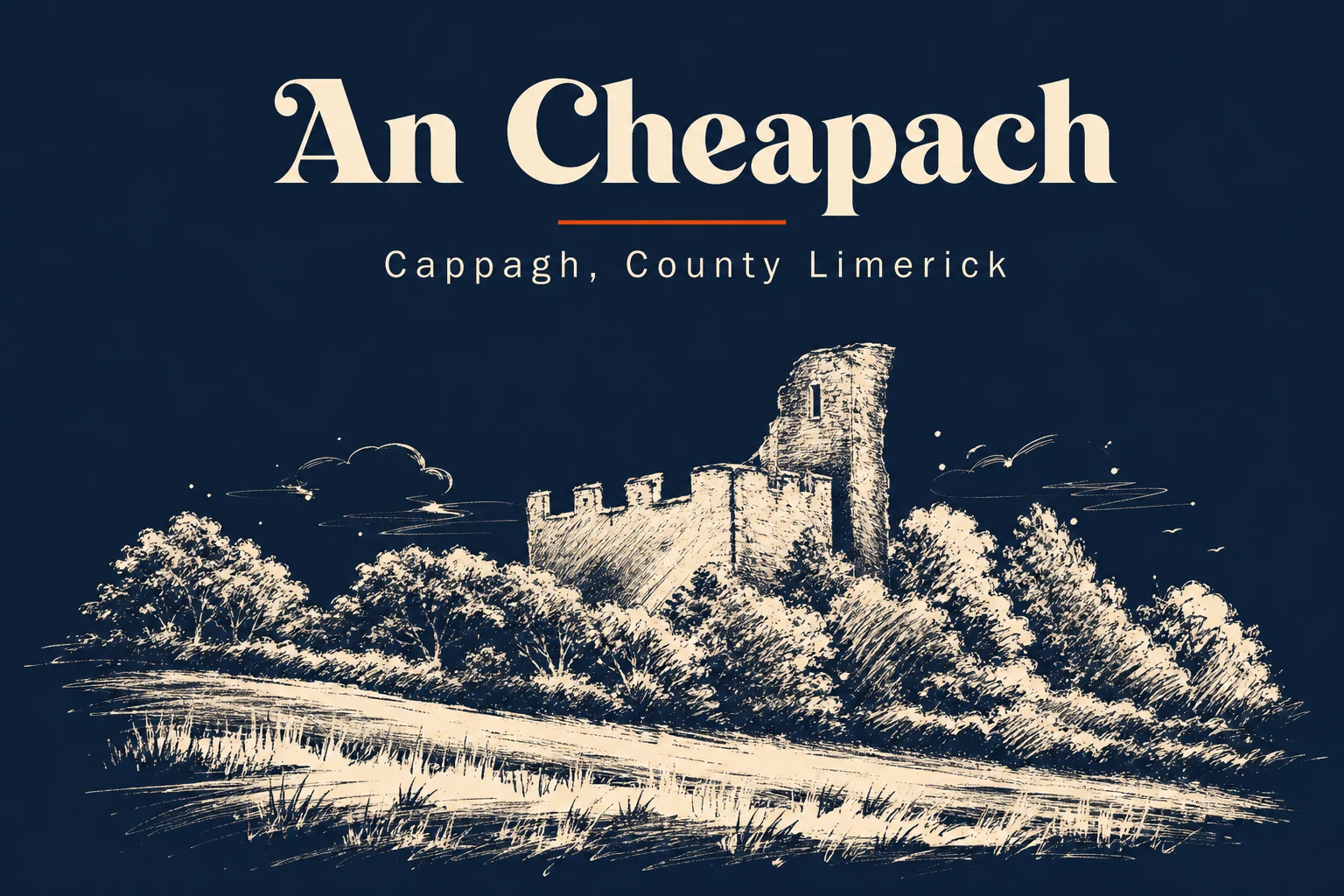
The parish sits in lowland farm country, hemmed by Askeaton and Kilcornan to the north, Rathkeale to the south, Croagh to the east and Coolcappa to the west. It was the old tuath of Nantenan in the territory of the Uí Fidgeinte, and Nantenan survives now only as a townland name. The Normans left Cappagh Castle, still on private land. The landscape is green and worked rather than dramatic - the drama is the human history, not the hills.

Do not come to Cappagh for a day out in the usual sense. There is nowhere to buy a coffee. Come if you are tracing Palatine or Methodist roots, if you want to stand in the Ballingrane graveyard among one of the densest concentrations of Palatine surnames anywhere outside the Rhineland, or if you simply want to see how most of rural Ireland is actually laid out - by parish and townland, not by main street. Askeaton, with its friary and castle on the Deel, is five minutes north and does the eating and drinking.
Population
~800 (parish)
Founded
Medieval parish; Norman Cappagh Castle; village of 20 houses recorded 1831
Coords
52.5583° N, 8.8992° W
01 / 05

At a glance.

Three things every local will eventually mention. Read these and you've already understood more than most day-trippers do.

02 / 05

Stories & lore.

The reason to come back. The things every local will eventually tell you about, usually after the second pint.

Embury and Heck, Ballingrane to New York

The cradle of American Methodism

Philip Embury was born at Ballygaran in this parish in 1729, schooled near Ballingrane, and trained as a carpenter. His cousin Barbara Heck was born at Ballingrane in 1734. Both came from the German Palatine families settled around Rathkeale after 1709, and both were converted under the early Methodist preaching that swept the colony. In 1760 they sailed for New York. For six years Embury did little, until in 1766 Barbara - finding their neighbours gambling at cards - swept the cards into the fire and demanded he preach. He held the first Methodist service in America in his own house on Barrack Street, then in a hired rigging loft, and the movement that grew from it now numbers in the millions. Barbara Heck is remembered as the 'mother of American Methodism', Embury as its founder. Both are buried in Canada, but the parish they came from has not forgotten them.

Built 1766, on land given by the Hecks

The Embury and Heck church at Ballingrane

In the same year Embury was preaching in New York, the Palatine community still at home built a Methodist meeting house at Ballingrane, on a site donated by the Heck family, replacing an earlier smaller meeting room. The plain little church still stands and still holds memorial tablets to Barbara Heck and Philip Embury, recording their part in founding the Methodist Church in America. The graveyard around it holds one of the greatest concentrations of Palatine family names found anywhere outside the Palatinate itself - Switzer, Teskey, Sparling, Ruttle, Bovenizer, Baker, Miller, Doupe, Delmege. It marked its 250th anniversary in 2016.

Rebuilt after a storm, 1839

St James's Church and the Night of the Big Wind

St James is the patron of the parish. The old Catholic chapel - described in the 1830s as a large plain thatched building - was blown down on the Night of the Big Wind, the catastrophic storm of 6 January 1839 that flattened buildings across Ireland. Fr Halpin built its replacement the same year. That church was itself reconstructed and reopened in February 1987. St James's Well survives in the parish, and St James's National School, built in 1866 and extended since, still teaches the parish's children. The church is one of the few public buildings Cappagh has.

An Cheapach, in the land of the Uí Fidgeinte

The name and the old tuath

Cappagh comes from An Cheapach, 'the tillage plot' - named for the patch of cultivated ground where the original church stood. Long before that the district was the tuath of Nantenan, in the wider territory of the Uí Fidgeinte, the early people who held most of west Limerick from around the fourth century. Nantenan is now just a townland name within the parish, and a ruined church there carries a shared Catholic and Anglican past. The Normans came later and raised Cappagh Castle, which still stands on private ground. Layer on layer, all of it on land, which is exactly what the parish name records.

03 / 05

Things to do outside.

Wear waterproofs. Bring a sandwich. Tell someone where you're going if it's the mountain.

Ballingrane graveyard and Palatine trail The Embury and Heck church and its graveyard are the heart of any visit. Walk the headstones for the Palatine surnames, then take in the quiet lanes around Ballingrane and Court Matrix where the colony first settled. This is a heritage walk, not a hike - flat, on minor roads, best done slowly with the history in mind.
Short, around the graveyard and lanesdistance
30-45 minutestime
St James's Church and St James's Well From the parish church out to St James's Well and back. Modest distances on quiet country roads. Good boots after rain - this is farmland, and the verges are soft.
Short parish loopdistance
30 minutestime
04 / 05

What to skip.

Honestly? Don't bother.

If a local was sitting beside you, this is the bit where they'd lean in.

×
Arriving expecting a village centre

There isn't one in the modern sense - no pub, no shop, no post office, no coffee. Cappagh is a parish of scattered farms and a church. If you want a high street, Askeaton or Rathkeale is five to ten minutes away. Come to Cappagh for the heritage, not for amenities.

×
Expecting Cappagh Castle to be open

It stands on private land. You can see the Norman tower from the road, but it is not a visitor site. Treat it as a landmark, not an attraction, and respect the boundary.

×
Confusing this Cappagh with the others

There is a Cappagh in Co. Tyrone and a Cappagh hospital in Dublin, among others. This is the west-Limerick parish near Askeaton and Rathkeale. If you are tracing Palatine or Methodist roots, that is the distinction that matters.

+

Getting there.

By car

Limerick city to Cappagh is about 40 minutes - the N21 toward Adare and Rathkeale, then local roads north toward Askeaton. Askeaton is roughly 5 km north, Rathkeale a similar distance south. There is no through-route signposting; you navigate by the surrounding villages.

By bus

No direct service to Cappagh itself. The nearest scheduled buses run through Rathkeale and Askeaton - Bus Éireann Limerick-Tralee corridor services and Local Link Limerick Clare routes. Local Link runs the rural roads of west Limerick; ring them to ask about the nearest stop and demand-responsive services.

By train

No rail service. The nearest stations are in Limerick city (about 40 minutes by car) on the lines to Dublin, Galway and Cork. The old Ballingrane railway station in the parish closed long ago; its forge and station buildings survive as heritage.

By air

Shannon Airport (SNN) is about 35 minutes north across the estuary roads - the most convenient airport for the parish. Cork and Kerry airports are each over an hour south.