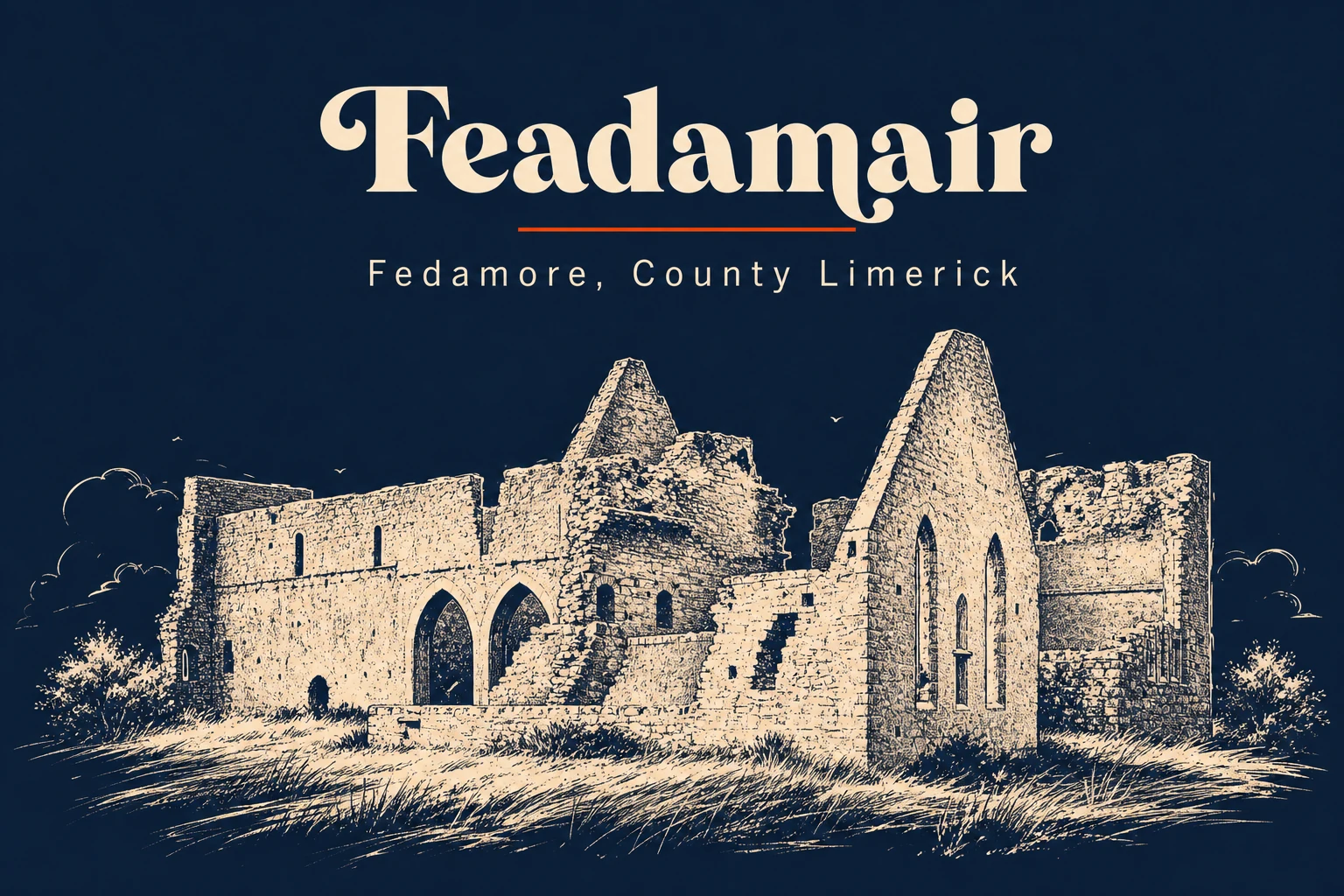
Feadamair · Co. Limerick
A one-pub farming village south of Limerick, with a great ruined Cistercian abbey a few minutes up the road.
Fedamore is a small farming village in east Limerick, about 13 kilometres south of the city on a minor road off the R511. The 2022 census counted 381 people; the wider parish, spread across the surrounding townlands, runs to roughly eighteen hundred. The land here is good - fertile pasture and tillage - and the village reflects that: a church, two national schools at Fedamore and Carnane, a community hall, a GAA pitch, a single pub, and a handful of housing estates with Irish-language names. It is not a destination. It is a working parish that happens to sit in pretty country.
The name is Feadamair, usually read as the wood of Damar after a local Gaelic chieftain. The medieval bones are scattered through the townlands rather than gathered in the village. There were tower-house castles at Englishtown, Rockstown and Williamstown - the ruins at the last two still stand in fields. The present Catholic church, dedicated to the Beheading of St John the Baptist, was built in 1830 by Fr Timothy MacCarthy and cost about £700, a serious sum then. A Latin plaque inside still names him.
Come here for the quiet and for what is nearby rather than for the village itself. Monasteranenagh Abbey, a few minutes south toward Manister and Croom, is one of the finer Cistercian ruins in Munster and you will usually have it to yourself. Hurling is the local religion - Fedamore took Limerick Senior Hurling Championships in 1912 and 1927, and bred Paddy Clohessy, who won All-Irelands with Limerick in 1934, 1936 and 1940. A pint in the village pub and an hour in the abbey ruins is a complete, honest afternoon. Do not expect more, and you will not be disappointed.