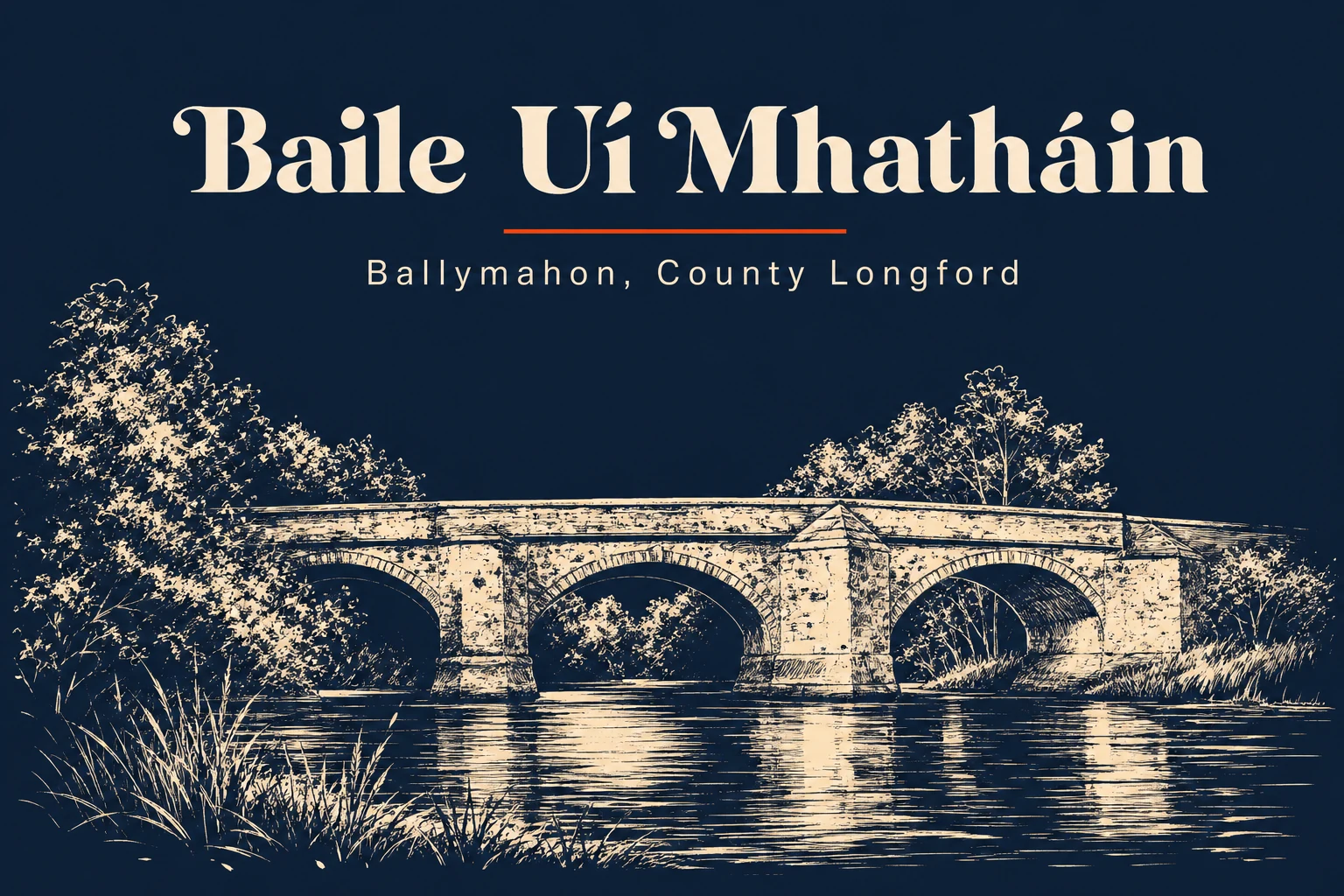
Baile Uí Mhatháin · Co. Longford
Market town where Oliver Goldsmith walked, and where the Goldsmith Country trail begins.
Ballymahon is a market town on the River Inny in south County Longford, 2,500-3,000 souls by reputation, 1,714 by the 2022 census. It is the centre of Goldsmith Country - the territory where Oliver Goldsmith, author of She Stoops to Conquer and The Vicar of Wakefield, spent his childhood. His birthplace is contested: born either in Pallas (near Ballymahon) or at his maternal grandparents' house near Elphin in Roscommon. He grew up in Lissoy, a nearby townland, and Lissoy became Auburn in his poem The Deserted Village. Ballymahon is where the trail begins.
The town itself is unpretentious. Late Georgian buildings, colour-washed gable houses in rows, a working market economy. Skelly's Bar has operated since the 1850s. The old courthouse (1819) is now a community library. The River Inny flows through, wide enough for fishing and canoeing. Walk the Newcastle Woods on a Tuesday morning and you are likely alone. That is the whole point.
The Oliver Goldsmith Summer School meets every June Bank Holiday at Ballymahon Library and the Bog Lane Theatre, with readings held at Goldsmith's birthplace in nearby Pallas. The town is the hub of the Goldsmith Country literary trail, which threads through Edgeworthstown, Ardagh, Pallas, Lissoy, Forgney, and Kilkenny West - the family's journey across three counties. The trail is not heavily marketed. That is also the whole point.