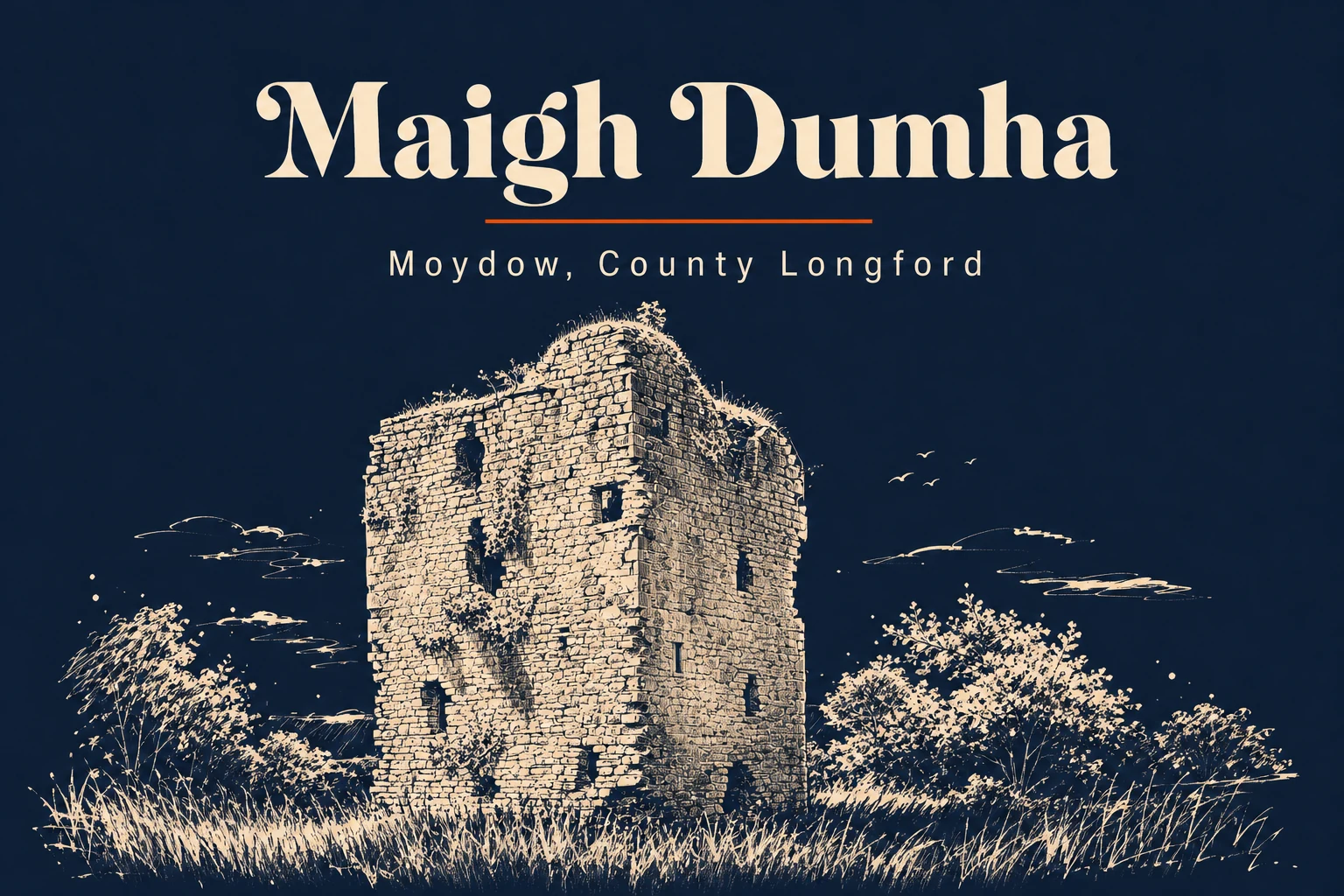
Maigh Dumha · Co. Longford
An old parish village south of Longford town, with two ruined tower houses, a lost saint's cell, and a GAA club older than most of the county.
Moydow is a small village a few kilometres south of Longford town, on the old road toward Athlone. It is the kind of place that is really a parish first and a village second - a church, a couple of pubs, a former schoolhouse turned community centre, a graveyard, and the farmland of south Longford spread out around it. It shares a parish and a football club with Ardagh up the road, and for most practical purposes the two places are spoken of in one breath: Ardagh and Moydow.
The name is Maigh Dumha, the plain of the mound. Underneath that is an older name, Cill-Modhint - the church of St Modhint, or Modan, a figure who is said to have had a cell here around the year 591 and to have been made a bishop. The early church was burned in 1155 and nothing of it survives above ground. What you see instead is the 19th-century village: St Mary's Catholic church with an 1838 date stone in the middle of it, and a disused Church of Ireland church on a site that goes back to the 17th century, rebuilt after a fire in 1831 and closed for worship since 1987.
It is not a tourist village and does not pretend to be. There are two pubs - the village locals, where the parish actually happens - a church, a community centre in the old school, and the GAA. Come for the quiet, the old stone, and a sense of a working rural parish that has been here a very long time. Then drive the few minutes back to Longford town for a bed and a choice of dinner.