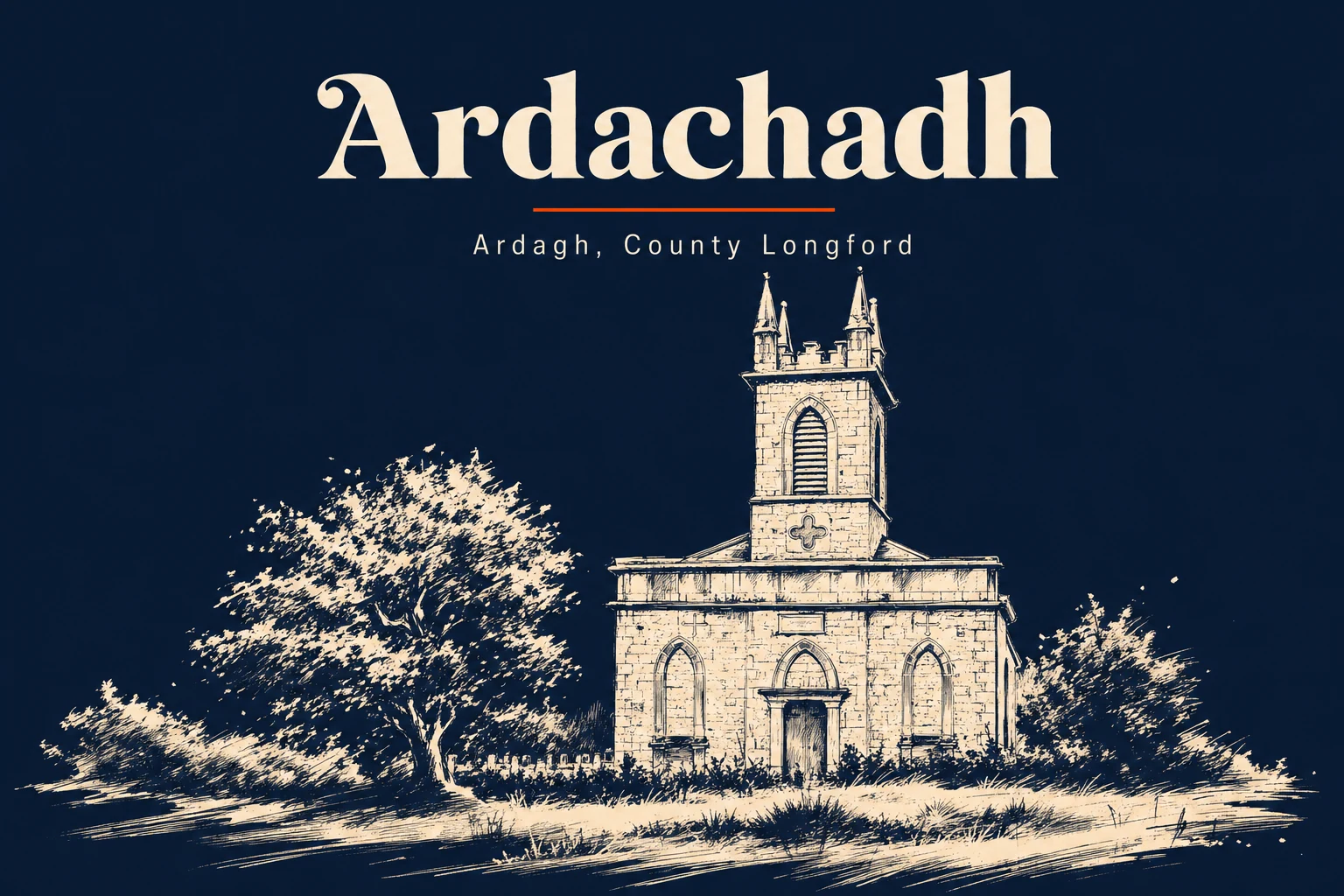
Ardachadh · Co. Longford
A planned estate village built over a 5th-century monastery, and a three-time Tidy Towns champion that looks the part.
Ardagh is a village built on a plan, and the plan is the point. In the 1800s the Fetherston family, who held Ardagh House and the land around it, laid out a model estate village - arts-and-crafts cottages, a green, a clock tower, the careful visual logic of a place someone sat down and drew. The story locally is that Lady Fetherston wanted something like a Swiss village; the architect J. Rawson Carroll gave it to her. The monastery underneath predates all of it by about thirteen centuries.
St Mel is the founding figure. The tradition has Patrick founding a church here around 434-435 and leaving his kinsman Mel as the first bishop of Ardagh - a name the Catholic diocese still carries. Of the monastery that grew up around him, the only fabric left is a small stone oratory in the grounds of the Protestant parish church. Everything else is grass and memory.
It is a tiny place now, a couple of hundred people, and it has won the national Tidy Towns Supreme title three times - 1989, 1996 and 1999 - which for a village this size is a serious haul. The heritage centre in the old schoolhouse tells the story of the monastery, the estate and the writers and players who passed through. There is one pub. This is not a stop you fall into off a motorway. It is a place you go to on purpose, look at properly, and leave.