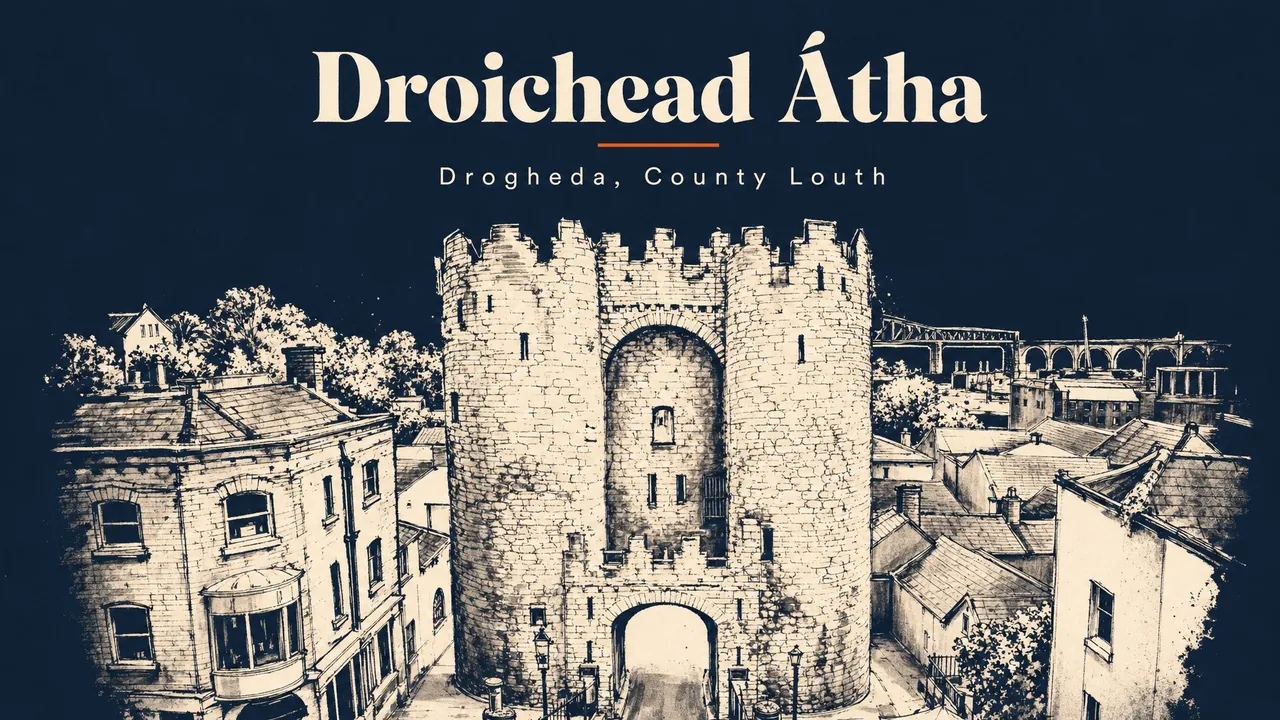
Droichead Átha · Co. Louth
A walled medieval port on the Boyne with the head of a saint in the church on West Street.
Drogheda is the biggest town in Co. Louth and, on the population numbers, the largest in the State outside the five cities. Forty-four thousand people, the River Boyne cutting straight through the middle, and a layer-cake of history that goes from a Norman walled town to a 17th-century massacre to a 19th-century railway viaduct to a 21st-century commuter belt feeding the M1 into Dublin. Most of it is still here. You walk past it on your way to the chemist.
It was founded as two towns. Drogheda-in-Meath on the south bank, Drogheda-in-Oriel on the north - separately chartered, separately walled, periodically fighting each other across the river - until Henry IV ordered them united in 1412. The walls went up in the 13th century, three and a half kilometres of stone enclosing 113 acres, and St Laurence's Gate is the best-preserved medieval town gate left in Ireland. The Tholsel on West Street is the 1770 replacement for the medieval one. Magdalene Tower at the top of the hill is what's left of the 14th-century Dominican friary. The kind of town where 'medieval' is not a decorating choice.
Don't come for a checklist. Come for an hour walking the south bank from St Laurence's Gate up to Millmount Fort with the Boyne underneath you, twenty minutes in St Peter's at the shrine of Oliver Plunkett, a pint in McPhail's beer garden if the sun is out or in Clarke's at the bar if it isn't, and dinner at Scholars Townhouse on King Street. The town does not put on a show. It assumes you've read up.
Drogheda is also the gateway to the Boyne Valley. Newgrange and Knowth are fifteen minutes west, the Battle of the Boyne site at Oldbridge is six kilometres up the river, Mellifont and Monasterboice are inland. Use the town as a base. The drive between sites is shorter from here than from anywhere else, and you eat better in the evening.