County Louth Ireland · Co. Louth · Termonfeckin Save · Share
POSTED FROM
TERMONFECKIN
CO. LOUTH · IE

Termonfeckin
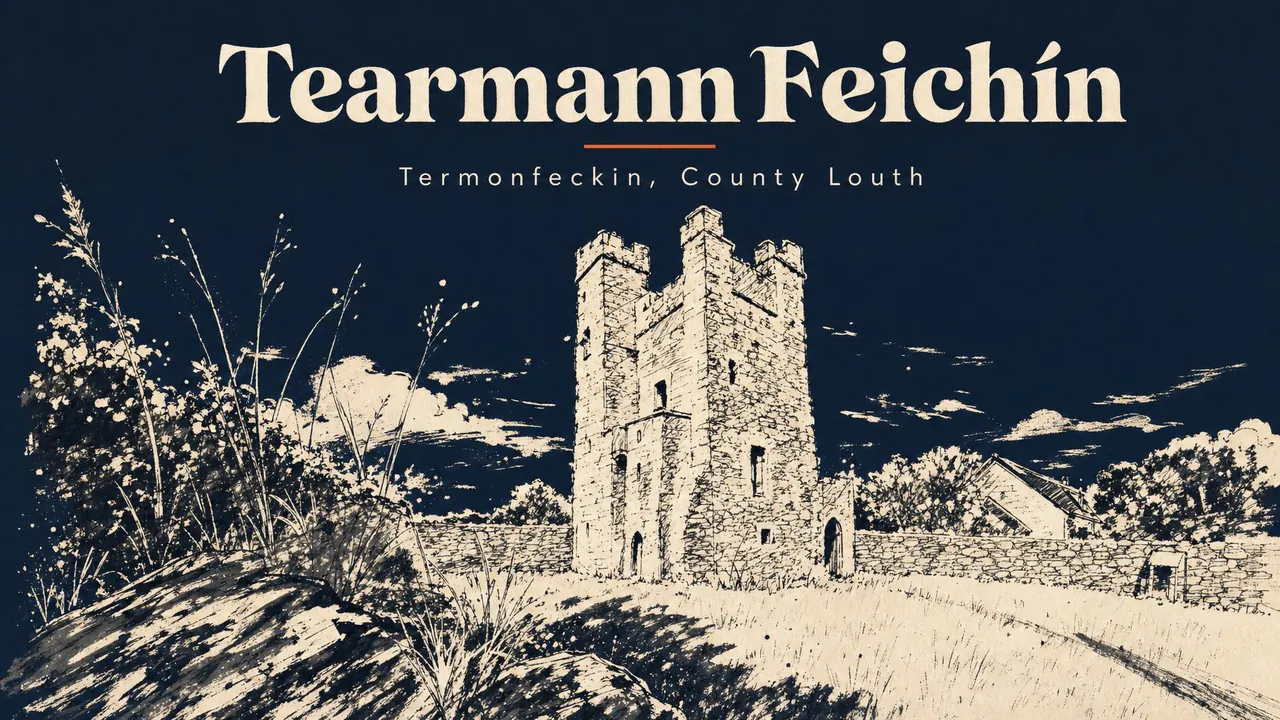
Tearmann Feichín

The Ireland's Ancient East
STOP 03 / 06
Tearmann Feichín · Co. Louth

St Feichín's sanctuary — a tower house, a 9th-century high cross, and the longest beach in Co. Louth.

Termonfeckin sits eight kilometres north-east of Drogheda on the Ballywater River, half a kilometre back from a long sand-and-shingle beach that runs north toward Clogherhead. The Irish name — Tearmann Feichín — translates as 'sanctuary of Feichín'; the village grew up around the 7th-century monastery the saint founded here, and the parish has carried the name through fourteen centuries.

St Feichín of Fore is the founder. He arrived around 665 AD from his mother house at Fore in Westmeath, founded a monastery on the bank of the river, and is also credited with the original of the high cross that still stands in the village. Pope Celestine III confirmed an Augustinian community here in 1195. From the medieval period until the Reformation, Termonfeckin was a country residence of the Archbishops of Armagh — the Primates of All Ireland kept a palace here for three months of every year, three hours' ride from the actual see at Armagh, on the lands the church still controlled. The palace stood beside the Ballywater River until 1830, when it was demolished. The 15th-century tower house up the lane survives.

The other layer is more recent. The Irish Countrywomen's Association — the ICA, founded 1910 — bought An Grianán in 1954 as the country's first residential adult-education college. The 18th-century McClintock house and grounds at the top of the village have hosted craft, cooking and arts courses for seventy years. The horticultural college closed in 2003; the residential and day courses run on. Generations of women across the country know An Grianán as the place they learned to bake bread, grow vegetables, or just take a week off.

Don't come for a checklist. Come for half an hour at the high cross in the churchyard, twenty minutes climbing the corbel-roofed tower house up the lane (free, OPW, key from the cottage opposite when in season), a long walk on Termonfeckin beach to the river mouth and back, and dinner at Triple House where Pat Fox has been turning out the same fish-and-steak set menu since 1988. Stay at Flynns if you want to be in walking distance of the village. The beach handles the rest.
Population
~700 (village)
Pubs
2and counting
Walk score
Tower house to high cross to beach in half an hour
Founded
Monastery founded by St Feichín c.665 AD; archbishop's palace from medieval period; tower house 15th–16th c.
Coords
53.7619° N, 6.2700° W
01 / 09

At a glance.

Three things every local will eventually mention. Read these and you've already understood more than most day-trippers do.

02 / 09

The pubs.

None of these are themed Irish pubs, because they don't need to be. A few that earn the trip:

Triple House Restaurant & Pub

Three houses joined into one
Restaurant pub since 1988, Drogheda Road

Pat and Siobhan Fox run it. Three small village houses knocked together — the layout is a little haphazard because of it, which is part of why it works. Local fresh fish and steaks on a fixed-price set menu, the homemade brown bread and garlic potatoes the locals come back for. Book Friday and Saturday — limited covers and a long-standing reputation.

Flynns of Termonfeckin

Locals and stayers mix
Hotel bar in a 19th-century building

On the banks of the Ballywater. The bar of Flynns Hotel; full lunch and dinner menu, a beer garden out the back, the kind of bar where the village football club's photographs are on the wall. Live music some weekends. Walking distance from the tower house, the cross and the An Grianán gates.

McEvoy's, Clogherhead

Coastal local
Pub, six minutes by road

Six kilometres north on the coast road in Clogherhead. The pub everyone goes to when they want a pint with a view of the harbour. Honest local, well-pulled stout, the regulars who run the pier on a Saturday morning. Five-minute drive from Termonfeckin.

Drogheda for the late session

A note

Termonfeckin is a two-pub village. For trad sessions, the late lounge or the proper choice of stout houses, locals drive ten minutes into Drogheda — Clarke's, Matthews, Sarsfield's. Taxi back is fifteen euro.

03 / 09

Where to eat.

PlaceTypeLocal note
Triple House Restaurant Set-menu restaurant since 1988 €€ The dinner in Termonfeckin. Pat Fox in the kitchen for thirty-five years, set price, fresh fish, the famous garlic potatoes. Booking essential at weekends and through the summer.
Flynns of Termonfeckin Hotel restaurant & bar food €€ The all-day option. Lunch menu in the bar, evening menu in the restaurant, the Sunday carvery the parish calls into. Less of an event than Triple House, more flexible.
An Grianán café College café Inside the ICA An Grianán complex, open during course days. Soup, sandwiches, traybakes, decent coffee. Useful if you've come for a course or a garden visit; not a destination otherwise.
Drogheda for fine dining A note For a proper sit-down dinner with a wine list, the answer is Scholars Townhouse on King Street in Drogheda — ten minutes back the road. Worth the drive, worth the booking.
04 / 09

Where to sleep.

PlaceTypeLocal note
Flynns of Termonfeckin Boutique hotel in a 19th-century building, 8 rooms The proper stay in the village. On the Ballywater, ten-minute walk to the beach, five-minute walk to the cross and the tower. Period rooms, modern bathrooms, breakfast in the bar. Book a river-side room if you can.
B&Bs on the Drogheda Road and Sandpit Country guesthouses Several long-running B&Bs along the Drogheda Road and on Sandpit (the lane between the village and the beach). Quiet, parking, twenty euro cheaper than the hotel. Search by townland or check Discover Boyne Valley for current operators.
An Grianán residential courses ICA college overnight If you fancy taking a one-day or weekend craft course, An Grianán has en-suite rooms in the original 18th-century house and the modern wings. Booking through the ICA programme. Genuine, unfussy, a meal in the dining hall, the gardens in the morning.
05 / 09

Stories & lore.

The reason to come back. The things every local will eventually tell you about, usually after the second pint.

c.665 AD, the founding monastery

St Feichín's sanctuary

Feichín of Fore — Féichín mac Caemáin, an early Irish Christian abbot whose mother house was at Fore in Co. Westmeath — founded a monastery here around 665 AD on the bank of the Ballywater River. The 'tearmann' in the name is the Irish word for sanctuary or termon land, the inviolable territory around a monastic settlement that custom (and later, canon law) protected from secular jurisdiction. Feichín died of yellow plague in 665. The community he founded survived him, was later regularised as Augustinian Canonesses Regular under the Blessed Virgin's invocation, and was confirmed by Pope Celestine III in 1195. The high cross in the churchyard dates from a hundred and fifty years after the saint, but the foundation is his.

A medieval country palace

The Archbishops of Armagh

From at least the 13th century until the Reformation, Termonfeckin was the country residence of the Archbishops of Armagh — Primates of All Ireland — for the months when they wanted to be three hours from the see and on the coast rather than in the church-political crossfire of Ulster. The palace, a fortified stone house with its own bawn and garden, stood on a sloping ridge beside the Ballywater. It was damaged in the Catholic Confederate rebellion of 1641, never properly repaired, and demolished around 1830. The 15th-century tower house up the village lane is sometimes confused with the palace — it isn't. The tower is a separate, smaller, fortified residence, possibly belonging to a steward of the archbishop's lands.

15th–16th century, the corbel roof

The tower house

Termonfeckin Tower House is a three-storey 15th- or 16th-century stone tower of the kind built across Co. Louth and the Pale by Anglo-Irish gentry as fortified family residences. Walls four feet thick, narrow defensive windows, a single spiral stair winding to the top. Its singularity is the corbelled stone roof on the third storey — overlapping flat stones built up into a vault, rather than the more common timber roof. The technique is the same as the chamber roof at Newgrange forty kilometres away and three thousand years older. OPW heritage site, free entry; the key for the door is traditionally held in the cottage opposite, available in summer hours.

Irish Countrywomen's Association, since 1954

An Grianán

An Grianán — 'the sunny place' — is an 18th-century country house built by the McClintock family at the top of the village. The Irish Countrywomen's Association bought it in 1954 as Ireland's first residential adult-education college for women. It ran a horticultural college from 1954 until 2003, and continues today as the ICA Adult Education Centre, offering one-day, weekend and week-long courses in art, crafts, cooking, gardening and personal development. Generations of women across the country first learned bread-baking, jam-making or stained glass on the lawn in front of the McClintock house. The grounds are open during course days; the bookshop in the entrance hall sells the ICA's own publications.

Sons of Mary, founded 1955

Termonfeckin GAA

The village GAA club is St Mary's Sons of Mary — a small parish club fielding football teams from under-7s to senior. The pitch is on the Drogheda Road. Modest in scale: not a county powerhouse, but the club that the village is built around. If you want to know what's on in Termonfeckin on a Saturday, look at the GAA fixture list. Every village in Louth has one of these — the difference is that this one's pitch is five minutes from a tower house with a Newgrange-style roof.

06 / 09

Things to do outside.

Wear waterproofs. Bring a sandwich. Tell someone where you're going if it's the mountain.

Village heritage circuit From Flynns of Termonfeckin up the village street to the parish church and the high cross in the churchyard, on to the tower house up the side lane (key from the cottage when open), past the An Grianán gates, and back along the Ballywater. Plaques are decent. The whole village layout is medieval — the street pattern is the church's.
2 km loopdistance
45 minutestime
Termonfeckin to Seapoint beach From the village down Sandpit Lane to the beach, then north along the strand toward Seapoint at low tide — the longest unbroken sand walk in Co. Louth. Watch for the Little Tern conservation cordon south of the river mouth in summer (May–August); keep dogs on leads in that section.
5 km returndistance
1.5 hourstime
Triple Mill river walk Short walk along the Ballywater River from the village downstream past the old mill site (the Triple Mill, now ruined, was one of three mills that gave the river its character) toward the strand. Quiet, hedgerow, herons in the river. The mill is on private ground but visible from the path.
2 km returndistance
30 minutestime
07 / 09

When to go.

There is no bad time. There are different times.

Spring
Mar–May

The beach is dry, the cross is photographable in the low spring light, the An Grianán gardens come on in late April. Triple House and Flynns open all year. Best time before the summer caravans.

◉ Go
Summer
Jun–Aug

The beach fills up at weekends but is empty most weekday mornings. Little tern colony active May to August on the strand south of the river mouth — check the Louth Nature Trust signage. Book Triple House two weeks ahead in July.

◉ Go
Autumn
Sep–Oct

Best of the year. School groups gone, beach back to dog-walkers, the light on the cross at four in the afternoon is the version that earns the trip. An Grianán autumn course programme is the busy season for the college.

◉ Go
Winter
Nov–Feb

OPW key for the tower house is harder to track down — phone Drogheda OPW office in advance, or just admire from outside. The beach is wild in a Force 7. Triple House and Flynns stay open. The estuary birding south at Baltray is at its peak.

◐ Mind yourself
08 / 09

What to skip.

Honestly? Don't bother.

If a local was sitting beside you, this is the bit where they'd lean in.

×
The wrong castle

The 'archbishop's palace' is gone — demolished around 1830. What survives is the smaller 15th-century tower house up the side lane. Don't ask the locals to point you to the palace; they'll point you to where it used to be, which is a field.

×
Driving onto the strand

The dunes north of the village are protected coastline and the Little Tern colony is a designated SPA. Don't drive on the beach, don't take the dog off the lead between May and August in the cordoned section. The Louth Nature Trust signage tells you exactly where.

×
Confusing An Grianán with the Donegal one

The other An Grianán — the Iron Age stone fort in Co. Donegal — is a different building, four hours away. This An Grianán is the ICA college. Don't drive up looking for a hillfort.

+

Getting there.

By car

Drogheda to Termonfeckin is eight kilometres on the R166 north-east — fifteen minutes. From Dublin, M1 to junction 10 (Drogheda North), through the town, R166 toward Clogherhead. Belfast is 1h 30m the other way down the M1.

By bus

Local Link Louth runs a service from Drogheda to Termonfeckin and on to Clogherhead several times a day on weekdays — pick up at MacBride station. No direct service from Dublin or Belfast; change at Drogheda.

By train

No train. Drogheda MacBride is the nearest station — half-hourly to Dublin Connolly, Enterprise services to Belfast. Fifteen minutes by taxi from the station to the village.

By air

Dublin Airport (DUB) is 50 minutes by car straight up the M1 and out at junction 10. Belfast International (BFS) is 1h 30m. Most visitors fly into Dublin and pick up a hire car for the coast.