Two generations, one bog
The Caulfield discovery
In 1934, Patrick Caulfield — a local schoolteacher — was cutting turf at Belderrig when he kept hitting stone walls too regular to be natural. He noted them and moved on; nobody had the frame of reference to know what they were. His son Seamus grew up hearing about the stones, trained as an archaeologist at University College Dublin, and returned in 1969 to find out. Using a long steel probe, he and his team spent years tracing the walls beneath the bog without disturbing them. What they mapped was a complete Neolithic landscape: field systems, house foundations, megalithic tombs, all in the same positions they were abandoned around 1,500 BC when the bog took over. The Céide Fields visitor centre — built above the site in 1993 with a glass pyramid roof — now tells both stories: the Stone Age farmers who built it, and the two Caulfields who found it again.
A headland in two pieces
Dún Briste
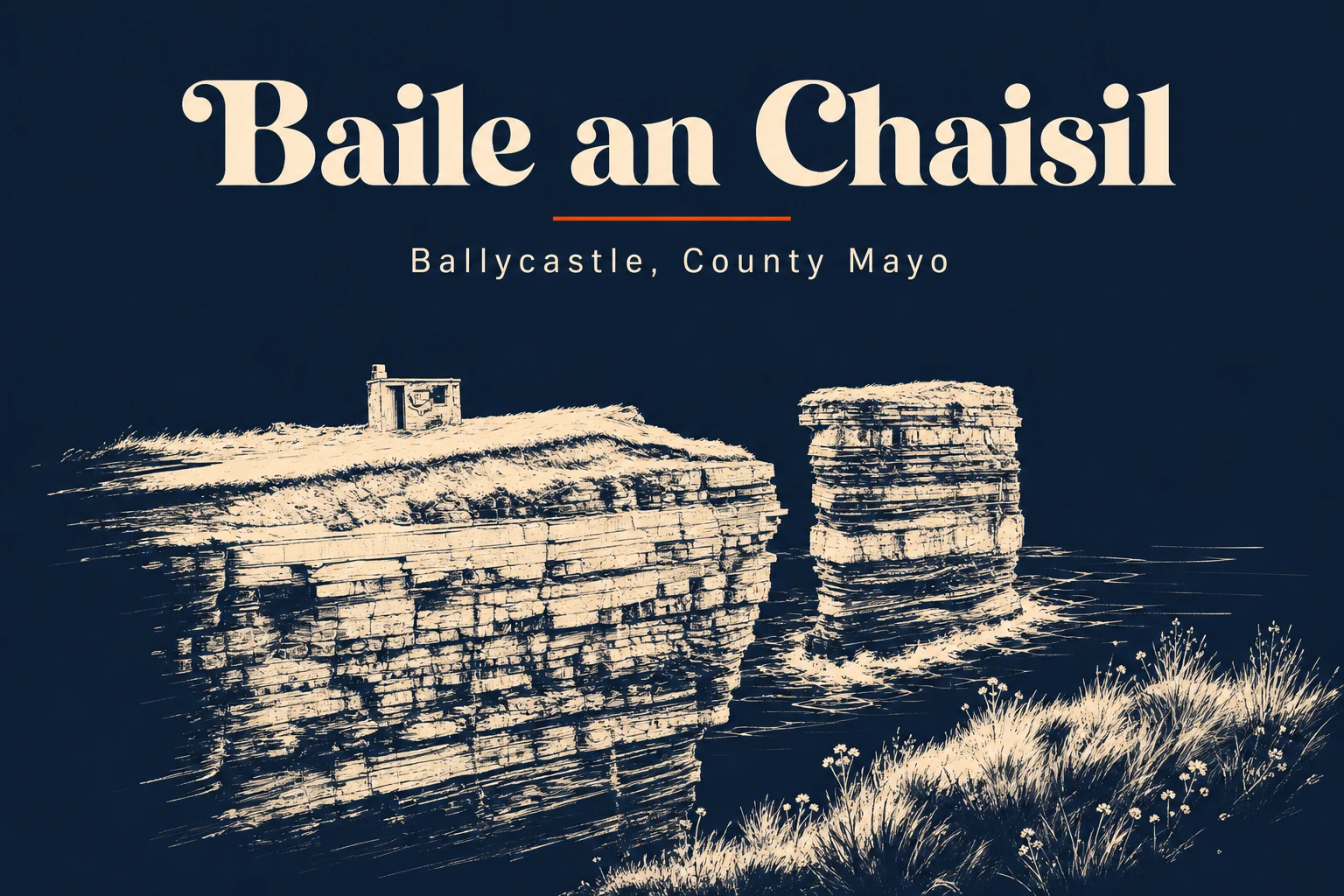
Downpatrick Head was once continuous cliff. In 1393 — the year is recorded — a storm or coastal collapse separated a section of the headland and left Dún Briste standing alone: a sea stack 45 metres high and 80 metres offshore. The people who had built a church on what became the stack had no way back. The foundations are still up there, visible from the clifftop on a clear day. The blowhole beside the main headland is a later detail — the sea working on the rock from below, building pressure, firing up through a shaft in the cliff. On a heavy swell, you hear it before you see it.
Turas at the cliff edge
St. Patrick's Well
At Downpatrick Head, tradition has it that Patrick himself stood here, and a holy well bears his name. The turas — the station walk — involves circuits of the well and the cross, on bare feet if the old practice is followed. The head is named for Patrick; the connection is old enough that nobody now can date it. Whether or not you're making the rounds, the walk to the well is a flat twenty minutes from the car park and the cliff view on the way back makes it worth doing regardless.
Why there are international artists in north Mayo
Ballinglen
In 1992, two American artists — James and Marie-Louise Boyle — established a residency programme in Ballycastle on the theory that north Mayo's landscape, its light, its particular quality of emptiness, was worth bringing artists to. The foundation has since hosted hundreds of residencies and built a permanent collection of over 550 works. The gallery on the main street is free to enter. It's the kind of thing that shouldn't survive out here, and it's been running for thirty years.