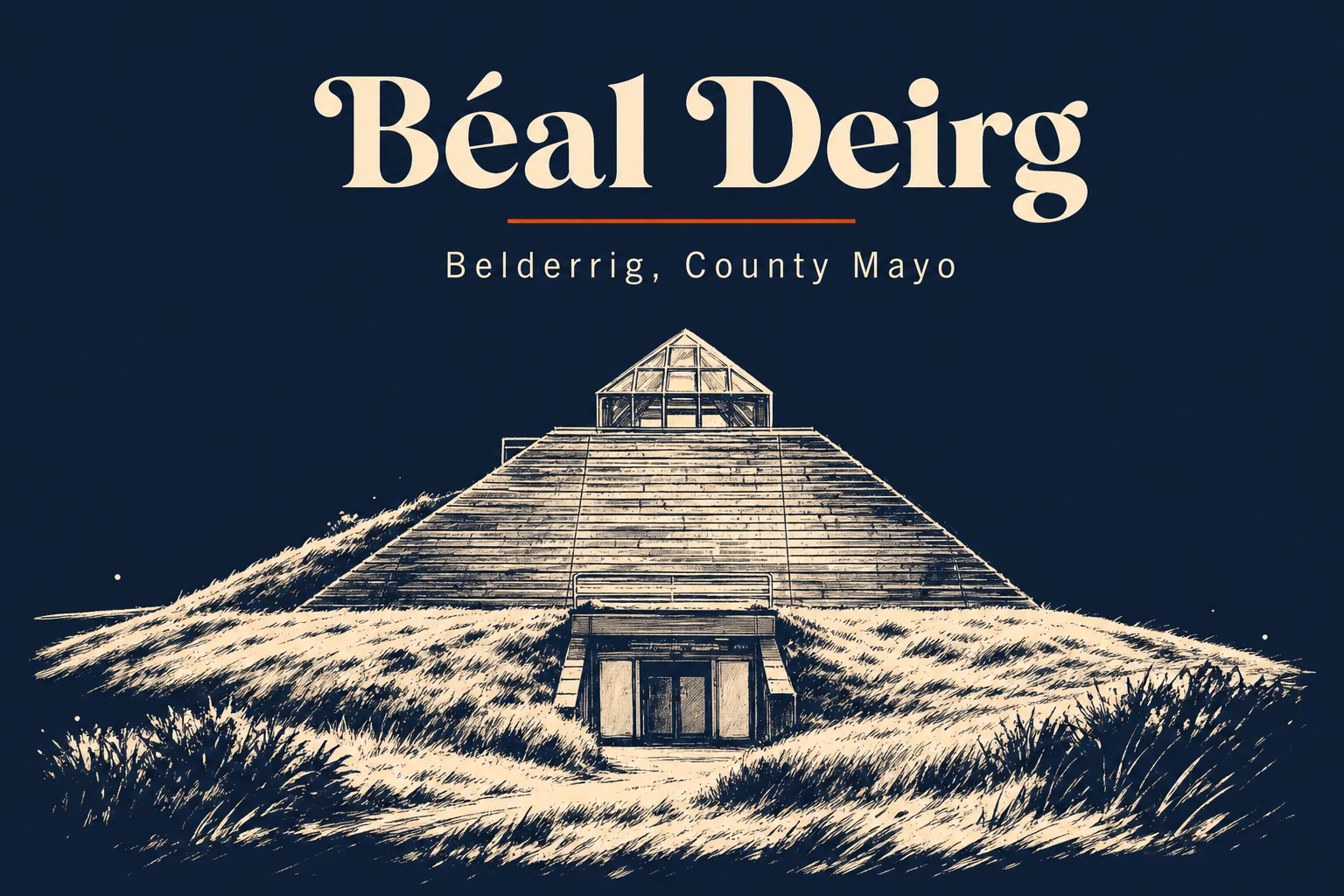
Béal Deirg · Co. Mayo
A pier, a handful of houses, and five-thousand-year-old field walls in the cliff face.
Belderrig is a small coastal valley on the north Mayo coast between Ballycastle and Glenamoy. A river comes down from the bog, crosses a flat bit of ground, and goes into the sea at a small harbour. The village is a handful of houses and a pier. There is no pub here, no shop, no hotel, no restaurant. The Wild Atlantic Way passes through because the landscape earned it.
What makes Belderrig extraordinary is invisible from the road. The sea cliffs to either side of the harbour have been cut through centuries of coastal erosion, and what the erosion has exposed - in the cliff face itself - are the stone walls of a Neolithic field system. Five thousand years old, give or take. A farming community worked this coastal plateau in 3,500 BC, built their walls and their houses and their tombs, and then the bog grew over everything and preserved it. Céide Fields, twelve kilometres east, is the famous site. Belderrig is where the same landscape reads differently - where the cliff has done the archaeology for you, and the walls are just there, in the rock face, at the edge of the Atlantic.
The valley also has fulachta fiadh - Bronze Age cooking pits, the kind found across Ireland, where heated stones were dropped into water-filled troughs to cook meat. Several have been identified along the valley floor. They are not signposted, and finding them requires some knowledge of what a slight depression in bog ground means. That's fine. The point of Belderrig is that it rewards people who pay attention. It does nothing for people looking for facilities.
Patrick Caulfield - the schoolteacher who first noticed the stone walls at Belderrig in 1934 while cutting turf - grew up in this landscape. His son Seamus became the archaeologist who proved what the walls were. The Nobel Prize-winning poet Seamus Heaney came to visit Patrick Caulfield in 1974, and pinned a poem called 'Belderg' to the old man's door when he left. The poem is about what it means to find the first ploughed field. The valley that inspired it still looks much as it did.