County Mayo Ireland · Co. Mayo · Glenamoy Save · Share
POSTED FROM
GLENAMOY
CO. MAYO · IE

Glenamoy
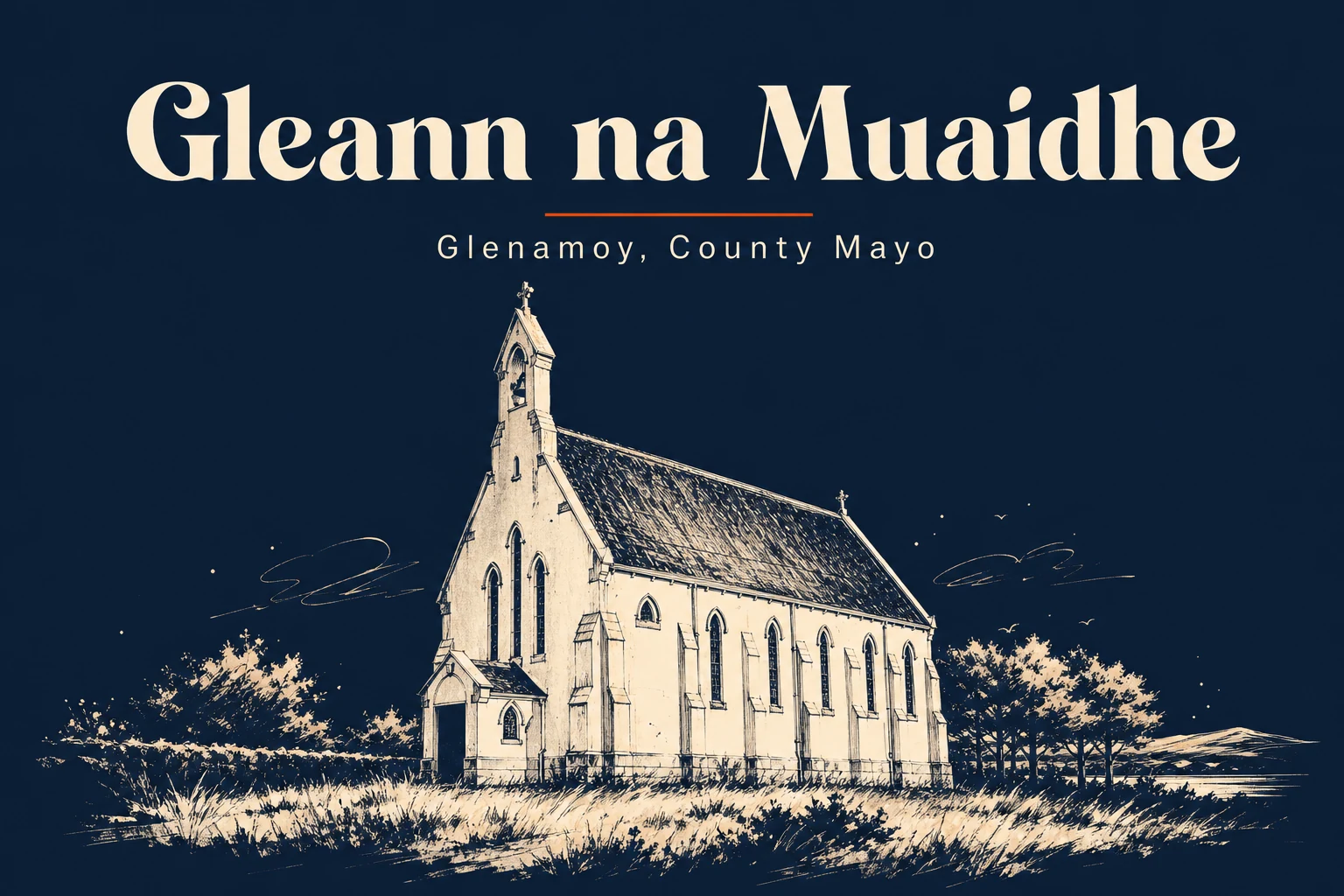
Gleann na Muaidhe

The Wild Atlantic Way
STOP 04 / 04
Gleann na Muaidhe · Co. Mayo

A crossroads where the Glenamoy River meets the bay, and the bog goes on forever.

Glenamoy is not a town. It is a crossroads on the R314 in the middle of Erris — a handful of houses, a pub or two, and a landscape that has no edge. The river estuary meets Sruwaddacon Bay to the north; the blanket bog stretches east and south without particular boundary. On a clear day you can see the outline of the Mullet Peninsula to the west. On most days the weather makes that decision for you.

The townland sits in the heart of the Céide Fields region of the Northwest Irish Biosphere Reserve — bogland that was mapped archaeologically through bog archaeology and pollen cores before much of it even had a road. The bog here is not decorative; it is the actual landscape, the actual economy for millennia, the actual reason people stay or leave. The Glenamoy River drops down to an estuary that has no settlement, no amenity, and no particular destination except the bay itself.

The Wild Atlantic Way runs through here on the R314, but Glenamoy is not a stop the road marketing would pick. There is no viewpoint, no heritage centre, no café with Atlantic views. What there is: bog, river, wind, silence, and the kind of light that arrives for about six weeks in early summer. Belmullet is fifteen kilometres west. Bangor Erris is ten kilometres east. Glenamoy is where you are when you choose to be in the middle of both.
Coords
54.2542° N, 9.9381° W
01 / 04

Stories & lore.

The reason to come back. The things every local will eventually tell you about, usually after the second pint.

Where the bog meets the bay

The Glenamoy River estuary

The Glenamoy River flows north from high bog ground and drops to an estuary at Sruwaddacon Bay with no road reaching it, no settlement at the mouth, and no history of navigation beyond what a small boat could manage in daylight. The estuary is a landscape of mud flats, salt marsh, and the kind of emptiness that defines the western Erris coast. The river itself is a brown peaty stream for most of its length, clear in spate.

Ancient landscape under peat

Céide Fields and the bog

The Céide Fields region — of which Glenamoy is part — is a UNESCO Biosphere Reserve containing some of Europe's oldest known field systems. Neolithic and Bronze Age farmers cleared and farmed the landscape five to six thousand years ago. Then the bog grew over it, preserving the field walls and settlements in peat. The bog archaeology here rewrote what was known about early Irish farming. Most of it is not visible above ground — the bog is the museum.

The bog road west

The R314 Atlantic Drive

The R314 runs from Crossmolina through Glenamoy to Belmullet — a narrow road across open bog with Croagh Patrick visible from the higher sections and the Atlantic always somewhere in the calculation. It was not a major route until tourism marketing named it the Atlantic Drive. It is still what it was: a quiet road through a landscape that the road does not change.

02 / 04

When to go.

There is no bad time. There are different times.

Spring
Mar–May

The bog is waking. Light extends. Before the midges. Before the summer crowds on the Atlantic Way.

◉ Go
Summer
Jun–Aug

Long daylight but the bog is wet and midges are numerous. Mist can close the view quickly. Belmullet and Bangor Erris are busier.

◐ Mind yourself
Autumn
Sep–Oct

Clear skies return. The bog drains slightly. The emptiness has weight without being bleak.

◉ Go
Winter
Nov–Feb

The bog is waterlogged. The wind is serious. The light is short. This is not a season to discover the place; it is a season to be here for a reason.

◐ Mind yourself
03 / 04

What to skip.

Honestly? Don't bother.

If a local was sitting beside you, this is the bit where they'd lean in.

×
Expecting a village

Glenamoy is a crossroads. There is no hotel, no restaurant, no visitor infrastructure. The nearest town is Belmullet, fifteen kilometres west.

×
Driving the R314 too fast to notice it

The bog landscape is subtle. The road is narrow. The corners are real. The speed should match what you are looking at.

×
Coming in July without bog insect repellent

The midges in blanket bog country are not a minor irritation. Bring repellent or stay in the car.

+

Getting there.

By car

Glenamoy is on the R314 between Crossmolina and Belmullet. From Castlebar, take the R310 north to Crossmolina (45 km, about 45 minutes), then the R314 west through Glenamoy to Belmullet (25 km, roughly 30 minutes). From Westport, the quickest route is south and around — not a fast drive.

By bus

No direct service. Bus Éireann 446 runs Ballina–Belmullet, passing near Glenamoy. Frequency is very low and seasonal. Check current schedules.

By train

No train. Nearest stations: Ballina (65 km, about 1h 15m) or Castlebar (50 km, about 1 hour).

By air

Ireland West Airport (NOC) at Knock is 100 km by road — roughly 1h 20m. Dublin is 4.5 hours.