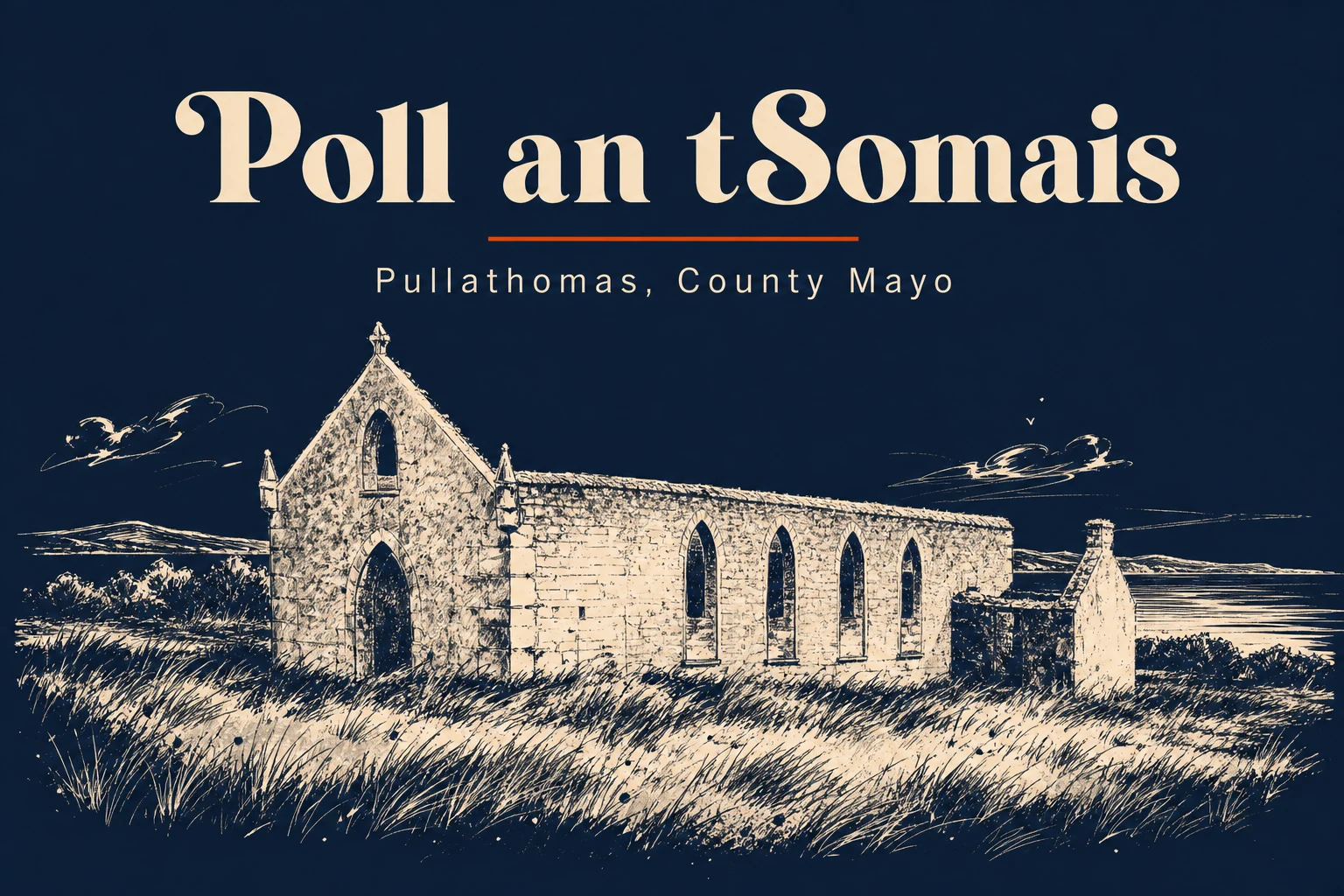
Poll an tSomais · Co. Mayo
A Gaeltacht townland on Sruwaddacon Bay whose name means hollow of comfort. A stone circle, a saint's grave, and the scar of a landslide that swept graves into the sea.
Pullathomas is a small Gaeltacht village in the Erris barony of northwest Mayo, strung along the shore where Sruwaddacon Bay narrows toward the mouth of Broadhaven. The Irish name, Poll an tSomais, is usually given as the hollow of comfort - a kind description of a townland that sits low and sheltered under the bog hills, with the tide coming and going across the inlet and Rossport on the far shore. Around a hundred people live here. It is small, Irish-speaking in part, and built for living in rather than visiting.
There is no pub and no shop in the village itself. The town of Belmullet, with its shops, pubs and services, is the place you go for anything you cannot carry in. What Pullathomas has instead is older and quieter: a saint's burial ground above the bay, a Bronze Age stone circle up at Dooncarton with a view over Broadhaven, and a waymarked loop walk that takes you up and around in an easy hour. That, and the hostel by the sea, is the whole of it - and on this coast that is plenty.
The bay and the bog are the real subject here. The light works hard, the weather changes its mind, and the road runs through quiet country between Belmullet and Bangor Erris. Come for the walk, the graveyard, the stones and the silence. Do not come expecting amenities. This is a place you slow down for, not one that performs for you.