County Mayo Ireland · Co. Mayo · Bunacurry Save · Share
POSTED FROM
BUNACURRY
CO. MAYO · IE

Bunacurry
Bun an Churraigh

The Wild Atlantic Way
STOP 05 / 05
Bun an Churraigh · Co. Mayo

The crossroads the island forgets about — until you find the friary.

Bunacurry is not the postcard Achill. The postcard Achill is Keem Bay, twenty minutes further west on the R319, with the turquoise water and the cliffs and the queue of people with cameras. Bunacurry is the island's interior — bog, road, a few houses, a church, a business park, and the ruins of a Franciscan monastery sitting just off the road as if they landed there and couldn't be moved. Which, in a way, is exactly what happened.

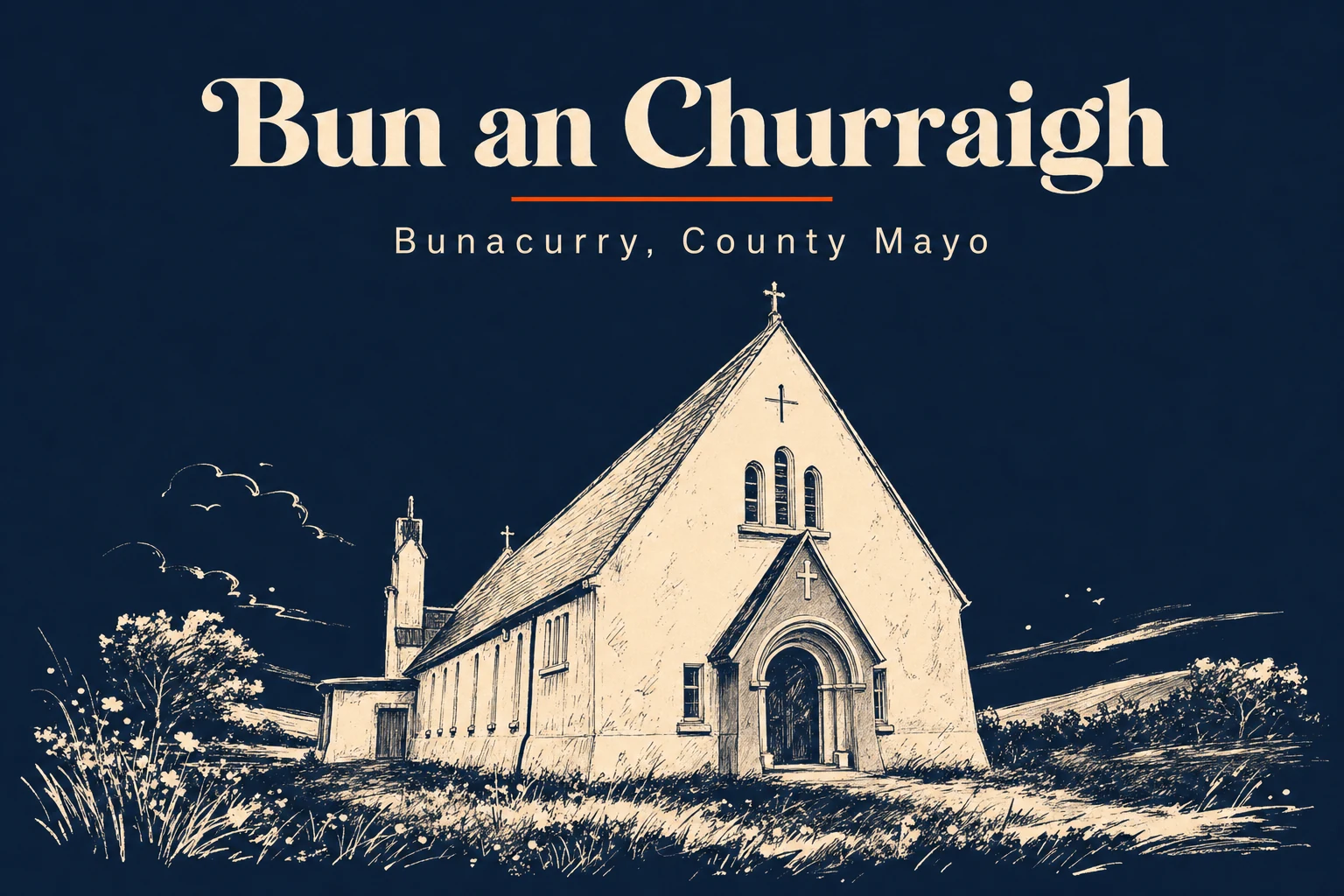
The monastery was put up between 1852 and 1854 on the instruction of Archbishop McHale of Tuam, a direct counter to Edward Nangle's Protestant mission colony at Dugort to the north. The building didn't go up quietly. Colonists demolished the walls during construction and removed the stones. The monks and the local workers rebuilt. By 1854 the monastery was done, and it ran as a boys' school — Irish and Latin, taught by Franciscan brothers — for over a century, closing in 1971. The ruins have the U-shaped footprint of a serious institution. Five bays, a north tower, crow-stepped parapets. It's more building than you expect to find this far up the bog.

The other thing worth knowing: Bunacurry is Gaeltacht. Or was. It's officially Irish-speaking territory and the road signs say so, though you'll use English for everything unless you make the effort. The McKay family's distillery in the old Údarás na Gaeltachta site is genuinely Irish-owned, genuinely island-made, and genuinely the only one in the country operating on an island. The guided tours are two hours, the Classic Blend is good, and the whiskey actually benefits from the Atlantic air doing its thing to the barrels.
Walk score
Village in five minutes, friary ruins in ten
Founded
Franciscan monastery built 1852–1854
Coords
53.9500° N, 10.0200° W
01 / 05

At a glance.

Three things every local will eventually mention. Read these and you've already understood more than most day-trippers do.

02 / 05

Stories & lore.

The reason to come back. The things every local will eventually tell you about, usually after the second pint.

Building the friary, 1852

The Battle of the Stones

Archbishop John McHale of Tuam sent five Franciscan brothers to Achill in 1852 with a specific brief: build a Catholic monastery and school to counter the Protestant mission colony Edward Nangle had been running at Dugort since 1831. Ground was broken near Bunacurry and construction started. Nangle's colonists — who had already established schools, a printing press, and a hospital, and who understood exactly what a Catholic institution on the island meant — demolished the partially completed walls one night and carried the stones back toward Dugort. The monks' workers retrieved them. The building went back up. It was finished in 1854 and ran as a boys' school until 1971. The ruins still carry the determination of the rebuild — five bays, a three-stage north tower, crow-stepped parapets — and they're free to walk through.

Thirty-two Achill workers drowned

The 1894 Clew Bay Disaster

On the 14th of June 1894, a boat carrying seasonal migrant workers — young men from Achill heading to Scotland for the potato harvest — capsized crossing Clew Bay toward Westport. Thirty-two people drowned. Almost all were from the same townlands in the west of the island. The communities they left had already been gutted by emigration and famine; this removed another generation in an afternoon. The local folklore holds that the disaster was foreseen. The historian Seosamh Mac Giolla Chríost recorded accounts of a 'death coach' passing through the island villages in the days before departure. Whether or not the vision was real, the grief was: the whole west of Achill was in mourning by nightfall on the 14th. Memorials to the dead are scattered across the island.

Irish American Whiskies, 2015–present

The island distillery

John McKay started Irish American Whiskies in 2015 with a simple observation: Ireland had no island whiskey distillery. Achill, with its Atlantic microclimate, its isolation, and its Gaeltacht designation, made a reasonable argument for why that should change. His sons Sean and Michael took over the operation after John died. They started distilling in July 2019 using copper pot stills in a purpose-built facility in Bunacurry's old Údarás na Gaeltachta business park. The Ten-Year-Old Single Malt is aged in barrels that breathe sea air for their full maturation — the maritime cask effect is real and measurable in the spirit. Tours run most days in season. The Barley Field Bar does cocktails. The Mayo Mojito sounds gimmicky and isn't.

03 / 05

When to go.

There is no bad time. There are different times.

Spring
Mar–May

Quiet, the bog going green, the road clear. Distillery tours without the queue. Friary to yourself.

◉ Go
Summer
Jun–Aug

The R319 carries every car heading for Keem through Bunacurry. The village itself is calmer than the road suggests. Book distillery tours ahead.

◐ Mind yourself
Autumn
Sep–Oct

The island empties and the bog turns. Best light for the friary ruins. Distillery is still open through October.

◉ Go
Winter
Nov–Feb

The distillery trims hours in winter — check before you drive out. The friary is open-air and has no off-season; it's just wetter.

◐ Mind yourself
04 / 05

What to skip.

Honestly? Don't bother.

If a local was sitting beside you, this is the bit where they'd lean in.

×
Treating Bunacurry as the Achill experience

Keem Bay, Slievemore, Croaghaun — the things people come to Achill for — are all west of here. Bunacurry is inland. The friary and the distillery are the genuine draws; the scenery is elsewhere.

×
Driving past the friary without stopping

The ruins sit just off the R319 and look, from the road, like they might not be worth the pause. They are. The 'Battle of the Stones' story alone makes it worth five minutes out of the car.

+

Getting there.

By car

From Achill Sound, take the R319 west for about 15 minutes. From Keel, head east on the same road — around 10 minutes. From Westport, allow an hour: N59 to Achill Sound via Newport and Mulranny, then the R319 west across the island.

By bus

Bus Éireann route 450 connects Westport to Achill Sound and continues across the island through Bunacurry toward Keel and Dooagh. Daily services, with more in summer.

By train

Nearest station is Westport (Dublin Heuston, 3h 15m). Bus or hire car for the final leg to Achill.

By air

Ireland West Airport (NOC) at Knock is about 1h 30m by car. Shannon (SNN) is 2h 45m.