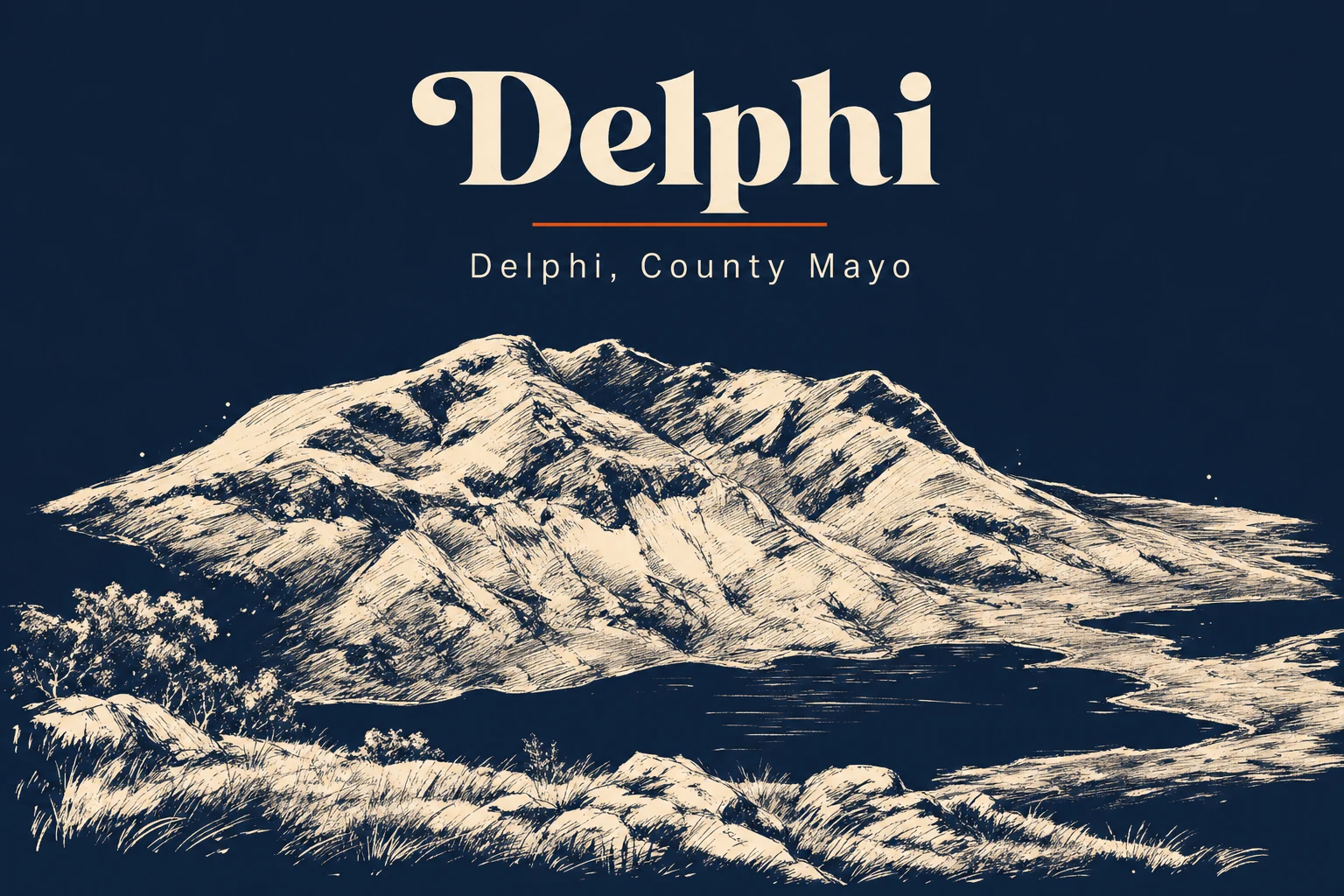
Delphi · Co. Mayo
It's not a village. It's a glacial valley with a history that doesn't let go.
Delphi is not a village. There's no shop, no pub, no post office. It's a deep glacial valley on the Mayo-Galway border, pinched between the Sheeffry Hills and the Partry Mountains, with a private estate, a river system, an adventure resort, and a road that runs through it carrying something heavier than traffic.
The name came from the second Marquess of Sligo, Howe Peter Browne, who visited the Greek Delphi in the early 1820s and decided his Mayo valley had the same quality of drama. He named his fishing lodge Delphi. Whether he was right about the comparison is a matter of taste. The valley is genuine; the name is an aristocrat's flourish.
What the Marquess's descendants prefer not to dwell on: in March 1847, at the height of An Gorta Mór, a crowd of several hundred starving people walked from Louisburgh to Delphi Lodge to put their case to the relief committee meeting there. They were kept waiting in a blizzard, then turned away with nothing. On the walk back along Doolough - the dark lake in the valley - some of them died in the cold. The exact number is disputed; contemporary accounts put it at dozens, later tellings say more. What's not disputed is what happened: people walked a long way for help, were refused, and some of them died on the road home.
Today the valley holds two very different operations. Delphi Lodge is high-end country-house fishing - private beats on the Finloughy, a walled garden, a dining room that seats guests together at one long table. Delphi Adventure Resort, a separate facility a kilometre up the road, does surfing, zip-lines, kayaking, and bunk accommodation. Both are real; neither pretends the other doesn't exist. The annual Famine Walk traces the route from Louisburgh to Doolough every May - a memorial march, not a heritage experience.