County Monaghan Ireland · Co. Monaghan · Annyalla Save · Share
POSTED FROM
ANNYALLA
CO. MONAGHAN · IE

Annyalla
Eanaigh Gheala, Co. Monaghan

The Ireland's Ancient East
STOP 06 / 06
Eanaigh Gheala · Co. Monaghan

Bright marshes on the old Derry road, a William Scott church, and the field where Monaghan football trains.

Annyalla (Irish: Eanaigh Gheala, "bright marshes") is a small village in east Monaghan, strung along the old main road between Castleblayney and Clontibret. It sits in the civil parish of Clontibret and the old barony of Cremorne, in the drumlin country that defines this corner of Ulster - a landscape of small rounded hills, wet hollows and field after field of hedged grassland.

Until 2007 the N2 Dublin-to-Derry road ran straight through. Then the bypass took the traffic away, which is the best and worst thing that ever happened to a village like this: the through-traffic and the noise went, and so did the reason most people had to stop. Annyalla was named a census town for the first time only in 2016, with 228 people. By 2022 it was 205, which makes it one of the smallest census towns in the country.

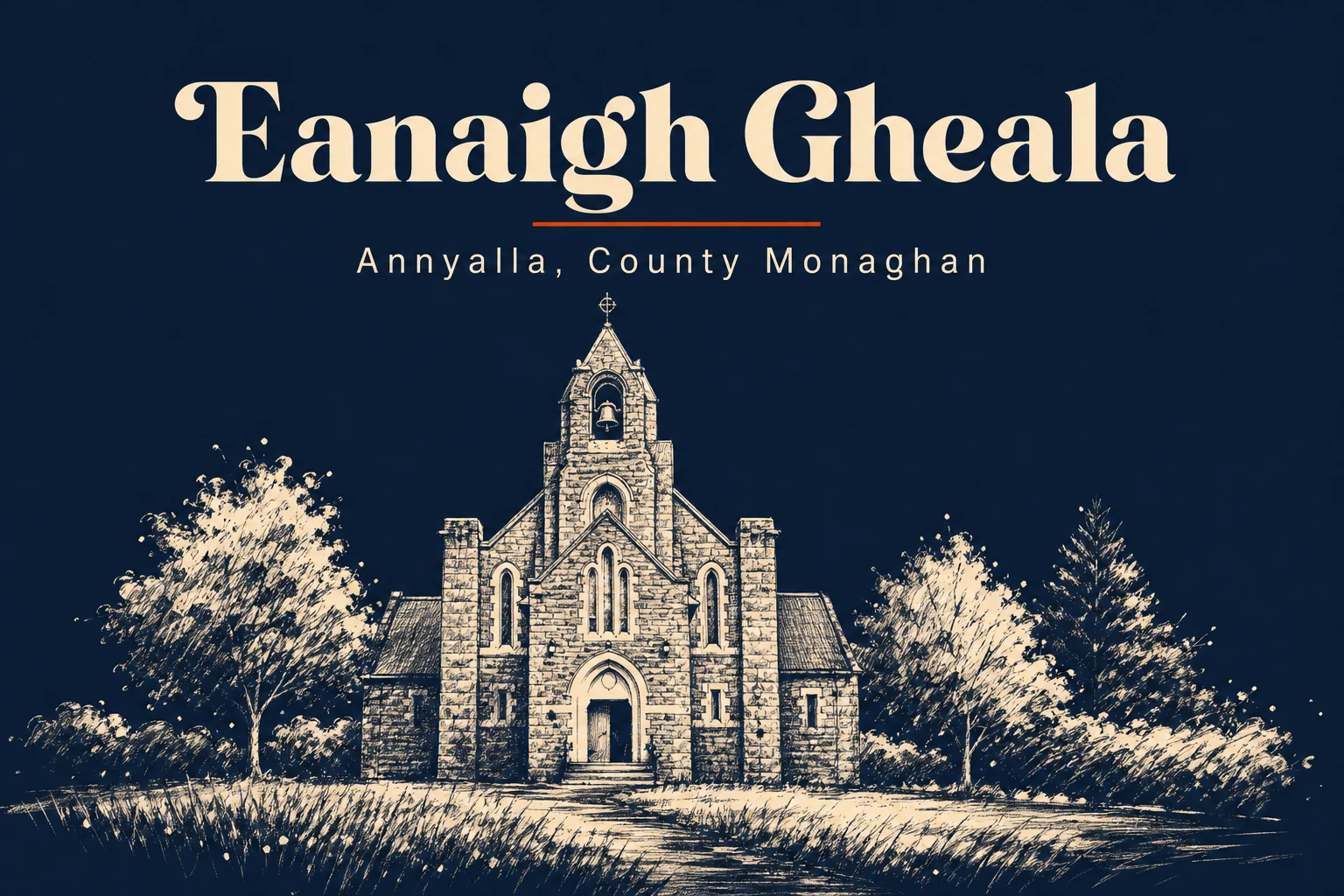
The thing that stands over the place is St Michael's Church, built in the early 1920s to a design by William A. Scott - the same architect who did the basilica out on Lough Derg - and finished under the supervision of R.M. Butler of UCD. It is a serious building for so small a parish: cruciform, Early English Gothic, a three-stage belfry, all in honest north-Monaghan limestone. Around it lie the bones of an older graveyard and an earlier chapel from about 1800; a newer cemetery opened in 1963.

Don't come to Annyalla expecting a day out. Come if you are tracing the parish, calling at the GAA centre at Cloghan, or simply driving the quiet roads off the N2 and want to know what you are looking at. The church and the drumlins are the whole of it, and on a clear evening that is enough.

Population
205 (2022 census)
Founded
Medieval parish; census town since 2016
01 / 06

At a glance.

Three things every local will eventually mention. Read these and you've already understood more than most day-trippers do.

02 / 06

Stories & lore.

The reason to come back. The things every local will eventually tell you about, usually after the second pint.

William A. Scott, early 1920s

St Michael's Church

St Michael's was built in the early 1920s to a design by William A. Scott, one of the more interesting Irish architects of his generation and the man who designed St Patrick's Basilica on Lough Derg. Work was completed under the supervision of R.M. Butler of University College Dublin. It is a freestanding cruciform church in the Early English Gothic style - a six-bay nave with transepts north and south, a two-bay chancel to the east, and a three-stage belfry at the centre. The walls are snecked rock-faced limestone with rusticated quoins; inside there are limestone pillars, pointed arches, an open timber-truss ceiling, a gallery and stained glass. The national survey calls the belfry, the buttresses and the masonry the work of skilled craftsmen, and it is right. For a parish of a couple of hundred souls it is a remarkably ambitious piece of building.

A site used since around 1800

The older church and graveyard

The church does not stand on new ground. The site contains the remnants of an earlier graveyard and an earlier Catholic chapel dating to around 1800, the older cemetery wrapped around where the previous church stood. A newer cemetery opened on the site in 1963. Worship has gone on in this one spot for well over two centuries, which is the real continuity here - the present church is just the third act.

County training base, opened 2008

Monaghan's Centre of Excellence at Cloghan

In the townland of Cloghan, just off the N2 between Castleblayney and Clontibret, sits the Monaghan GAA Centre of Excellence - the county board's training and development base. It opened in 2008 with five floodlit pitches, was extended in 2013 with more dressing rooms, meeting rooms and offices, and carries the Entekra naming rights. Every code uses it: men's and ladies' football, hurling, camogie, rounders. It is not a tourist site, but it is the engine room of Monaghan football, and for a small Ulster county that has spent the last decade competing well above its size, that is no small thing.

War of Independence

The ambush of May 1921

This was active ground during the War of Independence. The local IRA company belonged to the 2nd Monaghan Brigade of the 5th Northern Division. On 25 May 1921 a member of the Black and Tans was wounded in an ambush near here in which the unit seized a number of weapons. The border country of south Monaghan saw a good deal of this in 1920 and 1921 - quiet drumlin lanes that were anything but quiet at the time.

Ringforts, lime kilns, a megalith

Older still

People were here long before the parish. The townlands of Annyalla and Cloghan hold the remains of ringforts, lime kilns and at least one megalithic monument - the usual quiet archaeology of the Monaghan drumlins, mostly grass-covered banks and lumps in fields that you would walk past without a second look. Nothing is signposted or set up for visitors, but it is there in the landscape if you know to read it.

03 / 06

Things to do outside.

Wear waterproofs. Bring a sandwich. Tell someone where you're going if it's the mountain.

The parish loop A quiet road loop taking in St Michael's, its graveyards and the surrounding drumlins. No waymarking, no facilities - just hedged lanes and field views. Walk it for the church and the shape of the land, not for a destination.
4-5 kmdistance
1-1.5 hourstime
The old N2 stretch toward Clontibret Since the 2007 bypass the old main road is far quieter than it once was. You can follow it northwest toward Clontibret on foot. Mind the traffic where it still carries some, and turn back at your own discretion - there is no formal trail.
3 km one waydistance
45 mintime
04 / 06

When to go.

There is no bad time. There are different times.

Spring
Mar-May

The drumlins green up and the lanes dry out. The best light of the year on the church limestone.

◉ Go
Summer
Jun-Aug

Long settled evenings and the GAA centre at Cloghan in full use. The most comfortable time to wander the back roads.

◉ Go
Autumn
Sep-Oct

Low light and a particular quality on the hedgerows. The football season is in its stride at Cloghan.

◉ Go
Winter
Nov-Feb

Short grey days and wet, muddy lanes. The drumlin country can be bleak. Bring boots and low expectations.

◐ Mind yourself
05 / 06

What to skip.

Honestly? Don't bother.

If a local was sitting beside you, this is the bit where they'd lean in.

×
A day out

Annyalla is a parish, not a destination. There is a fine church, a county GAA base and a lot of quiet road. If you arrive expecting cafes, shops or a pub crawl you will be disappointed - there is none of that. Treat it as a half-hour stop, or a piece of a longer drive through east Monaghan, and it gives you exactly what it has.

×
The GAA centre as a visitor attraction

The Centre of Excellence at Cloghan is a working training base, not a museum or a tour. You can see it from the road and understand what it is, but it is not set up to receive sightseers. Respect that it is somebody's workplace and the county team's ground.

+

Getting there.

By car

Annyalla sits just off the N2 between Castleblayney (about 15 minutes south) and Clontibret. Monaghan town is roughly 30 minutes northwest. The N2 bypassed the village in 2007, so you turn off the main road to reach it. Dublin is about 1h 40m down the N2/M2.

By bus

No direct village service. The nearest options are Bus Eireann and Local Link services on the Castleblayney and Monaghan corridor along the N2; you would need a car or lift to cover the last stretch into the village.