County Monaghan Ireland · Co. Monaghan · Scotshouse Save · Share
POSTED FROM
SCOTSHOUSE
CO. MONAGHAN · IE

Scotshouse
Teach an Scotaigh, Co. Monaghan

The Ireland's Ancient East
STOP 07 / 07
Teach an Scotaigh · Co. Monaghan

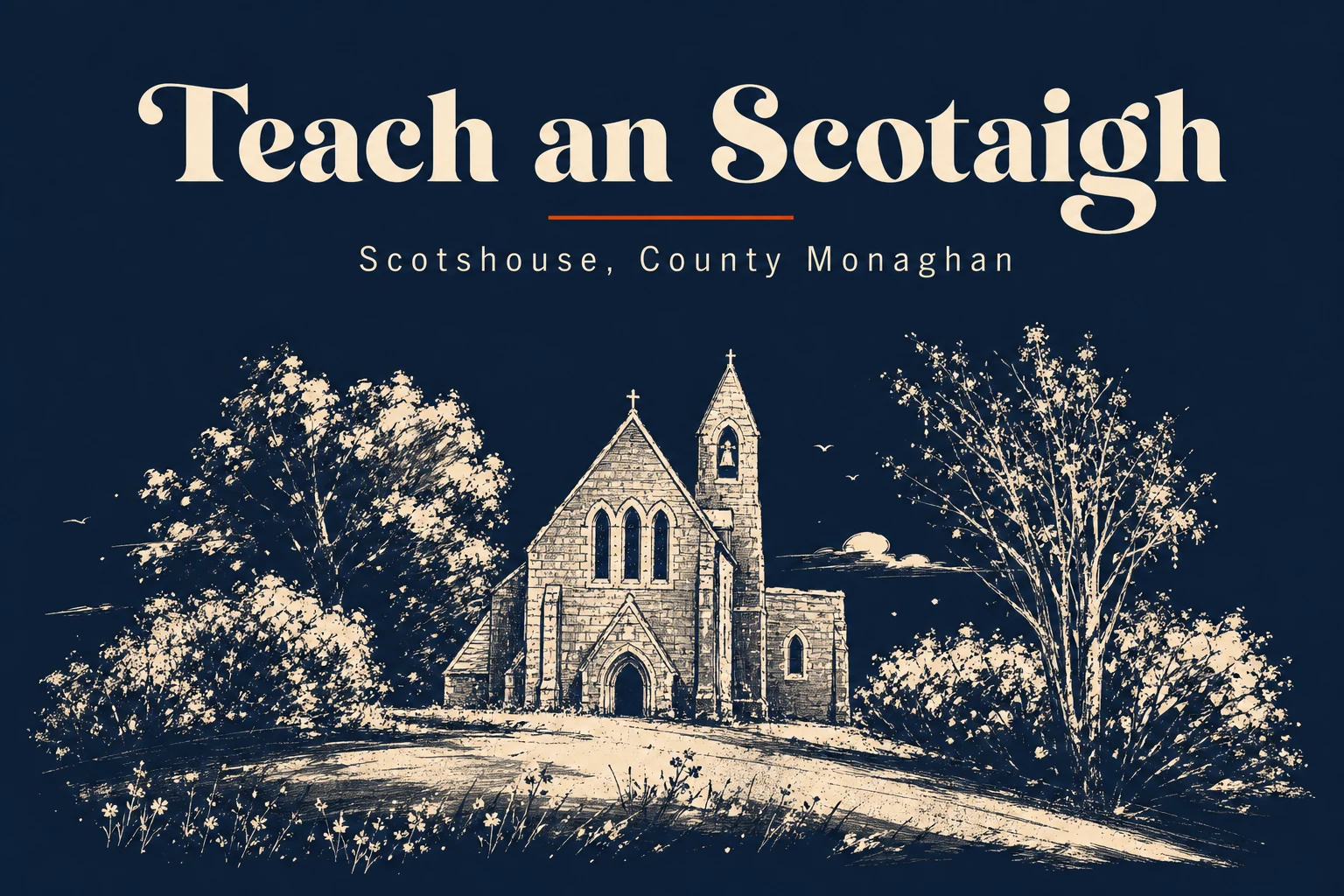
House of the Scot. A drumlin crossroads three miles from where three counties meet, with a Titanic name on the church wall and a great house down the road.

Scotshouse is small - around 220 people at the last count - and honest about it. A crossroads, two churches, a community centre, a GAA pitch, and drumlin farmland rolling away in every direction. It sits in the old parish of Currin in the far south-west of Monaghan, three miles east of the point where Cavan, Fermanagh and Monaghan all touch. The English name comes from a Cromwellian soldier called Scott who took land here in the 1650s and stayed; the Irish, Teach an Scotaigh, says the same thing.

The thing worth stopping for is the church wall. St Andrew's, the Church of Ireland church on the rise (it turned two hundred in 2010), carries a memorial plaque to Ernest Waldron King, a young assistant purser with the White Star Line who went down with the Titanic in 1912. There is a stained-glass window for the men of the parish killed in the First World War beside it. Two small village memorials to the two great catastrophes of the early twentieth century, a few feet apart, in a place most maps skip.

Down the Clones road is Hilton Park, the Madden family's place since 1734 - a Hague mansion of the 1870s on a 600-acre demesne, with a nine-hole golf course in the parkland and rooms for the night. For a few years in the late 2000s it hosted the Flat Lake Literary and Arts Festival, run by the author Pat McCabe (a Clones man) and the film-maker Keith Allen, a gloriously shambolic gathering that ran its last in 2014. The estate is still here; the festival is a memory.

Don't come expecting a destination. Come for the quiet - the Comber where the Finn and the wee river meet, Carnroe hill with its long view over the Erne valley, Lisabuck lake with its ringfort - and use Clones or Hilton Park as the base. This is a place you pass through slowly, not one you arrive at.
Population
~220 (2016)
Founded
Plantation settlement, mid-17th century
Coords
54.1219° N, 7.2489° W
01 / 07

At a glance.

Three things every local will eventually mention. Read these and you've already understood more than most day-trippers do.

02 / 07

Where to sleep.

PlaceTypeLocal note
Hilton Park Country house guesthouse, Clones road The proper bed in the area. A William Hague mansion of the 1870s on the Madden family's 600-acre demesne, individually decorated en-suite rooms with antique baths and estate views, plus a self-catering gate lodge. Country-house cooking, a nine-hole golf course in the parkland, restored gardens. Booked well ahead in summer. Easily reached from both Dublin and Belfast. The reason to stay near Scotshouse rather than press on to Clones.
03 / 07

Stories & lore.

The reason to come back. The things every local will eventually tell you about, usually after the second pint.

Ernest Waldron King, 1912

The Titanic purser

Ernest Waldron King, an assistant purser with the White Star Line, had family roots in Scotshouse. He died when the Titanic sank on 15 April 1912. A memorial plaque to him is set in the wall of St Andrew's Church of Ireland in the village - one of the countless small threads tying quiet Irish parishes to the disaster. Beside it is a stained-glass window remembering the local men killed in the First World War. Two memorials to the two great calamities of the age, in a church most travellers drive straight past.

Church of Ireland, c. 1810

St Andrew's, two hundred years

St Andrew's was built around 1810 and marked its bicentenary in 2010. It is a plain, dignified Clogher-diocese church - the building and its graveyard are both on the record of protected structures. The Roman Catholic church in the village, the Church of the Immaculate Conception, came later, a Romanesque gable-fronted building of 1924. The two share the same parish boundary, which is its own quiet story about how a border parish learned to hold two communities.

A seat since 1734

Hilton Park and the Maddens

The Madden family have held Hilton Park, on the Clones road just outside the village, since 1734. The house you see now is largely the work of the architect William Hague, who remodelled it in 1874-75 - reckoned one of his most important country-house commissions. The 600-acre demesne carries a nine-hole golf course (Clones Golf Club plays there) and restored gardens. The family have run it as a country house guesthouse for decades. For a handful of years it was also the unlikely home of the Flat Lake Festival.

Aghnahola, the field of the apples

Currin and the planter name

The village stands in the townland of Aghnahola - "the field of the apples" - in the civil parish of Currin, which straddles the Monaghan and Fermanagh line in the barony of Dartry. The English name Scotshouse records a Cromwellian-era settler, William Scott, who took land here around the middle of the 1600s. Linen and farming kept the parish going for the next two centuries. The drumlins did the rest - small fields, small hills, small roads, a landscape that hides its distances.

04 / 07

Things to do outside.

Wear waterproofs. Bring a sandwich. Tell someone where you're going if it's the mountain.

The Comber and Finn Bridge West out of the village on quiet lanes to the Comber, where the Finn River and the so-called wee river meet, and on to Finn Bridge - a crossing on the border itself. Flat, easy, properly quiet. The landscape pays no attention to the line on the map; the road does.
4 km returndistance
1-1.5 hourstime
Carnroe hill A short pull up to Carnroe for the long view over the Erne valley spilling away into Cavan and Fermanagh. On a clear day it is the best vantage in the parish. Lanes and farm tracks - boots, not trainers, after rain.
3-4 kmdistance
1 hourtime
Village and Lisabuck lake An easy potter around the immediate village and out toward Lisabuck lake and its ringfort. The drumlin country at its most domestic - hedged fields, a few houses, water in the low ground. Good for an hour when you don't want a project.
2-3 kmdistance
45 min - 1 hourtime
05 / 07

When to go.

There is no bad time. There are different times.

Spring
Mar-May

The drumlins green up and the lanes dry out. Hilton Park gardens are at their best from late spring. The quietest, cleanest light of the year over the Erne valley.

◉ Go
Summer
Jun-Aug

Long evenings for the Comber and Carnroe walks, settled enough weather, and Hilton Park open for the season. Book the house ahead at weekends.

◉ Go
Autumn
Sep-Oct

Low light over the lakes and a parkland full of colour at Hilton Park. A good month to have the lanes to yourself.

◉ Go
Winter
Nov-Feb

Short days and grey, wet roads. The drumlin lanes go to mud and the border crossings are bleak. The churches and the great house carry on; not much else does.

◐ Mind yourself
06 / 07

What to skip.

Honestly? Don't bother.

If a local was sitting beside you, this is the bit where they'd lean in.

×
Expecting a high street

Scotshouse is a crossroads village of a couple of hundred people, not a town. There is no row of shops, no string of pubs, no tourist office. If you want a meal out, a bank or a proper night's drinking, that is Clones, 7 km up the road. Scale your expectations to the place and it rewards you. Arrive expecting a destination and you will be back in the car in five minutes.

×
Chasing the Flat Lake Festival

The Flat Lake Literary and Arts Festival was a real and much-loved thing at Hilton Park in the late 2000s, run by Pat McCabe and Keith Allen - but it ran its last in 2014. Do not turn up in summer looking for it. The estate is open as a guesthouse; the festival is not coming back.

+

Getting there.

By car

Off the R212 / R183 web of roads between Clones and Cavan. Clones is 7 km (10 minutes), Cavan town 18 km, Monaghan town about 30 minutes. Dublin is roughly 2 hours via the N3/M3 to Cavan and across, Belfast about 1h 45m. The lanes around the village are narrow drumlin roads - take them slowly.

By bus

No scheduled bus serves the village directly. Bus Éireann and Ulsterbus services run through Clones (7 km), which is the nearest pickup point; Local Link Cavan Monaghan covers some of the rural routes by request. A car is effectively essential.