County Offaly Ireland · Co. Offaly · Bracknagh Save · Share
POSTED FROM
BRACKNAGH
CO. OFFALY · IE

Bracknagh
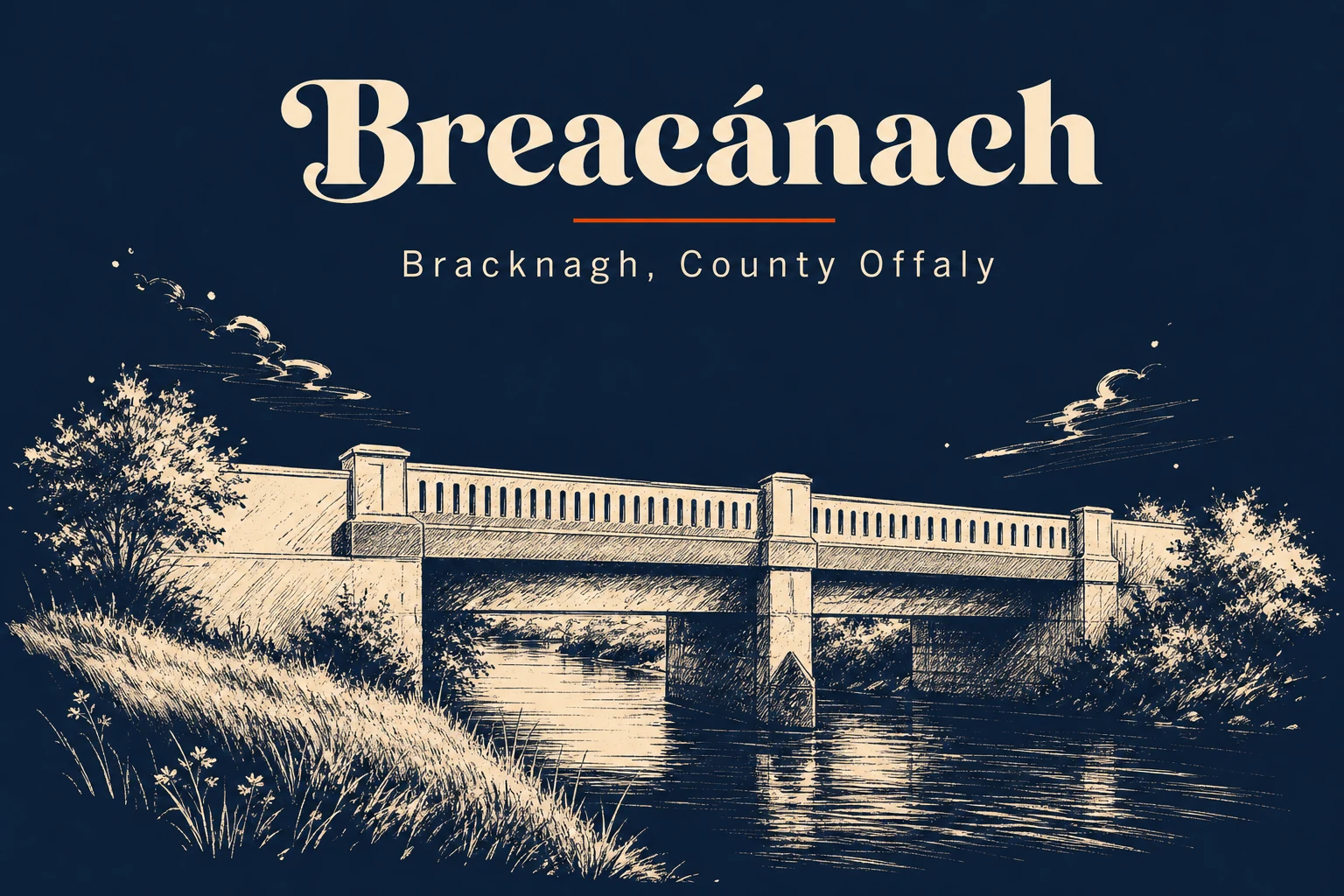
Breacánach, Co. Offaly

The Ireland's Ancient East
STOP 07 / 07
Breacánach · Co. Offaly

A bog-edge village on the Figile where a road junction, one pub, and a long memory of eviction are the whole of it.

Bracknagh sits in the flat east corner of Offaly, where the Figile River runs and the Bog of Allen presses in from three sides. It is a small village - 274 people at the 2022 census - built around the junction where the R442 and the R419 meet. Portarlington is eight kilometres south in Laois; Rathangan is eight kilometres east across the Kildare border. Bracknagh is halfway between them and on the way to neither.

The Irish is Breacánach, usually read as "speckled place", and the speckling is generally taken to mean the scattered, dispersed way the houses sat across the bog and farmland in the eighteenth and nineteenth centuries. The land here is bog, drained ground, and grass. This was King's County once, the parish of Clonsast, where Saint Broghan is said to have founded a monastery in the seventh century. The village now belongs to the parish of Clonbullogue.

There is one thing every visitor should know before they come, because it explains the quiet. In June 1851, in the last years of the Famine, the village was levelled. Charles Trench, agent for the second Baron Ashtown, brought in a team of wreckers and pulled the houses down; over 700 people were cleared off the land and scattered. The local rector at Hollywood House, John Plunket Joly, noted in his diary only that "most of the houses of Bracknagh were pulled down." No newspaper covered it. The village that stands today grew back on the same crossroads afterwards.

So this is not a touring stop. It is a working bog-country village with one pub, a church, a shop, a school and a strong GAA club. Come if you want to stand on a quiet junction in the middle of Ireland, walk out to a holy well, and understand that some of the emptiest-looking places carry the heaviest history.
Population
274 (2022)
Coords
53.2097° N, 7.0969° W
01 / 07

At a glance.

Three things every local will eventually mention. Read these and you've already understood more than most day-trippers do.

02 / 07

The pubs.

None of these are themed Irish pubs, because they don't need to be. A few that earn the trip:

Murphy's Bar

The one pub, and the heart of the place
Village pub, on the R419

On the R419 in the centre of the village, on the spot where the old forge once stood. It is the social anchor of Bracknagh - the place the GAA crowd ends up, the place a passing visitor gets a pint and the lie of the land. There is one pub in Bracknagh and this is it. Do not arrive expecting a choice.

03 / 07

Stories & lore.

The reason to come back. The things every local will eventually tell you about, usually after the second pint.

Clonsast, seventh century

Saint Broghan and the monastery

The townland of Clonsast, just outside the village, is held to be the site of a monastery founded by Saint Broghan in the seventh century. Little stands of it now, but the saint is still woven through the place: the Catholic church is St Broghan's, the national school is St Broghan's, and there is a holy well dedicated to him nearby that was long held to be a healing site. The dedication has outlasted almost everything physical that once went with it.

1643, on little Christmas Day

The burning at Ballynowlart

Ballynowlart church, in the area around Bracknagh, carries one of the grimmer pieces of local tradition. The story holds that in 1643, during the wars of that decade, a number of people were burned to death while attending Mass on little Christmas Day. The memory stayed local and specific: when remains were exhumed at the site in 1917, they were taken to be those of the people who died in the massacre. It is folk history rather than a tidy documented event, but it is held to here, and the name Ballynowlart still carries it.

June 1851

The levelling of Bracknagh

The single largest fact about Bracknagh is what was done to it. In June 1851 Charles Trench, acting as agent for the second Baron Ashtown, oversaw the clearance of the village - wreckers pulling down house after house, over 700 people put off the land and scattered through the country and beyond. The Famine-era eviction rates in King's County were among the worst in the country in 1849 to 1851, and this was one of the worst of them. Yet no paper reported it; the rector John Plunket Joly's one diary line is close to the whole written record. The village rebuilt around the same junction, which is why the place can feel both ordinary and haunted at once.

04 / 07

Things to do outside.

Wear waterproofs. Bring a sandwich. Tell someone where you're going if it's the mountain.

St Broghan's Well A holy well dedicated to Saint Broghan, long held locally to be a healing site, sits near the village in the old monastic townland of Clonsast. It is a modest spot rather than a managed visitor site - ask in the pub or the shop for the way, wear boots, and treat it as the quiet devotional place it still is for locals.
Short walk near the villagedistance
30 minutestime
The bog roads Bracknagh sits on the edge of the Bog of Allen with the Figile River running through. The local roads out across the drained bog and grassland are flat, empty and good for a slow walk or cycle - reedy ditches, big midland sky, almost no traffic. There is no waymarked trail; this is unscripted bog country, which is the point of it.
As far as you likedistance
Opentime
05 / 07

When to go.

There is no bad time. There are different times.

Spring
Mar-May

The bog greens up and the light over the flat country is at its best. Dry tracks for walking the bog roads and getting out to the well.

◉ Go
Summer
Jun-Aug

Long midland evenings and the GAA season in full swing - a club match is the busiest Bracknagh ever gets. The pub is your one indoor stop.

◉ Go
Autumn
Sep-Oct

Quiet, soft light, and the championship run-in for the GAA club. A fine time for the empty bog roads before the ground turns.

◉ Go
Winter
Nov-Feb

Short days and wet, heavy bog ground. The church, the school run and the pub keep the village going, but there is little for a visitor in the cold and the dark.

◐ Mind yourself
06 / 07

What to skip.

Honestly? Don't bother.

If a local was sitting beside you, this is the bit where they'd lean in.

×
Coming for a day out

Bracknagh is a small working village of fewer than 300 people, not a destination. There is one pub, a shop and a church. Come for the history and the quiet, or come on your way between Portarlington and Rathangan - do not build a day around it.

×
Expecting a tidy heritage site at Ballynowlart or the well

The 1643 burning and St Broghan's Well are local tradition kept alive by the community, not signposted attractions with car parks and panels. Ask locally, go respectfully, and adjust your expectations to a lived-in landscape rather than a managed one.

+

Getting there.

By car

From Portarlington, eight kilometres north-east. From Rathangan in Co. Kildare, eight kilometres west on the R419. From Dublin it is about an hour and a quarter south-west via the M7 and then north on regional roads. Bracknagh sits at the R442/R419 junction; it is between towns rather than on a through route to anywhere bigger.

By bus

No scheduled town bus service. Local Link serves the rural area around Bracknagh - check current Local Link Laois Offaly timetables, as routes and days are limited. For mainline buses use Portarlington.

By train

No station. The nearest is Portarlington (8 km), on the Dublin to Cork and Dublin to Galway lines with frequent services - the easiest rail approach to the area.

By air

Dublin Airport is about an hour and a half north-east by car. Dublin is by far the most practical arrival point for international visitors.