County Offaly Ireland · Co. Offaly · Daingean Save · Share
POSTED FROM
DAINGEAN
CO. OFFALY · IE

Daingean
Daingean

STOP 05 / 05
Daingean · Co. Offaly

An old county town where the canal still runs and the past sits heavy.

Daingean sits in the belly of Offaly, population around a thousand, a town that has shrunk from what it once was but hasn't forgotten it. It was Philipstown once, named in 1610 for Philip II of Spain, and for centuries it was the seat of King's County—the place where the county business got done. That changed. Tullamore took the role, and Daingean became something else.

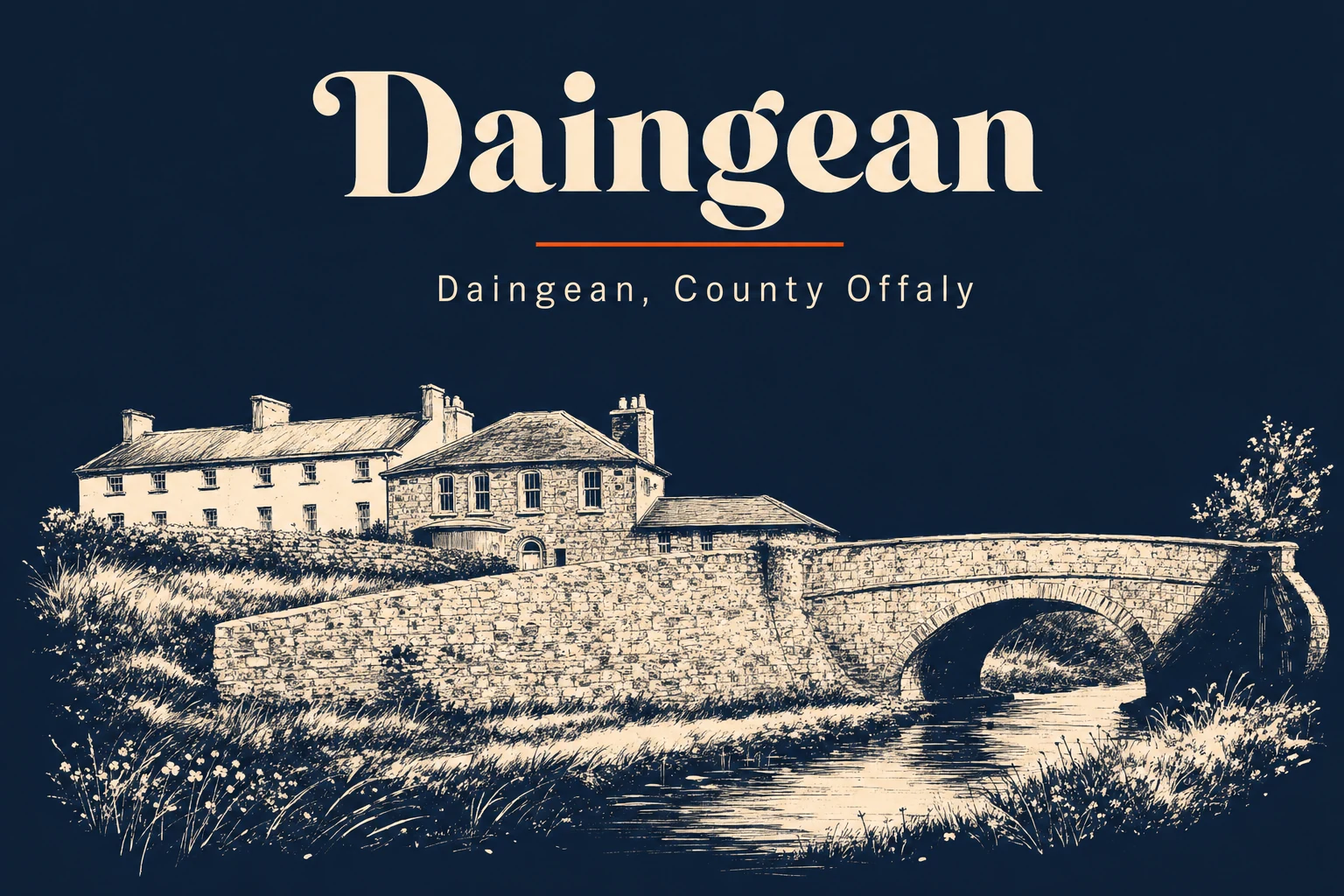
The Grand Canal runs through the town, bringing water from Dublin towards the Shannon. Daingean Harbour is the end of the navigable stretch, and today it is leisure boats that use it—small craft, people who have chosen to come here for the quiet. The commercial barges are long gone. The town adjusted.

What lingers hardest is the reformatory. St. Conleth's operated here from the early 20th century, part of the industrial school system that Ireland has had to reckon with in recent decades. The buildings are still there. The weight of that history is part of the place now, not hidden away.
Population
~1,000
Founded
1610 (as Philipstown)
01 / 05

At a glance.

Three things every local will eventually mention. Read these and you've already understood more than most day-trippers do.

02 / 05

Stories & lore.

The reason to come back. The things every local will eventually tell you about, usually after the second pint.

The name change

Philipstown to Daingean

In 1610, the town was founded and named Philipstown for Philip II of Spain. It became the county town of King's County—the administrative heart, where the courthouse and gaol stood, where the county business was conducted. For centuries that mattered. Then Tullamore grew stronger and took the role. After independence, the town reverted to its Irish name, Daingean. The courthouse still stands, a reminder of when this small place held official power.

A water connection

The Grand Canal

The Grand Canal reaches its terminus at Daingean Harbour. For much of the 19th and 20th centuries this was a working waterway—boats carrying goods between Dublin and the midlands, connecting the town to a wider commercial world. The leisure boats that use it now are the remnant of that. The canal itself survives, kept for tourist and recreational use. It is still possible to walk the towpath, to sit by the water, to understand the town's place on that old route.

A difficult history

St. Conleth's Reformatory

The Daingean Reformatory, later known as St. Conleth's, operated as an industrial school for much of the 20th century. It was part of a system that Ireland has recently confronted—institutions that held children and young people, often in harsh conditions, often for minor offences or simply because they had no other family. The survivors' testimonies, the government inquiries, the slow reckoning—all of this is now part of the town's story. The buildings remain. The history does not leave.

03 / 05

When to go.

There is no bad time. There are different times.

Spring
Mar–May

Mild, the canal towpath is clear, the light lengthens. A quiet time to walk and think.

◉ Go
Summer
Jun–Aug

Leisure boats on the canal, tourists passing through. The town fills slightly but is never crowded.

◐ Mind yourself
Autumn
Sep–Oct

Cool, clear, reflective. The local season. The canal is beautiful in the low light.

◉ Go
Winter
Nov–Feb

Cold, wet, the canal towpath can be slippery. Go for solitude, not comfort.

◐ Mind yourself
04 / 05

What to skip.

Honestly? Don't bother.

If a local was sitting beside you, this is the bit where they'd lean in.

×
Expecting a working market town

Daingean is smaller and quieter than it was. It is a place to pass through or to sit by the canal, not a destination for shopping or big facilities.

×
The canal without proper walking boots

The towpath can be muddy and uneven. Bring proper footwear if you plan to walk far.

×
Visiting to get away from difficult Irish history

The reformatory is part of the story. If you need to avoid that weight, go elsewhere. If you are ready to understand it, it is here.

+

Getting there.

By car

From Tullamore, 20 minutes north on the R356. From Portarlington, 20 minutes west on the R440. From Dublin, 1 hour 30 minutes via Portarlington.

By bus

Bus routes connect Daingean to Tullamore and Portarlington. No direct Dublin service—change at either of those towns.

By train

Nearest station is Portarlington or Tullamore. No direct train to Daingean.

By air

Dublin Airport is 1 hour 30 minutes by car. Shannon is 1 hour 30 minutes.