County Offaly Ireland · Co. Offaly · Durrow Save · Share
POSTED FROM
DURROW
CO. OFFALY · IE

Durrow
Darú, Co. Offaly

The Ireland's Hidden Heartlands
STOP 05 / 05
Darú · Co. Offaly

A scatter of houses on the Tullamore-Kilbeggan road, and one of the great monasteries of early Christian Ireland sitting quietly behind it.

Durrow is one of those Irish places where the name carries far more weight than the map suggests. There is no real village to speak of - a scatter of houses on the N52 between Tullamore and Kilbeggan, a church, the gates of a demesne, and the long flat midland fields around it. What there is, behind the trees, is one of the most important early monasteries in the country.

Columba - Colum Cille, the same monk who founded Iona and Derry - established a monastery here in the 6th century on a plain of oak trees. The Irish name, Darú, means exactly that: plain of the oaks. The Venerable Bede, writing in Northumbria a century or so later, called it a noble monastery in Ireland. For a time it rivalled Armagh as a seat of learning, and it gave its name to the Book of Durrow, an illuminated gospel book older than the Book of Kells and now kept under glass in Trinity College Dublin.

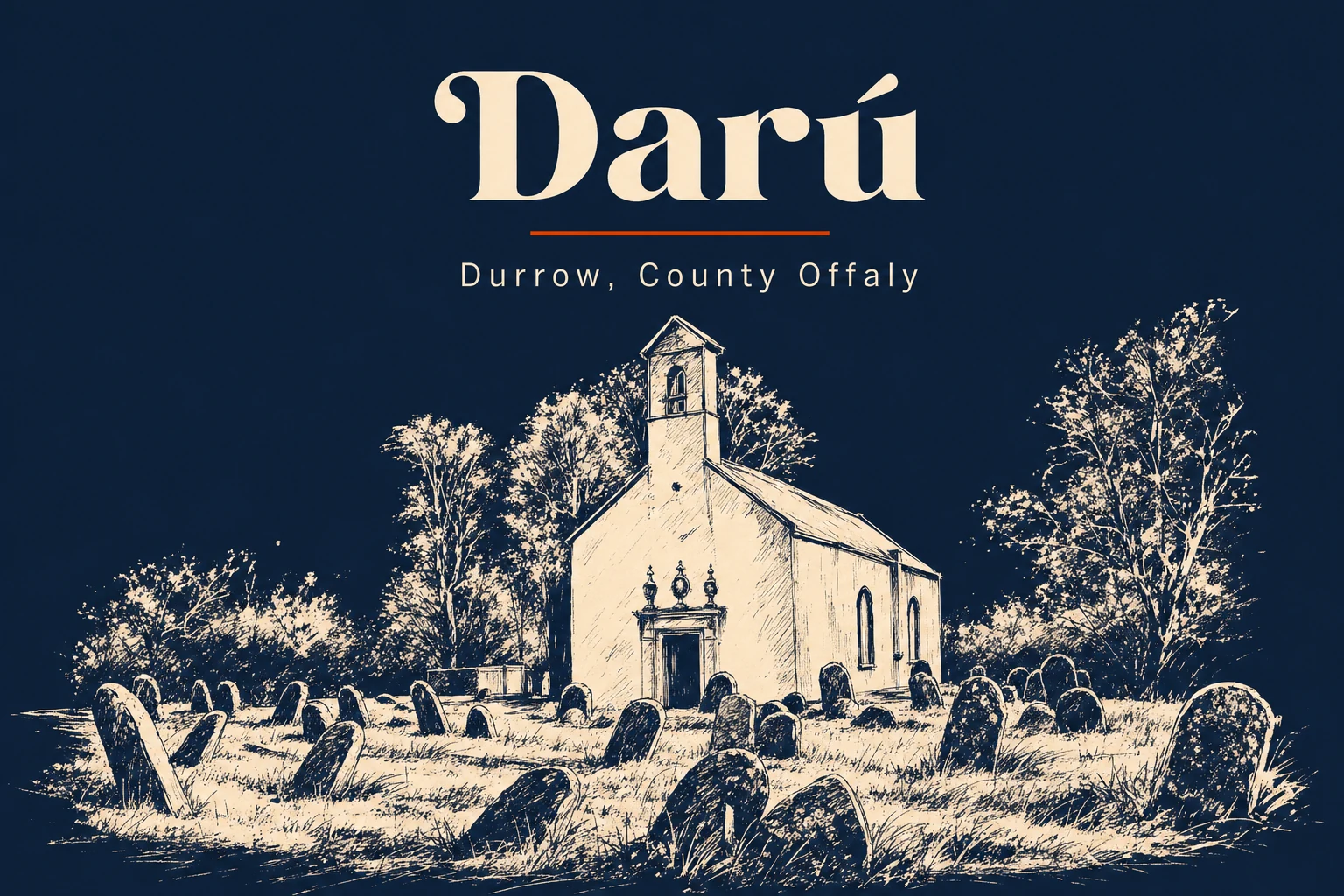
What you can actually visit is the later medieval church on the monastic footprint, the great sandstone high cross now moved inside to keep the carvings out of the rain, a clutch of early Christian grave slabs, and a holy well. The State bought the abbey and its 6th-century site in 2003 to keep it out of the hands of developers. It is a National Monument in the care of the OPW, and parts have spent long stretches closed for conservation - check before you make a special trip.

Set your expectations right and Durrow rewards you. This is a place to come quietly, read the cross panel by panel, and stand on ground that was a university of the west when most of Europe could not read. It is not a place for a pint and a feed. For that, point the car at Tullamore.
Population
Rural village, a few hundred in the townland and its surrounds
Founded
Monastery founded by St Columba c. 556-585
Coords
53.3433° N, 7.4678° W
01 / 05

At a glance.

Three things every local will eventually mention. Read these and you've already understood more than most day-trippers do.

02 / 05

Stories & lore.

The reason to come back. The things every local will eventually tell you about, usually after the second pint.

The earliest fully decorated Insular gospel book

The Book of Durrow

The Book of Durrow is the oldest surviving fully decorated Insular gospel book, produced somewhere between roughly 650 and 700 - a clear century before the Book of Kells. It runs to 248 vellum folios and was among the first manuscripts to give over entire pages purely to ornament, the so-called carpet pages of interlaced patterns and spirals. Whether the monks made it at Durrow itself or it arrived later is argued over, but it was certainly here by the year 916. It now sits in the Long Room at Trinity College Dublin. You will not see it in Durrow, but Durrow is where its name comes from.

A noble monastery in Ireland

Columba's monastery

Columba founded the monastery in the 6th century, around 556 to 585 by the various accounts. He is the same figure who later crossed to Scotland and founded Iona, and whose name attaches to Derry. Durrow grew rich and learned enough that Bede, writing in England, called it Monasterium nobile in Hibernia - a noble monastery in Ireland - and tradition has it rivalling Armagh as a centre of study. The Vikings raided it more than once, as they raided Clonard and Derry and the rest, but it survived in some form until the Norman period reshaped the landscape around it.

9th-century sandstone, read like a comic strip

The high cross

The Durrow high cross is a mid-9th-century sandstone cross, a little over three metres tall, carved on every face with biblical scenes. You can pick out Adam and Eve, the Sacrifice of Isaac, the Last Judgement, David playing the lyre, David killing the lion, and the Crucifixion, along with winged beasts and Christ with the apostles Peter and Paul. It has been moved inside the church to shield the soft sandstone from the weather. A complete cross-head from the site is held in the National Museum in Dublin. Five early Christian grave slabs and a holy well survive on the same enclosed ground.

03 / 05

Things to do outside.

Wear waterproofs. Bring a sandwich. Tell someone where you're going if it's the mountain.

Durrow Church and High Cross The reason to come. The late-medieval church sits on the footprint of Columba's monastery, with the high cross now housed inside it and early grave slabs in the graveyard. It is an unguided OPW National Monument, and it has spent long spells closed for conservation works - check Heritage Ireland before travelling. Mind your footing; this is a working historic site, not a manicured park.
Short walk on the groundsdistance
30-45 minutestime
Durrow Demesne and the old oaks The wider demesne around Durrow Abbey house holds some of the only surviving pre-medieval oak in Ireland - a direct link to the Darú of the name, the plain of the oaks. Access to the house and parts of the estate has been tangled in disputes and closures over the years, so do not assume everything is open. The setting, flat midland parkland under big skies, is the point.
Demesne paths, length variesdistance
1 hourtime
04 / 05

What to skip.

Honestly? Don't bother.

If a local was sitting beside you, this is the bit where they'd lean in.

×
Confusing this Durrow with the one in Co. Laois

There is a much larger and better-known town called Durrow in Co. Laois, with a green and plenty of pubs. It is a different place entirely. The Book of Durrow and Columba's monastery belong to this small Offaly townland on the N52, not the Laois town. Plenty of people, and a few websites, get them mixed up.

×
Turning up expecting a village

There is no street of shops, no row of pubs, no hotel here. Durrow is a church, a demesne, a famous old monastery and some houses on a main road. If you want food, drink or a bed, Tullamore is ten minutes south and Kilbeggan a short hop north into Westmeath.

×
Making a special trip without checking access

The church and high cross are state-owned but have repeatedly closed for conservation, and access to the abbey house and demesne has been disrupted by legal disputes. This is exactly the kind of site that can be shut on the day you arrive. Check Heritage Ireland or the OPW first.

+

Getting there.

By car

Durrow sits on the N52 about 8 km north of Tullamore, on the road toward Kilbeggan and the Co. Westmeath border. From Tullamore it is roughly ten minutes. From Dublin, take the M6/M4 corridor toward the midlands or come via Tullamore; allow around 90 minutes. A car is effectively essential.

By bus

There is no village bus service to speak of. Bus Eireann and Local Link routes serve Tullamore, the county town, which is the practical hub; from there it is a short taxi or drive out the N52. Plan around Tullamore rather than Durrow.

By train

No station in Durrow. The nearest railway station is Tullamore, about ten minutes south by road, on the Dublin Heuston to Galway line. Trains run frequently to Dublin Heuston and west to Athlone and Galway.