County Roscommon Ireland · Co. Roscommon · Cornafulla Save · Share
POSTED FROM
CORNAFULLA
CO. ROSCOMMON · IE

Cornafulla
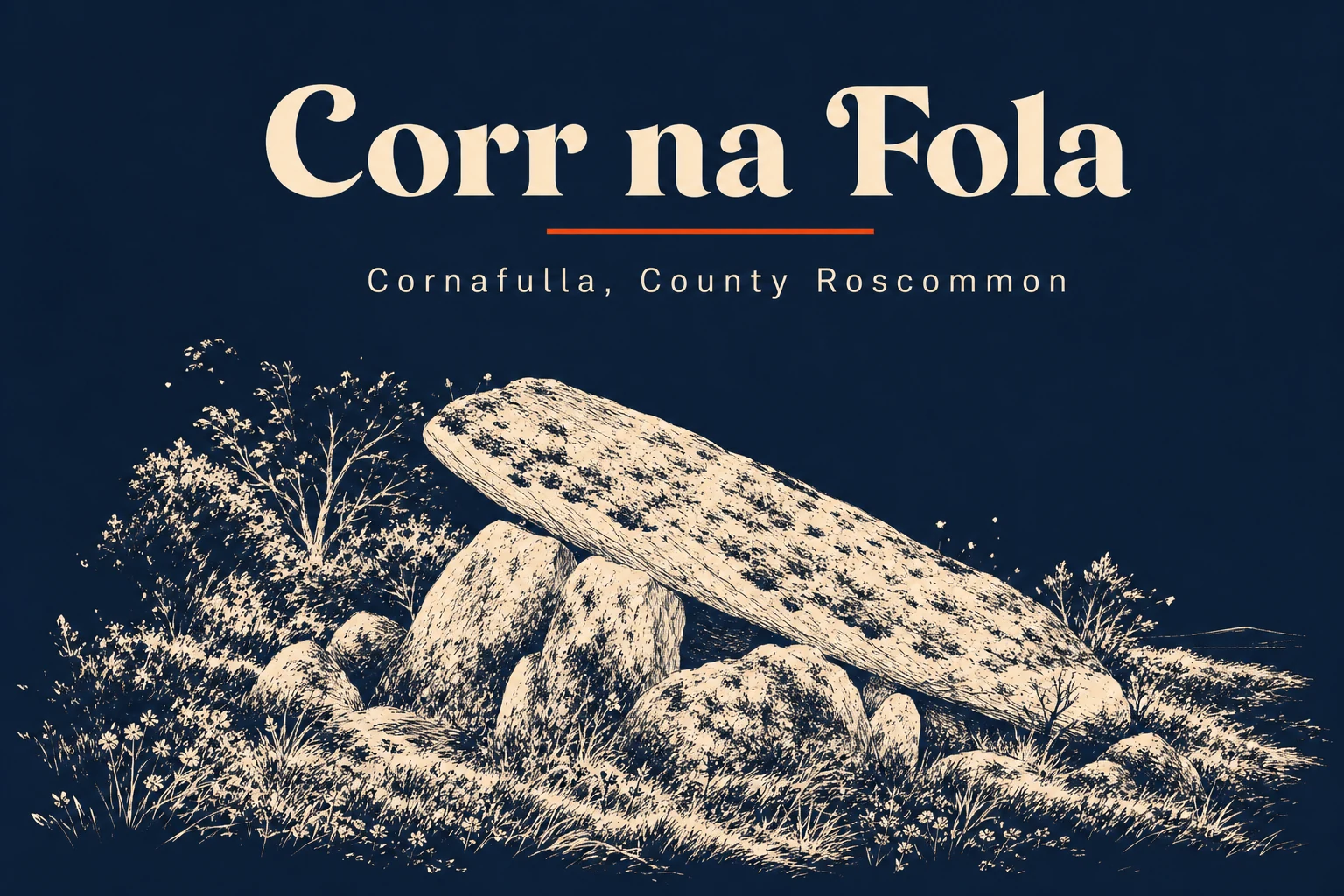
Corr na Fola, Co. Roscommon

The Ireland's Hidden Heartlands
STOP 07 / 07
Corr na Fola · Co. Roscommon

A roadside village eight kilometres west of Athlone, in the parish of Drum, with a War of Independence ambush site signposted off the R446.

Cornafulla is a small village in the parish of Drum, in south County Roscommon, about eight kilometres west of Athlone on the R446 - the old road to Ballinasloe before the M6 took the through traffic away. The Irish name Corr na Fola means "hill of the blood", and the old names usually mapped what a place felt like to the people who named it.

There is not a great deal at the centre. A national school, first opened in 1843 and rebuilt in the 1980s with a major extension finished in 2011, and a garage with car sales. The post office and convenience store closed in 2019. What sustains the place now is the countryside around it and the proximity of Athlone, which is where people drive for the things the village no longer holds.

What Cornafulla does have is a story worth stopping for. On 2 February 1921 a flying column of four volunteers ambushed a convoy of twenty Crown forces on this road. The half-hour battle cost the life of James Tormey, a Moate man and former Connaught Ranger who had fought at Gallipoli before he led the Athlone column. The memorial on the spot was restored by the Drum Heritage volunteers in 1992 and is signposted off the R446. It is the reason most visitors who are not from here ever slow down.

Beyond that, treat Cornafulla as the threshold of the parish of Drum rather than a destination in its own right. The village of Drum nearby holds the older heritage - an early monastic site, a heritage centre, and a portal tomb in the fields to the north - and Athlone, with everything a town offers, is fifteen minutes east.
Population
A few dozen in the village, more across the townland
Founded
Townland in the civil parish of Drum; monastic roots in the parish from the late 5th century
Coords
53.3760° N, 8.0051° W
01 / 07

At a glance.

Three things every local will eventually mention. Read these and you've already understood more than most day-trippers do.

02 / 07

The pubs.

None of these are themed Irish pubs, because they don't need to be. A few that earn the trip:

Athlone, 8 km east

Honest about it
Where the pubs are

Cornafulla itself has no pub - the post office and shop went in 2019 and the village never carried much more. For a pint you are heading into Athlone, fifteen minutes east on the R446, where Sean's Bar on the west bank claims to be the oldest pub in Ireland and the choice runs from there. This is a place to stop and learn something, not to drink.

03 / 07

Stories & lore.

The reason to come back. The things every local will eventually tell you about, usually after the second pint.

2 February 1921

The Cornafulla ambush

At the height of the War of Independence, four volunteers of the Athlone flying column intercepted a convoy of around twenty British military and police on the Cornafulla road. The fight lasted about half an hour. James Tormey, the column leader - a Moate man who had served with the Connaught Rangers at Gallipoli in the First World War, and who had lost his own brother weeks earlier - was shot dead on the spot, aged twenty-one. His comrades raised a memorial where he fell. It fell into disrepair until the Drum Heritage voluntary workforce restored it in 1992. The site is signposted on the old Athlone to Ballinasloe road, the R446, and is the village's one unmissable stop.

A monastery from the 5th century

The parish of Drum

Cornafulla sits in the civil parish of Drum, named from An Droim, "the ridge". An abbey was founded in the parish around the close of the 5th century, traditionally by St Diradius (or Deoradius), a brother of St Canoc. The monastic remains, St Brigid's Church, and the Drum Heritage Centre and parish hall - the latter housed in a former national school beside the graveyard - are clustered together a short drive from Cornafulla. To the north of the parish stands the Meehambee Dolmen, a portal tomb reckoned to be around 5,500 years old.

Born in Drum, 1873-1921

Fr James Coyle

The parish of Drum produced Fr James Coyle, born in 1873, who emigrated to the United States and became a Catholic priest in Birmingham, Alabama. He was murdered there on 11 August 1921, shot by a Ku Klux Klan member - a Methodist minister - after officiating at a marriage. His killing became a notorious case in the American South. A local man, then, with a far harder fate than a quiet Roscommon parish would suggest.

04 / 07

Things to do outside.

Wear waterproofs. Bring a sandwich. Tell someone where you're going if it's the mountain.

The Tormey memorial Signposted off the R446 on the old Athlone to Ballinasloe road. The memorial marks the exact spot where James Tormey was killed in the 1921 ambush. Not a walk so much as a place to stop, read the inscription, and stand for a minute. Pull in carefully - this is a country road, not a layby.
Roadside stopdistance
15 minutestime
Drum monastic site & dolmen The older heritage of the parish is concentrated at Drum village rather than Cornafulla: the early monastic remains, St Brigid's Church, the graveyard, and the heritage centre in the old national school. The Meehambee Dolmen, a 5,500-year-old portal tomb, is in the north of the parish. Combine the two for a morning of quiet parish history. Bring boots for the field at the dolmen.
Short drive plus walkingdistance
1 hourtime
05 / 07

When to go.

There is no bad time. There are different times.

Spring
Mar-May

The south Roscommon countryside is at its greenest and the R446 is quiet. The Tormey memorial and the Drum heritage sites are best in dry, bright weather.

◉ Go
Summer
Jun-Aug

Long evenings and the Shannon close by at Athlone. The heritage centre at Drum keeps more reliable summer hours; check before you set out.

◉ Go
Autumn
Sep-Oct

Soft light over the fields and few cars on the old road. A good time to pair the ambush site with the monastic remains.

◉ Go
Winter
Nov-Feb

Short days and little open in the village itself. The memorial is roadside and always accessible, but the 2 February anniversary of the ambush falls in the bleakest stretch of the year, which is its own kind of fitting.

◐ Mind yourself
06 / 07

What to skip.

Honestly? Don't bother.

If a local was sitting beside you, this is the bit where they'd lean in.

×
Expecting a village centre

There is a school and a garage and the open road. The post office and shop closed in 2019. Come for the history and the parish, not for somewhere to wander - the wandering is done at Athlone or at Drum village.

×
Looking for the heritage at Cornafulla itself

The monastic site, the church, the heritage centre and the dolmen are at and around Drum village, a short drive on. Cornafulla's own claim is the 1921 ambush memorial on the R446. Don't expect to find the older sites in the village proper.

+

Getting there.

By car

Athlone is 8 km east on the R446, the old Athlone to Ballinasloe road; the village is signposted off it, as is the Tormey memorial. The M6 motorway runs through the parish for the fast route to Galway or Dublin. Roscommon town is about 40 km north, Dublin roughly 2 hours via the M6.

By bus

No direct village service. Athlone, 8 km east, is the transport hub - Bus Eireann and Citylink coaches on the Dublin to Galway corridor call there, and Local Link covers rural south Roscommon.

By train

Athlone railway station, 8 km east, is on the Dublin Heuston to Galway and Westport lines, and the Athlone to Athenry line runs through the parish itself. Athlone is the practical railhead for Cornafulla.