County Roscommon Ireland · Co. Roscommon · Elphin Save · Share
POSTED FROM
ELPHIN
CO. ROSCOMMON · IE

Elphin
Ail Finn, Co. Roscommon

The Ireland's Hidden Heartlands
STOP 06 / 06
Ail Finn · Co. Roscommon

An old cathedral town that lost its cathedral, with the oldest working windmill in Ireland on the edge of it and Oliver Goldsmith's schooldays in the ground.

Elphin is a small town in the north of Roscommon, about 715 people, sitting at the meeting of the R368 and R369 in the flat green middle of the country. It was a cathedral town once, the seat of a diocese reaching back to St Patrick, and for centuries that made it more important than its size suggests. Then the cathedral came down and the bishop moved on, and what is left is a quiet Main Street, a Fair Green, and a windmill on the edge of the village doing the work the town is now known for.

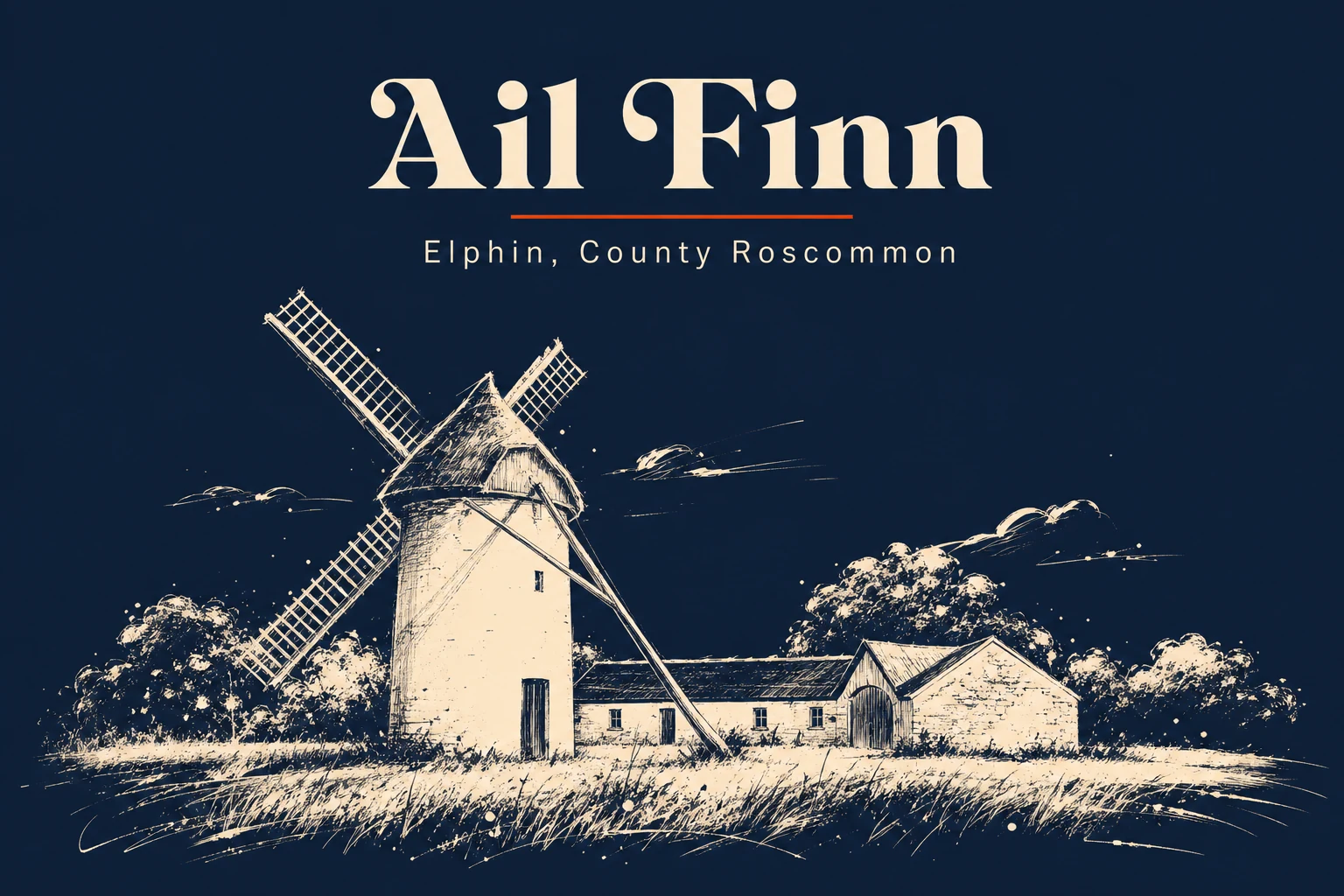
The windmill is the thing. Edward Synge, the Bishop of Elphin in the 1720s and 1730s, put up a stone tower mill to grind corn for the locals. It worked until cereal milling stopped paying after the Napoleonic Wars, and it was a roofless ruin by the 1830s. In the 1990s the community took it on - a three-year job, finished and reopened in June 1996 by the actor Gabriel Byrne - and it is now reckoned the oldest windmill in Ireland and the only one of its kind in the west. The thatched cap turns to face the wind and the timber sails go round. There is a small agricultural museum of threshers and winnowers in the yard.

The other history is in the ground and the names. The medieval cathedral east of the village was wrecked in a storm in 1957 and demolished in 1964; the walled site, a prehistoric standing stone and St Patrick's well are still inside the Fair Green. Bishop Hodson's Grammar School on Main Street - the Latin School - schooled Oliver Goldsmith and William Wilde before the bishopric was moved to Kilmore in Cavan in the 1840s and the school faded out. Goldsmith spent his childhood at Ballyoughter just south of here. Percy French was born a few miles away at Cloonyquin.

Do not come to Elphin for a day out on its own merits - it is a half-hour stop, an hour if the windmill is open and you take the museum slowly. Come for it as one point on a Hidden Heartlands run: Rathcroghan, the great royal complex of the Connacht kings, is only a few miles south near Tulsk, and Boyle with its abbey and Lough Key is up the road. Elphin is the kind of place you pass through and are glad you stopped, not the kind you build a holiday around.
Population
~715 (2022)
Pubs
1and counting
Walk score
Main Street end to end in ten minutes
Founded
Early monastic see attributed to St Patrick (5th century); diocesan town for centuries
Coords
53.8503° N, 8.1947° W
01 / 06

At a glance.

Three things every local will eventually mention. Read these and you've already understood more than most day-trippers do.

02 / 06

The pubs.

None of these are themed Irish pubs, because they don't need to be. A few that earn the trip:

Creightons

Local, no frills, a pool table out the back
Family-run bar, Main Street

The village pub. Family-run, friendly, plenty of room and a room with a pool table. They do not serve food, but they will happily let you bring in a takeaway from next door and eat it with your pint. This is the village social life in one room. Do not expect more than that and you will not be disappointed.

03 / 06

Where to eat.

PlaceTypeLocal note
Royal Spice Indian and pizza takeaway, Main Street The takeaway on Main Street - Indian food and pizza, delivery available locally. Not a sit-down dinner, but the practical answer to eating in Elphin, and the place the pub will point you to if you want something to go with the pint at Creightons.
04 / 06

Stories & lore.

The reason to come back. The things every local will eventually tell you about, usually after the second pint.

c. 1730, turning again since 1996

Bishop Synge's windmill

Edward Synge, Church of Ireland Bishop of Elphin, built the stone tower mill around 1730 to grind corn and mill flax for the people of the area. It is a circular three-stage tower with a thatched cap that rotates to turn the sails into the wind - a design more common in eastern England than in the Irish midlands, which is part of what makes it rare. Milling cereal stopped paying after the Napoleonic Wars ended in 1815, and the mill was already a ruin by the 1830s. It sat that way for over a century and a half. A community scheme rebuilt it over three years, reopening it in June 1996 with Gabriel Byrne doing the honours. It is now the oldest windmill in Ireland and the only working one of its type in the west, run as a not-for-profit by the village. An agricultural museum of old harvest machinery sits in the yard.

St Patrick to Kilmore

The diocese that left

Elphin claims one of the oldest church origins in Connacht. Tradition holds that St Patrick founded the first church here and ordained Asicus as the first bishop; Asicus became the patron saint of the place. The medieval cathedral, St Mary's, stood east of the town and is reckoned to date from around 1200. The Church of Ireland rebuilt it in the 18th century, but a storm on the 4th of February 1957 wrecked it and it was demolished in 1964. The site is walled and holds a prehistoric standing stone and a holy well known as St Patrick's well, all inside the Fair Green at the entrance. The bishopric itself was united with Kilmore and Ardagh and the seat moved to Kilmore in County Cavan in the 1840s. The town has been living off the memory ever since.

Bishop Hodson's Grammar School

Goldsmith, Wilde and the Latin School

The diocesan school on Main Street, also called the Latin School, taught the writer Oliver Goldsmith - author of "She Stoops to Conquer" and "The Vicar of Wakefield" - who spent his childhood at Ballyoughter just south of Elphin and may have been born at his mother's family home, Smith Hill, outside the village. Sir William Wilde, the eye surgeon and father of Oscar Wilde, was another pupil. The building, properly Bishop Hodson's Grammar School, is a protected structure and has been earmarked for use as a heritage centre. The school went into decline when the bishopric moved to Kilmore in the 1860s. For a clever boy in the eighteenth-century midlands, this small school was the door out.

Shankhill, two Victoria Crosses

The men on the cross

Elphin sent out a remarkable number of soldiers. The monument at Shankhill Cross, three over-life-size figures put up in 1963, marks the military connection. Two men with Elphin ties won the Victoria Cross: Luke O'Connor, born nearby in 1831, was the first man awarded the VC at the Battle of the Alma in the Crimea, and Patrick Roddy was another recipient. It is the sort of thing that does not advertise itself - a stone group at a crossroads in a small town - but it is real and worth the two minutes to read.

05 / 06

Things to do outside.

Wear waterproofs. Bring a sandwich. Tell someone where you're going if it's the mountain.

Main Street and the Fair Green Walk the length of Main Street past Bishop Hodson's Grammar School, then out to the cathedral site and the Fair Green at the east end. The standing stone, the holy well and the walled graveyard with the Goldsmith and French family burials are all here. It is small and it is quiet. Read the stones.
1.5 km loopdistance
30 mintime
The windmill On the edge of the village. Check ahead that it is open before you go - it is community-run and the hours are not constant. If it is open, take the cap, the sails and the agricultural museum slowly. If it is closed you can still see it from the road, which is half the picture.
Short walk on the groundsdistance
45 mintime
+

Getting there.

By car

Elphin sits at the junction of the R368 and R369 in north Roscommon. Roscommon town is about 30 minutes south, Boyle about 20 minutes north, Strokestown around 15 minutes east. Off the N5 and N61 corridors rather than on them.

By bus

Local Link route 570 connects Elphin to Boyle, Strokestown and Roscommon. Bus Éireann route 468 calls on Mondays, Wednesdays and Saturdays, and route 451 on Fridays. Rural timetables - check before you rely on them.

By train

No train. The line never came - a railway was proposed in 1859 and failed. Nearest stations are at Boyle and Carrick-on-Shannon on the Dublin to Sligo line, both a short drive away.

By air

Ireland West Airport (Knock) is about 50 km west, roughly 40 minutes by road. Dublin Airport is around two hours east.