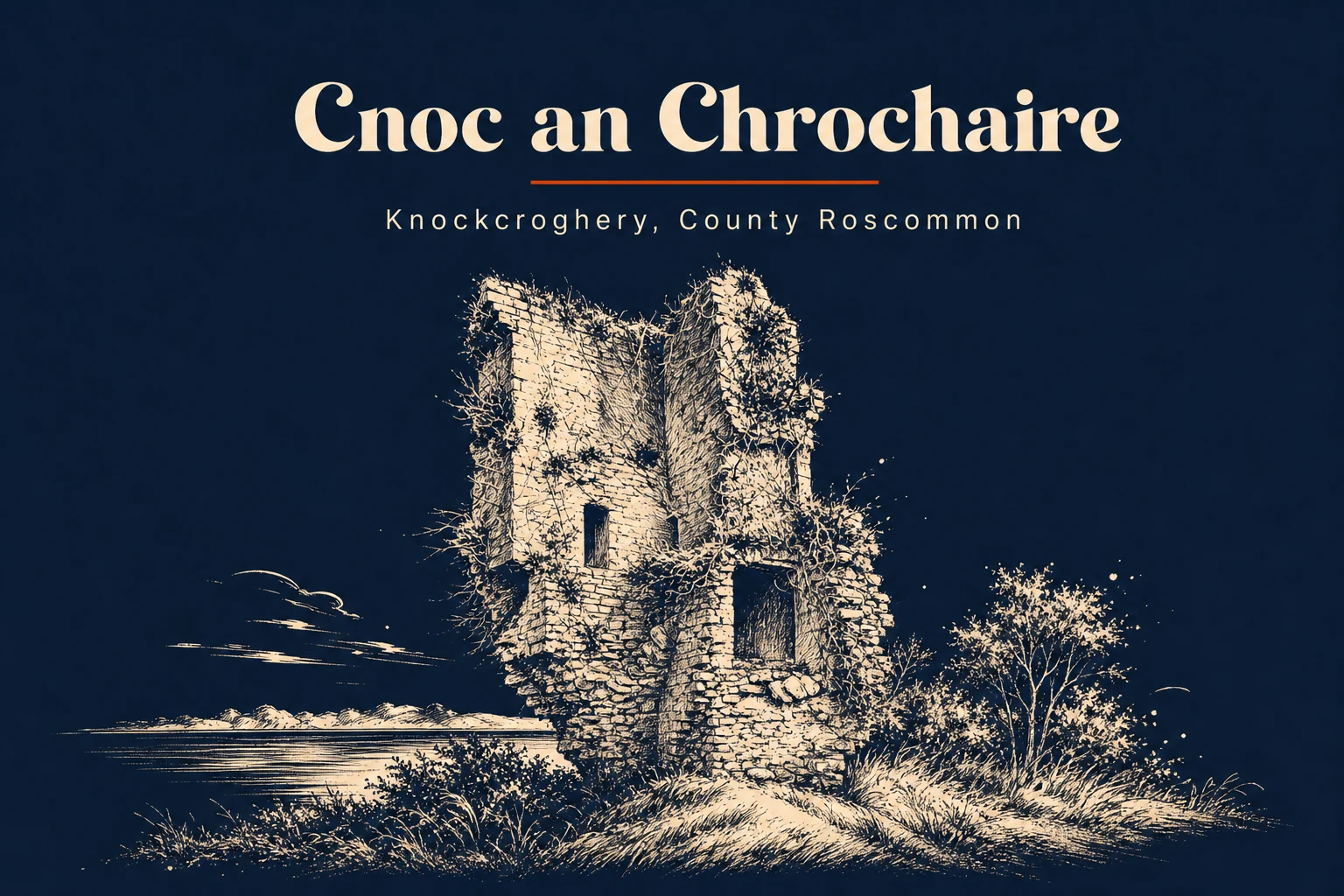
Cnoc an Chrochaire · Co. Roscommon
The village that made clay pipes for 300 years, was burned to the ground in 1921, and rebuilt itself on the same street.
Knockcroghery is a one-street village on the N61, the road that runs from Roscommon town down to Athlone. Three hundred and eighty-eight people at the last count. You could drive through it in twenty seconds and miss the whole story, which would be a mistake, because the story here is one of the better ones in the midlands.
For the best part of three centuries this village made clay tobacco pipes - the short-stemmed dúidíns that were smoked at wakes, then broken and laid on the grave. A Scotsman named Buckley brought the craft in the 1700s; local families took it up until eight kilns and around a hundred people were turning out pipes for export to America and Australia. Then on 21 June 1921, during the War of Independence, the Black and Tans burned the village to the ground. The trade was already fading against the cigarette, and the fire finished it. Almost every building on the street is the rebuild that followed, which is why a Roscommon village looks like it was put up in a single decade.
The name itself is a hanging story. It was the Creagan - the stony hill - until the 1650s, when Cromwell's man Sir Charles Coote took Galey Castle and the O'Kelly clan who held it were marched to the hill at the north end of the village and hanged. After that it was Cnoc an Chrochaire, the Hill of the Hangman, anglicised to Knockcroghery. Hangman's Hill is still there, opposite the post office, if you want to stand on it.
Come for the Claypipe Centre, a pint in Murray's where Roscommon's two All-Ireland cups once sat in the window, and the walk out to Lough Ree at Galey Bay. It is a small place that knows exactly what it is, and does not pretend to be Athlone.