County Roscommon Ireland · Co. Roscommon · Lecarrow Save · Share
POSTED FROM
LECARROW
CO. ROSCOMMON · IE

Lecarrow
An Leithcheathrú, Co. Roscommon

The Ireland's Hidden Heartlands
STOP 08 / 08
An Leithcheathrú · Co. Roscommon

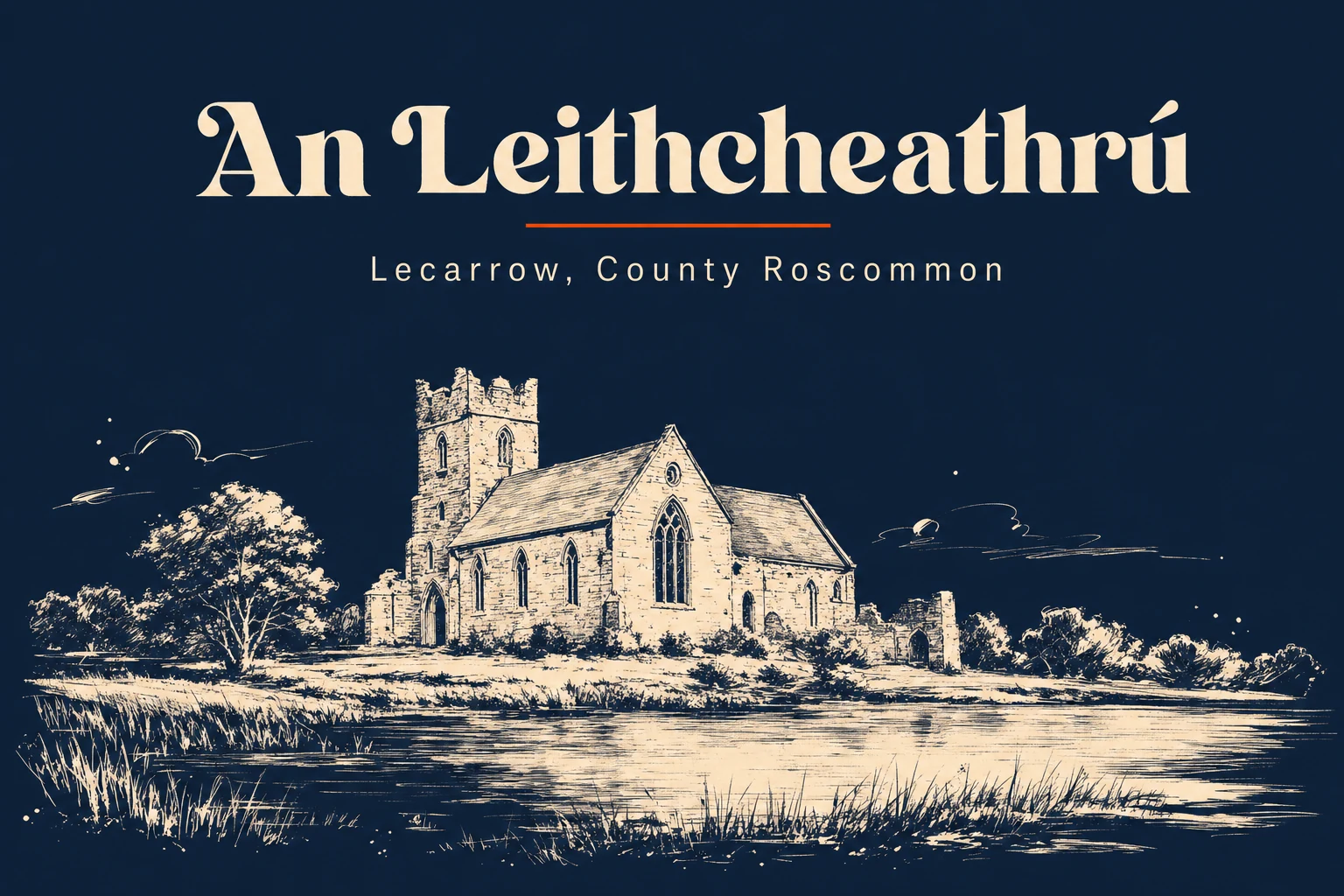
A canal village on Lough Ree, a mile from the deserted medieval town of Rindoon and the closest place to the geographical centre of Ireland.

Lecarrow is small. The electoral division around it counted 333 people in 2022, and the village proper is a scatter of houses on the N61 about a quarter of an hour from both Athlone and Roscommon town. There is a pub, a canal, a marina, and a national school. That is more or less the inventory. People come for the water and the ruins, not the village.

The canal is the thing that put it on a map. The Shannon Commissioners cut it in 1840 to move limestone from a quarry down to the Shannon at Athlone, a mile and a half of straight dark water dropping from the village to Blackbrink Bay on Lough Ree. It fell out of use, was reopened to navigation in 1967, and the marina at the head of it has since been rebuilt. On a summer evening it is hire-cruisers and the odd kayak; the rest of the year it is heron-quiet.

The real reason to stop is a mile south on the peninsula. Rindoon - Rinn Dúin, the fort of the promontory - was an Anglo-Norman walled town of around a thousand souls in the thirteenth century, built around a castle of 1227. It was fought over for a hundred years and then abandoned to the fields. The castle, the town wall running clean across the neck of the peninsula, the gateway, a windmill stump and a church are all still there. It is one of the most complete deserted medieval towns in Ireland, and almost nobody knows it exists.

A word of caution before you set off: the Rindoon land is privately farmed, and the looped walk out to the ruins has been closed off and on over disputes with the landowner. The St John's Wood forest walk beside it - one of the oldest native oak woods left in the country - stays open. Check the state of access before you bank on reaching the castle.

Population
~333 (Lecarrow electoral division, 2022)
Pubs
1and counting
Walk score
Marina to the medieval town wall at Rindoon in under an hour
Founded
Canal cut 1840 by the Shannon Commissioners; the medieval town at Rindoon nearby dates to 1227
Coords
53.55° N, 8.05° W
01 / 08

At a glance.

Three things every local will eventually mention. Read these and you've already understood more than most day-trippers do.

02 / 08

The pubs.

None of these are themed Irish pubs, because they don't need to be. A few that earn the trip:

Coffey's Bar

Old country bar, fourth generation
Village pub & shop

The pub in Lecarrow - a small old bar with a grocery side, run by the same family since 1918 and into a fourth generation under Sarah Jane Coffey. Named Best Pub in Roscommon at the 2026 Connacht Irish Restaurant Awards, which for a village this size is no small thing. The kind of place that is the social centre of the parish rather than a stop on a tourist trail.

03 / 08

Where to eat.

PlaceTypeLocal note
The Yew Tree Restaurant, near the village €€€ An ambitious country restaurant tucked into the Lecarrow countryside, open since 2018, doing classic European and contemporary Irish cooking - a genuinely good kitchen in an out-of-the-way spot, the sort of find people drive from Athlone and Roscommon for. Check days and book ahead; this is rural opening hours, not a town that trades every night.
04 / 08

Stories & lore.

The reason to come back. The things every local will eventually tell you about, usually after the second pint.

Rinn Dúin, the fort of the promontory

Rindoon, the lost town

In 1227 a castle went up on St John's peninsula, jutting into Lough Ree on the edge of Norman-held territory - the work tied to Geoffrey de Marisco and the Anglo-Norman push up the Shannon. A town followed: a walled settlement of perhaps a thousand people, with a parish church, a hospital run by the Fratres Cruciferi, a mill and a harbour, trading between the Norman river towns and the Gaelic country beyond. A town wall close to two kilometres long was thrown across the neck of the peninsula, with a gatehouse and towers. From 1229 it was attacked again and again, and with the Gaelic resurgence of the fourteenth century it was sacked and slowly emptied; by 1342-3 it was described as in Irish hands. It was never rebuilt. What survived is extraordinary - castle, wall, gateway, a later windmill on the church tower, the church and graveyard - sitting in farmland with the lough on three sides. Some call it the Camelot of the Shannon. Access is across private land and has been on-and-off closed, so check first.

Old-growth oak on the lough shore

St John's Wood

Beside Rindoon runs St John's Wood, one of the largest and most intact ancient semi-natural woodlands left in Ireland - oak, ash, hazel that has held the shore of Lough Ree for centuries. A waymarked forest loop of around 5 km runs through it from a car park near the village. In late spring the floor goes blue with bluebells. It is a nature reserve, and unlike the Rindoon ruins it stays open to walkers, which makes it the dependable outing here when the medieval town is shut.

A ditch with a purpose

The canal

Lecarrow Canal was cut in 1840 by the Shannon Commissioners to float limestone from a quarry above the village down to the Shannon navigation at Athlone. It is short - about a mile and a half - and dead straight, dropping from the village to Blackbrink Bay on Lough Ree. It silted up within a couple of decades, was cleared in 1889, dredged again by the Office of Public Works in the 1960s and reopened to navigation in 1967. Today it ends at a rebuilt marina, and it is the reason a cruiser bothers to leave the open lough at all. The towpath is a flat, still, heron-watching sort of walk.

05 / 08

Things to do outside.

Wear waterproofs. Bring a sandwich. Tell someone where you're going if it's the mountain.

St John's Wood forest loop From the marked car park near the village, a waymarked loop through one of the oldest native oak woods in Ireland on the shore of Lough Ree. Easy underfoot, mostly forest track. Bluebells in late spring. This is the walk that is reliably open when the Rindoon ruins are not - take it as the default.
~5 km loopdistance
1.5 hourstime
Rindoon / Warren looped walk The big one: out the peninsula to the deserted medieval town - castle, town wall, gateway, windmill and church, with information panels along the way. Crosses working farmland with livestock, soft ground around the ruins, no dogs, sturdy boots. IMPORTANT: this route runs over private land and has been closed during disputes with the landowner. Check current access before you go, and respect any closure.
~5 km loopdistance
1.5-2 hourstime
The canal towpath From the village down the Lecarrow Canal to the marina and the mouth on Blackbrink Bay. Flat, straight, very quiet. Herons, the odd cruiser turning in, Lough Ree opening out at the end. The low-effort water walk for an idle hour.
3 km returndistance
45 minutestime
06 / 08

When to go.

There is no bad time. There are different times.

Spring
Mar-May

The best window. St John's Wood goes blue with bluebells in late April and May, the lough light is good, and the ground out at Rindoon has had a chance to dry. Cool and quiet.

◉ Go
Summer
Jun-Aug

Long evenings, cruisers turning into the canal, the marina busy. The walks are at their easiest. Verify Rindoon access for the season before you rely on it.

◉ Go
Autumn
Sep-Oct

Quiet and handsome, the oak wood turning. Boat traffic thins out. A good time for the towpath and the forest loop.

◉ Go
Winter
Nov-Feb

Short days and a lot of mud underfoot on the peninsula. The forest loop and the canal still walk fine in boots; the medieval town is heavy going and often inaccessible. Coffey's keeps the lights on.

◐ Mind yourself
07 / 08

What to skip.

Honestly? Don't bother.

If a local was sitting beside you, this is the bit where they'd lean in.

×
Turning up at Rindoon without checking access

The deserted town is the headline attraction and also the one most likely to disappoint, because the looped walk crosses private farmland and has been closed during landowner disputes. Check the current status before you drive here for it. If it is shut, the St John's Wood loop next door is open and worth the trip on its own.

×
Expecting a village with much in it

Lecarrow is one pub, a canal, a marina and a school. That is not a criticism - it is the whole point - but do not arrive expecting cafes and craft shops. Stock up in Athlone or Roscommon town, both a quarter of an hour away.

×
Making a pilgrimage to the centre of Ireland

Lecarrow is the nearest village to the geographical midpoint of the island, but there is no monument, no marker, no visitor centre - just farmland and water. It is a pub-quiz fact, not a destination. Enjoy it as trivia and go and look at the medieval town instead.

+

Getting there.

By car

On the N61 between Athlone and Roscommon town, about 15 minutes from each. Athlone is roughly 17 km south-east. The village turn is signposted off the main road; the marina and the walks are a short way beyond.

By bus

TFI Local Link route RR30 (Roscommon town to the south-Roscommon villages) serves Lecarrow along with Knockcroghery, Ballymurray and Kiltoom. Bus Éireann route 461 runs the Athlone-Roscommon corridor on the N61. Services are rural and limited; check timetables before you plan around them.

By train

No station in the village. Nearest are Athlone (about 15 km, on the Dublin Heuston-Galway/Westport lines, a busy junction) and Roscommon (on the Dublin-Westport line). From Athlone it is a short drive or local bus out the N61.

By air

Ireland West Airport Knock (NOC) is about 1 hour 15 minutes north. Dublin Airport (DUB) is roughly 2 hours east via the M6/M4.