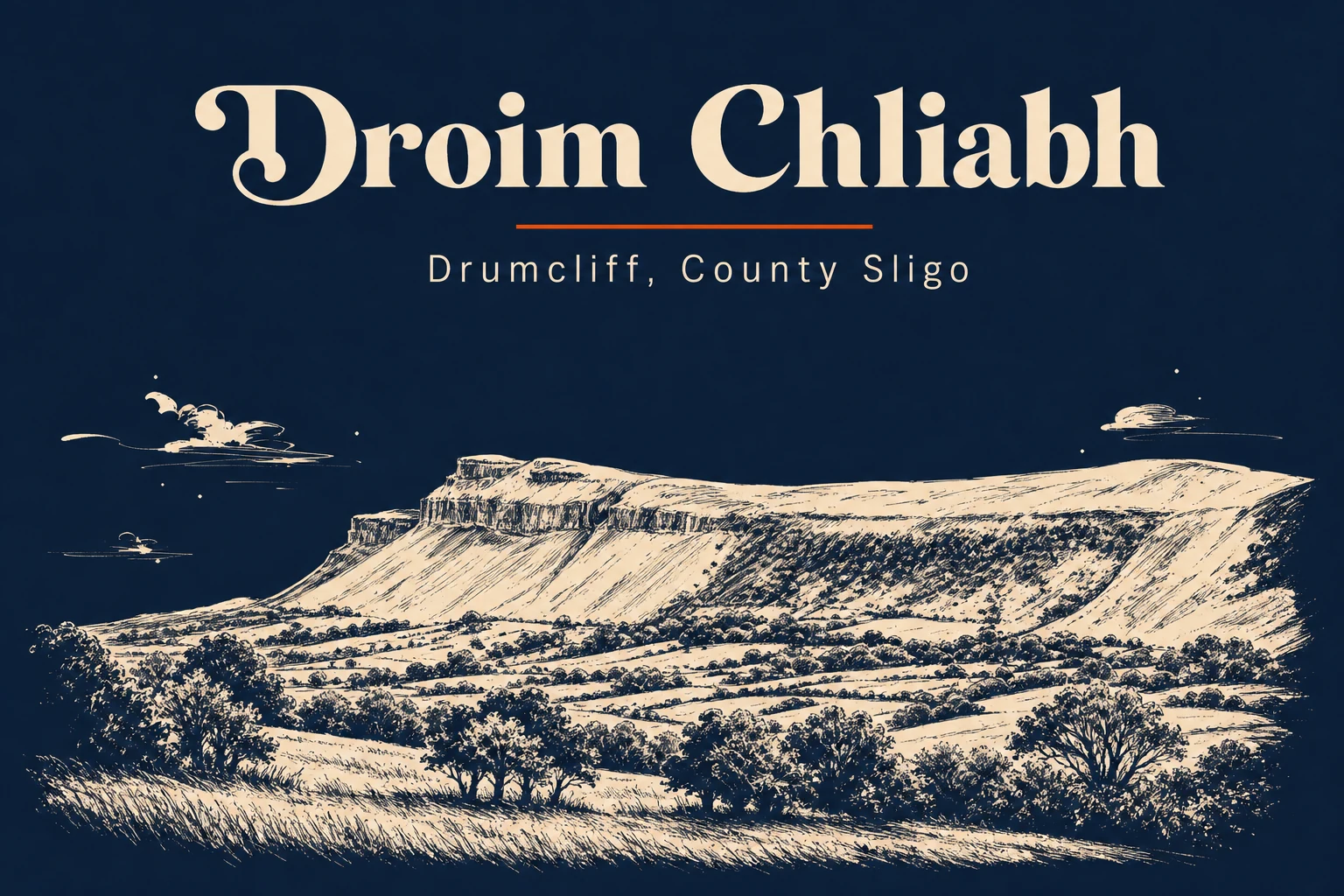
Droim Chliabh · Co. Sligo
Yeats's grave under Ben Bulben, and a monastery that started a war.
Drumcliff is small. A church, a tea house, a graveyard, a round tower stub, a high cross, and a mountain doing most of the talking. You can park, walk the lot, read the headstone, and be back in the car in forty minutes. Most people are. That is the wrong way to do it.
The graveyard is the headline because of Yeats, and Yeats earned the headline. He died in the south of France in January 1939, was buried there during the war, and was brought home in September 1948 on the Irish naval corvette Macha. His grandfather had been rector of this church. He had asked, in a late poem, to be laid "under bare Ben Bulben's head". The grave is plain. The epitaph is the last three lines of "Under Ben Bulben". Stand there long enough and it stops being a literary stop and starts being a graveyard.
But the ground is older than the poem. St Colmcille - Columba to the English-speakers - founded a monastery on this spot around 574, in the years after the Battle of Cúl Dreimhne was fought just up the road. The battle in 561 was, depending on who you ask, the world's first copyright dispute: Colmcille had copied a psalter without permission, the high king ruled against him, and the fight that followed sent him into exile on Iona. The monastery he left behind grew, was raided by Vikings, lost its tower top to a lightning strike in 1396, and quietly slipped under the present Church of Ireland building. The high cross at the gate - biblical scenes, weathered to soft outlines - has been standing there for a thousand years.
Spend an hour. Read the cross. Walk the back of the churchyard where the older stones lean. Then look up at Ben Bulben and put the poem back where it came from.