County Tipperary Ireland · Co. Tipperary · Cashel Save · Share
POSTED FROM
CASHEL
CO. TIPPERARY · IE

Cashel
Caiseal Mumhan

The Ireland's Ancient East
STOP 10 / 10
Caiseal Mumhan · Co. Tipperary

A limestone spike crowned with a thousand years of ambition. Hard to look away.

Cashel is the kind of town that stops people in the middle of a motorway journey. They see the Rock from the M8 and pull off at the next junction. That says something about the skyline and something about the M8.

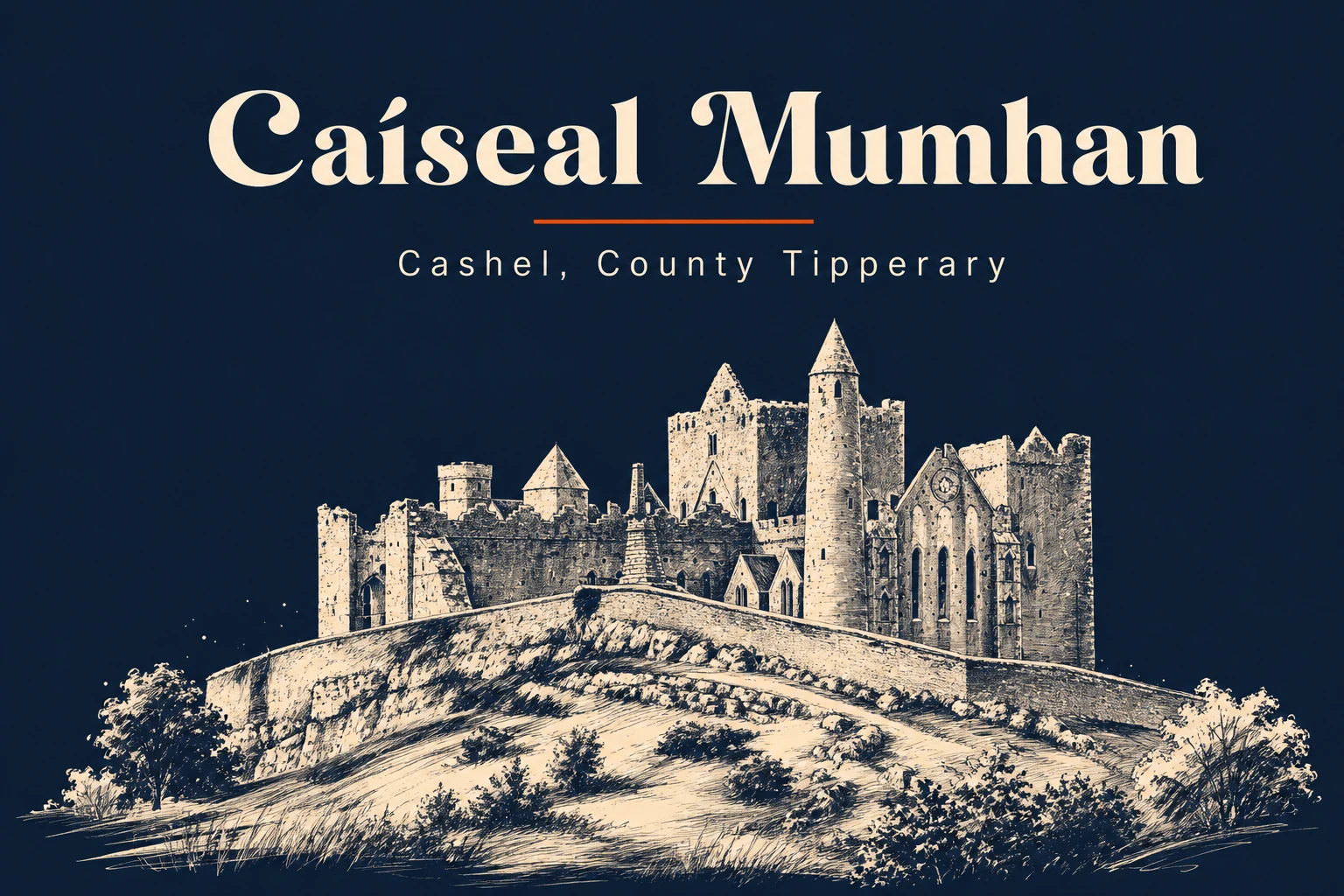
The Rock of Cashel — Carraig Phádraig in Irish, St Patrick's Rock in the guidebooks — is a limestone outcrop that carries the full weight of early Christian Ireland. The Eóganacht dynasty ruled from here before the Normans arrived. In 1101, Muirchertach Ua Briain handed the fortress to the Church, which then spent the next two centuries building one of the most concentrated collections of medieval architecture in Europe. Cormac's Chapel (1134) is the centrepiece: intact, Romanesque, with frescoes that lay hidden under limewash until the 1980s. The roofless 13th-century Cathedral and the 28-metre round tower complete the picture. Below the Rock, Hore Abbey — a Cistercian foundation from 1272, the last such foundation in Ireland — sits in a field you can walk into without a ticket.

The town beneath the Rock has been quietly outpacing its reputation. Cashel Palace, a Palladian manor built in 1732 as a home for the Church of Ireland Archbishops, reopened in 2022 as a five-star hotel. Its cellars hold The Bishop's Buttery, which picked up a Michelin star within two years of opening. Chez Hans has been a Tipperary institution since 1968. The Guinness brewery origin story has a Cashel chapter — Arthur Guinness's godfather, Archbishop Arthur Price, employed a steward called Richard Guinness who is believed to have brewed ale on the palace grounds. These things accumulate.

Stay a night rather than a morning. The Rock after the coach parties leave — early evening, low sun, the plain of Tipperary going gold in every direction — is a different place entirely.

Population
4,805
Walk score
Rock to town centre in 10 minutes
Coords
52.5158° N, 7.8856° W
01 / 10

At a glance.

Three things every local will eventually mention. Read these and you've already understood more than most day-trippers do.

02 / 10

The pubs.

None of these are themed Irish pubs, because they don't need to be. A few that earn the trip:

Mikey Ryan's Bar & Kitchen

Locals and visitors in equal measure
Gastropub

76 Main Street. Proper old bar at the front, food operation out the back, courtyard garden that works when the weather holds. Works directly with local farmers. The most animated place in town on a match night.

03 / 10

Where to eat.

PlaceTypeLocal note
The Bishop's Buttery Fine dining, one Michelin star (awarded 2024) €€€ In the vaulted cellars of Cashel Palace. Flagstone floors, local producers, beef from the Golden Vale done with precision. Picked up its first Michelin star in 2024 and retained it for 2025. Book ahead — the hotel draws destination visitors from Dublin and beyond.
Chez Hans Fine dining, MICHELIN Guide listed €€€ Moor Lane, in a converted 19th-century Synod Hall. Running since 1968, which in Irish restaurant terms is geological time. Classical cooking — sole meunière, Irish beef, old-school desserts. Closed Sunday and Monday. No walk-ins for dinner.
Café Hans Daytime café €€ Next door to Chez Hans on Moor Lane. The sister operation: no reservations, no dinner service, long queues at peak times. Soups, open sandwiches, daily specials. Worth the wait if you get there before the lunch rush.
Mikey Ryan's Bar & Kitchen Gastropub food €€ Lunch and dinner seven days. Local produce, pub portions, no ceremony. A reliable option when the fine-dining rooms are full.
04 / 10

Where to sleep.

PlaceTypeLocal note
Cashel Palace Hotel 5-star hotel, Relais & Châteaux The 1732 Palladian manor, restored and reopened in March 2022. Two Michelin Keys awarded in 2024. The mulberry trees in the garden were planted in 1702. Archbishop's bedroom, spa, the Bishop's Buttery in the cellars. If you are going to stay somewhere once, this is the argument for Cashel over Kilkenny.
Cashel Town B&Bs B&B Several guesthouses within a short walk of the Rock. Pricing is considerably more reasonable than the Palace and the town is small enough that nothing is far. Check availability ahead in summer — Cashel has limited bed stock relative to visitor numbers.
05 / 10

Stories & lore.

The reason to come back. The things every local will eventually tell you about, usually after the second pint.

How St Patrick converted a king

The crozier and the foot

The tradition holds that St Patrick came to Cashel in the 5th century and baptised Aengus, son of Nadfraoch, King of Munster. During the ceremony Patrick drove his crozier into the ground — and through the king's foot. Aengus said nothing, assuming the stabbing was part of the ritual. Patrick said nothing either, then or afterwards. Neither man ever mentioned it. Whether the silence was tact or embarrassment has been debated for fifteen hundred years.

1101 and the end of a royal seat

Cormac hands over the keys

In 1101, Muirchertach Ua Briain — King of Munster, most powerful ruler in Ireland at the time — donated the Rock of Cashel to the Church at a synod held on the site. The political calculation was subtle: he was a Dál Cais man, not Eóganacht, and the Rock was the Eóganacht's ancestral seat. Giving it to the bishops removed a rival symbol of Munster kingship and made him look pious. It worked on both counts.

What was brewing at the Palace

The Guinness well

Richard Guinness, steward to Archbishop Arthur Price at Cashel Palace in the 1720s, is believed to have brewed ale on the palace grounds using water from its well. His son, Arthur Guinness, was the Archbishop's godson. Arthur went on to sign a 9,000-year lease on a brewery at St James's Gate in Dublin in 1759. The family connection between a Tipperary archiepiscopal household and the most recognisable pint in the world is the sort of story that sounds made up.

Hore Abbey and the Archbishop who changed his mind

The last Cistercians

Archbishop David Mac Cerbaill transferred Hore Abbey from the Benedictines to the Cistercians of Mellifont in 1272, endowed it with lands and mills, and later entered the monastery himself, dying there in 1289. Hore was the last Cistercian monastery founded in Ireland. It sits in a field below the Rock — roofless since the Dissolution, free to enter, and usually empty of everyone except the jackdaws.

06 / 10

Things to do outside.

Wear waterproofs. Bring a sandwich. Tell someone where you're going if it's the mountain.

The Rock of Cashel OPW site. Admission charged. Walk up from the town car park — it takes five minutes and you arrive seeing the wall, which is the right way to do it. Early morning or early evening empties the coach parties. The path circles the outer walls before you enter the complex. Allow time for Cormac's Chapel: the scale of the Romanesque carving is only apparent in person.
1.5 km on the Rock itselfdistance
1.5–2.5 hours depending on time insidetime
Hore Abbey circuit Walk from the Rock car park down to Hore Abbey and loop back. The Abbey ruins are free to enter and sit in a field with direct sight-lines back up to the Rock. Best in morning light. No signage, no ticket office, no cafe. Just the ruins.
2 kmdistance
30–45 mintime
Cashel town trail Cashel has a waymarked town trail taking in the GPA Bolton Library at St John the Baptist Cathedral, the Brú Ború cultural centre, the Cashel Folk Village, and the main street. Flat, short, and useful for placing the Rock in context of the wider town.
2 km loopdistance
45 mintime
07 / 10

Tours, if you want one.

The ones below are bookable through our partners — pick one that suits, or skip the lot and just turn up.

We earn a small commission when you book through our tour pages. It costs you nothing extra and keeps the village hubs free. All Co. Tipperary tours →

08 / 10

When to go.

There is no bad time. There are different times.

Spring
Mar–May

The Rock in March light is serious. Coach numbers are still manageable. Hore Abbey is quiet and the surrounding fields are green in a way that earns the cliché.

◉ Go
Summer
Jun–Aug

One of Ireland's most visited heritage sites — in July the car parks fill before 11am and the Rock is shoulder-to-shoulder by noon. Go early, go late, or adjust expectations. The Bishop's Buttery and Chez Hans both need weeks of advance booking.

◐ Mind yourself
Autumn
Sep–Oct

The best combination: reasonable weather, reduced crowds, and the low October light turning the limestone something close to amber. The restaurants stay open. The town quietens.

◉ Go
Winter
Nov–Feb

The Rock stays open all year. The town is quiet. Chez Hans closes Sunday and Monday year-round, so check opening days. Cashel Palace is a reason to visit in itself — a winter weekend there is the point, not just the backdrop.

◐ Mind yourself
09 / 10

What to skip.

Honestly? Don't bother.

If a local was sitting beside you, this is the bit where they'd lean in.

×
Driving to the Rock base by car

The car park is at the base of the hill and walking up takes five minutes. The approach on foot — seeing the walls rise above you — is part of how the place works. Arriving by car removes it.

×
Café Hans without checking the queue first

No reservations. At 1pm in July there is a line out the door. Either arrive before noon, after 2pm, or accept that Mikey Ryan's down the road does lunch too.

×
The Rock at midday in summer

The tour coaches are timed for midday arrival. The site is not large. Share it with four coaches and the experience degrades. The OPW opens at 9am. Use that.

×
Assuming the GPA Bolton Library is still in the chapter house

The Bolton collection was transferred to the University of Limerick in 2016 for restoration. The chapter house building is still there and worth a look from the outside, but verify current access before making it a destination.

+

Getting there.

By car

Cashel is 2km off the M8 Cork–Dublin motorway, 100km from Dublin (about 1h 20m), 60km from Cork (55 min). The signed turn-off is at junction 11. Kilkenny is 40km east.

By bus

Bus Éireann route 55 (Dublin–Cork Expressway) stops at Cashel. Several services daily. From Dublin about 2 hours, from Cork about 1 hour. The town is a five-minute walk from the stop.

By train

No train station. Nearest is Thurles (18km north) on the Dublin–Cork mainline, then taxi or onward bus.

By air

Cork (ORK) is 60km, about 55 min by car. Dublin (DUB) is 2 hours. Shannon (SNN) is 80km.