County Waterford Ireland · Co. Waterford · Lismore Save · Share
POSTED FROM
LISMORE
CO. WATERFORD · IE

Lismore
Lios Mór

The Ireland's Ancient East
STOP 03 / 06
Lios Mór · Co. Waterford

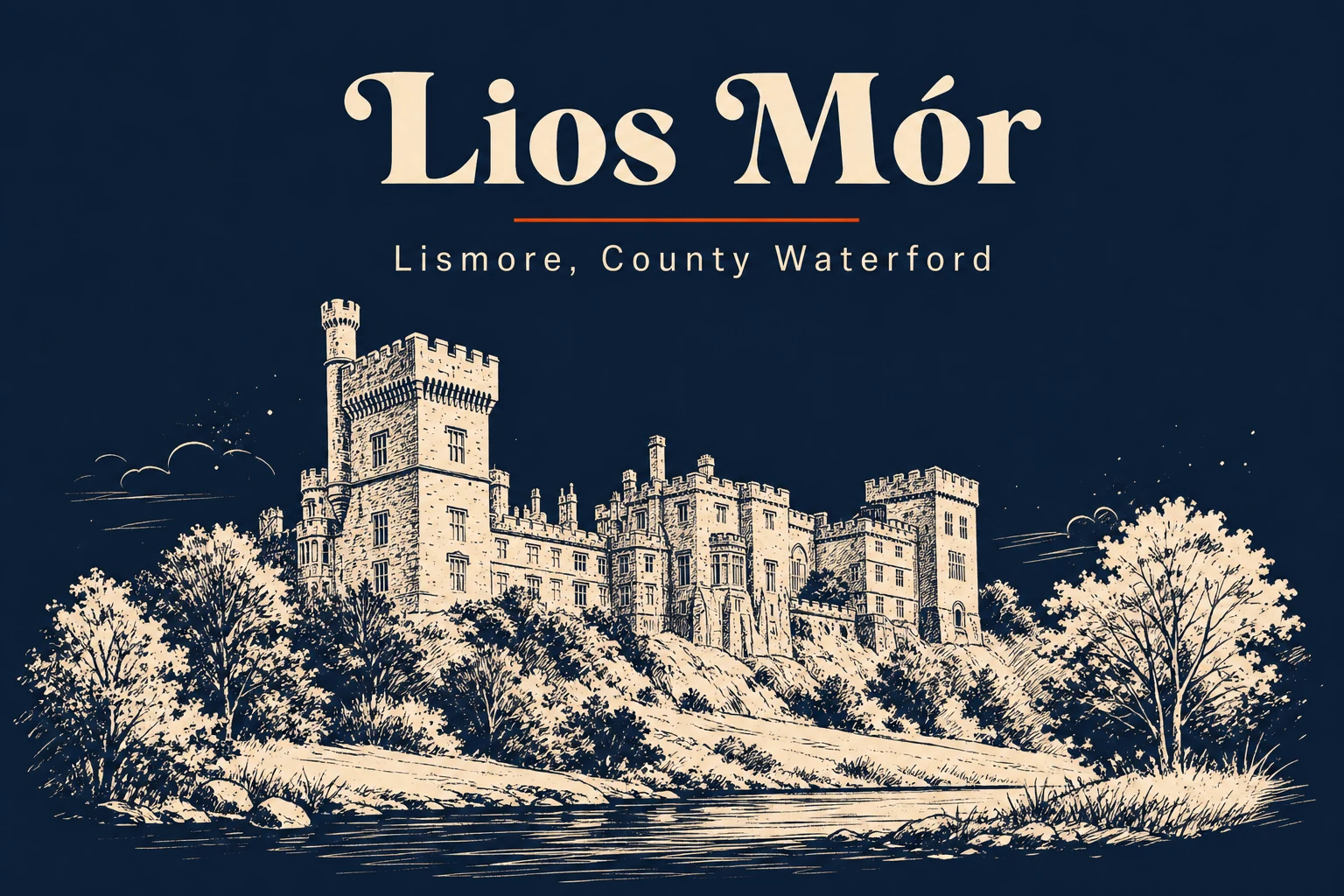
A castle on a bluff, a cathedral on a hill, a river that knows its own mind.

Lismore is a town that has been important for so long it stopped having to prove it. St Carthage founded a monastery here in 635 and it became one of the great centres of learning in early medieval Europe. The Normans built a castle on the same bluff. The Boyles took it. The Cavendishes married into it. Robert Boyle was born inside its walls in 1627 and went on to put chemistry on a scientific footing. The town that came out the other side of all that is small, calm, and properly itself.

What you see now is two streets, a cathedral, a heritage centre in the old courthouse, and the castle on the bluff above the bridge. The 6th Duke of Devonshire — "the Bachelor Duke" — got Joseph Paxton in to remake it in 1850, and the silhouette you photograph from the bridge is essentially Paxton's. The gardens open in season. The house does not, unless you rent it for a wedding the way Adele Astaire's family did in 1932.

Come for an afternoon and you will leave puzzled at how much was packed into one bend of a river. Come for two nights and you start to notice the rhythm — the cathedral bells, the slow turn of the Blackwater, the lights coming on at the Classroom on a Thursday for the trad. Lismore rewards the longer look. It always has.
Population
1,347
Walk score
Cathedral to castle gate in fifteen minutes
Founded
Monastic settlement, 635 AD
Coords
52.1389° N, 7.9333° W
01 / 09

At a glance.

Three things every local will eventually mention. Read these and you've already understood more than most day-trippers do.

02 / 09

The pubs.

None of these are themed Irish pubs, because they don't need to be. A few that earn the trip:

The Classroom Bar

Locals, music
Pub & trad sessions

Main Street. Traditional music on Thursday nights. The kind of small pub where the players sit by the window and you sit where you can.

Eamonn's Place

Quiet, conversational
Old-school pub

On Main Street. The room is the room it was thirty years ago. No music, no telly bothering anyone, the point is the talk.

Madden's

Steady regulars
Local

Town-centre pub of the sort that opens at five and never makes a fuss. A pint, a paper, a nod to whoever comes in.

The Red House Inn

Distinctive building, weekend music
Pub, food & rooms

Arts-and-Crafts end-of-terrace from 1902, and you'll spot it. Pub, restaurant, accommodation, music in the bar at weekends.

The Lismore House Hotel bar

Lounge, slower
Hotel bar

Quieter than the street pubs. Useful if you want a drink and a chair and to hear the person opposite you.

03 / 09

Where to eat.

PlaceTypeLocal note
Foley's on the Mall Bar & restaurant €€ On the Mall. Sit-down dinner that the town actually goes to — steaks, fish, a proper Sunday lunch. Book on weekends.
The Summerhouse Café Café & lunch 16c Main Street. Daytime spot for soup, brown bread, a cake at three. The kind of café you end up in twice in two days without meaning to.
The Lismore House Hotel Hotel restaurant €€ Town-centre hotel with a kitchen that turns out a fair dinner. Useful when the rain is in and you don't want to walk far.
The Red House Inn kitchen Pub food €€ If you're staying in Lismore on a Sunday and the rest of the town is shut, the Red House is open and the carvery is honest.
04 / 09

Where to sleep.

PlaceTypeLocal note
The Lismore House Hotel Hotel On the main square, the only proper hotel in town. Old building, comfortable enough, ten minutes' walk from the castle gate.
Ballyrafter House Hotel Country house hotel Across the river on the Cappoquin road, sitting in its own grounds with a direct view of the castle. The dining room is the postcard angle.
The Red House Inn Pub with rooms Rooms above the bar in the 1902 Arts-and-Crafts building on Main Street. Cheaper than the hotels and central to a fault.
A house out the Vee road Self-catering Drive ten minutes south toward the Knockmealdowns and the prices halve and the hills do the rest. Trust us.
05 / 09

Stories & lore.

The reason to come back. The things every local will eventually tell you about, usually after the second pint.

Born in the castle, 1627

Robert Boyle

The seventh son of the 1st Earl of Cork was born at Lismore Castle in January 1627. He went on to write The Sceptical Chymist in 1661, formulated the gas law that bears his name, and is generally credited with dragging chemistry out of alchemy. He died in London in 1691 and is buried there. The plaque on the bridge is the town's quiet claim on him.

How an English duke ended up with the place

The Devonshires

The Cavendish family came in by marriage in 1753, when Lady Charlotte Boyle married the Marquess of Hartington. The 6th Duke — the "Bachelor Duke" — engaged Joseph Paxton in 1850 and the present castle silhouette is largely Paxton's work, finished in the 1850s with help from his son-in-law and Pugin's panelling. In 1932 Lord Charles Cavendish, second son of the 9th Duke, married Adele Astaire — Fred Astaire's older sister and stage partner — at Chatsworth, and the pair were given Lismore as a wedding present. Adele lived here, on and off, until Charles died in 1944. The current Duke is still the owner.

The Munster planters next door

Spenser, Raleigh, and the river

Edmund Spenser did not live at Lismore — his castle at Kilcolman was over the Knockmealdowns in Cork, near Buttevant — but Sir Walter Raleigh held vast tracts at Lismore and Youghal in the same Munster Plantation, and Spenser was Raleigh's frequent guest. The story that Spenser finished the last verses of The Faerie Queene at Myrtle Grove in Youghal belongs there, not here, but the planters' Munster ran on the Blackwater and Lismore was its hinge.

Two treasures, one walled-up doorway

The Crozier and the Book

In 1814 workmen at Lismore Castle broke through a sealed doorway and found two of medieval Ireland's great objects: the Lismore Crozier — made for a 12th-century bishop of Lismore by a craftsman named Neachtain — and the 15th-century Book of Lismore. The Crozier is in the National Museum in Dublin. The Book of Lismore went to the Cavendishes' English seat at Chatsworth in 1930 and stayed there ninety years, until the trustees gave it to UCC in 2020. Both objects are gone from the town. The doorway is still there.

06 / 09

Things to do outside.

Wear waterproofs. Bring a sandwich. Tell someone where you're going if it's the mountain.

Lismore Castle Gardens Open seasonally — usually April to October. The upper garden is walled and Jacobean-old; the lower is the 19th-century pleasure ground with a Yew Walk that Spenser is sometimes claimed to have walked (he didn't, but it's old enough that he could have).
Seven acresdistance
1–2 hourstime
The Towers Walk Out from the town toward the wooded ridge above the river, past the Gothic estate towers built by the 6th Duke as eye-catchers in the 1820s. A short, properly woodland walk that doesn't show up on most lists.
3.5 km loopdistance
1 hourtime
The Vee Pass viewpoint The R668 climbs over the Knockmealdowns into Tipperary; the gap at the top is the Vee. Pull in at the layby and walk up to Bay Lough or to the cross above the road. South to the Comeraghs, north to the Galtees, the Blackwater valley laid out below.
Drive 18 km south, walk 10 minutesdistance
Half a morningtime
The Blackwater Way The waymarked riverside route runs east through Cappoquin and west toward Fermoy. From the bridge in Lismore you can pick it up either way and walk for an hour or a day.
As far as you likedistance
Open-endedtime
07 / 09

When to go.

There is no bad time. There are different times.

Spring
Mar–May

The castle gardens open in April; magnolias and camellias in the lower garden are worth the trip on their own. The river is high, the woods come into leaf, the town is quiet.

◉ Go
Summer
Jun–Aug

Long evenings on the Mall. Foley's gets busy, the Classroom is loud on a Thursday, the gardens are at their fullest. The Lismore Festival of Travel Writing pulls a crowd in June.

◉ Go
Autumn
Sep–Oct

Probably the best time. The crowds thin, the Blackwater valley turns, and the salmon are running. Immrama, the travel-writing festival, is in early June so you've missed it; the town is at its calmest.

◉ Go
Winter
Nov–Feb

The gardens shut in late October and don't reopen until April. The town stays open; the day is short. Come for the cathedral lit up, a fire at the Classroom, and an early dinner.

◐ Mind yourself
08 / 09

What to skip.

Honestly? Don't bother.

If a local was sitting beside you, this is the bit where they'd lean in.

×
Trying to tour Lismore Castle itself

The house is a private home and is not open to the public. The gardens are. If a brochure tells you you can tour the castle, the brochure is selling you the gardens with a misleading photograph.

×
The Book of Lismore

It is in UCC's Boole Library in Cork city, has been since 2020, and the Heritage Centre will tell you so. Worth seeing — in Cork.

×
Lismore as a half-hour stop on the way to somewhere

It looks small from the road. Stay a night. The cathedral, the gardens, the Towers walk, the Vee, a session at the Classroom — none of it fits into ninety minutes.

×
The Vee in low cloud

The viewpoint is the whole reason you drive up there. If the Knockmealdowns are in cloud, save it for another day; you'll be looking at a hedge.

+

Getting there.

By car

Cork city to Lismore is 1h on the N72 via Fermoy. Waterford city is 1h via Dungarvan and the N72. Cappoquin is five minutes east, Tallow twelve minutes west.

By bus

Local Link 360 runs Dungarvan–Lismore–Cappoquin several times a day. Bus Éireann's Cork–Waterford services pass through Fermoy and Dungarvan rather than Lismore itself; you transfer.

By train

No train. Nearest stations are Mallow (50 min by road) and Waterford (1h). Then bus or a hire car.

By air

Cork (ORK) is the obvious airport — 1h 15m by car. Shannon is 2h. Dublin is 3h.