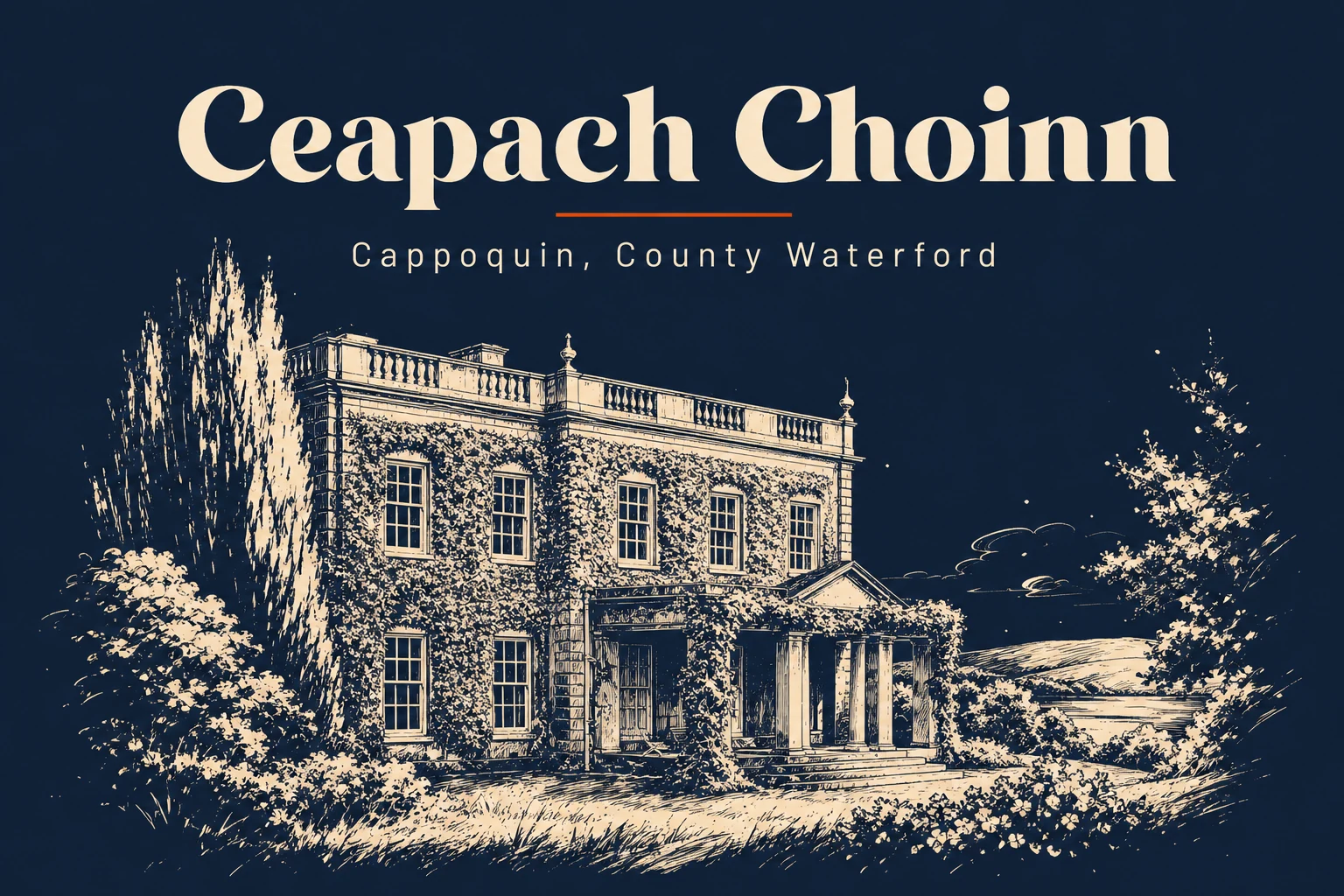
Ceapach Choinn · Co. Waterford
Where the Blackwater turns south, and a bakery has been open since 1887.
Cappoquin is the town where the Blackwater turns south. The river comes down through Cork and through Lismore, hits a wall of Knockmealdown sandstone, and pulls a sharp right for the sea at Youghal. The bridge sits on the corner. Above it the river is salmon water; below it the tide comes up. The town grew on the inside of the bend, between the river and the hill, and it has stayed roughly the size it was when the railway came in 1878 and roughly the size it was when the railway closed in 1967.
The two stories that matter are both about families that stayed. The Keanes have lived at Cappoquin House since the seventeenth century - the present house was built in 1779, burnt in 1923, rebuilt almost exactly. Six kilometres up the mountain, at land Sir Richard Keane gave the Cistercians in 1832, Mount Melleray Abbey ran a Trappist community for 190 years - the first monastery founded in Ireland after the Reformation, and as of January 2025, the most recent one to close. Down at the Square, John Barron opened a bakery in 1887. His great-great-granddaughter is still running it. The blaa from those ovens has EU geographical-indication status. None of these things are tourism. They are just what is here.
Don’t come for a checklist. Come for an afternoon. Park near the bridge, eat a blaa at Barron’s, walk the riverbank as far as the rapids, drive up to Melleray to see the empty cloister, drop down into Lismore for tea. If you stay for dinner, Richmond House on the Dungarvan road has been doing it properly since the Deevys took it on. If you stay the night, do it there or at the Toby Jug above the Main Street bar. That’s the town. Two days is generous. One is exactly enough.