County Waterford Ireland · Co. Waterford · Villierstown Save · Share
POSTED FROM
VILLIERSTOWN
CO. WATERFORD · IE

Villierstown
An Baile Nua

The Ireland's Ancient East
STOP 07 / 07
An Baile Nua · Co. Waterford

The only Hindu-Gothic gate in Ireland sits at the end of a 1740s linen village.

Villierstown was built on purpose. In the 1740s John Villiers — 1st Earl Grandison, landlord of the Dromana estate — laid out a single street, a church, a rectory, a school, a court, a police barracks and twenty-four houses, and brought linen-weavers down from Lurgan in Armagh to fill them. The Irish name, An Baile Nua, just means the new town. It has been the new town for two hundred and eighty years.

The linen industry did well for a century and then died with the Famine. The weavers' children turned to the river. The estate kept going. Dromana House — the seat above the Blackwater — has stayed in the same family line since the FitzGeralds of the Decies in the 1200s, through the Villiers marriage in the 1700s, into the Villiers-Stuarts who still live there. Eight centuries in one place, more or less unbroken, is a thing.

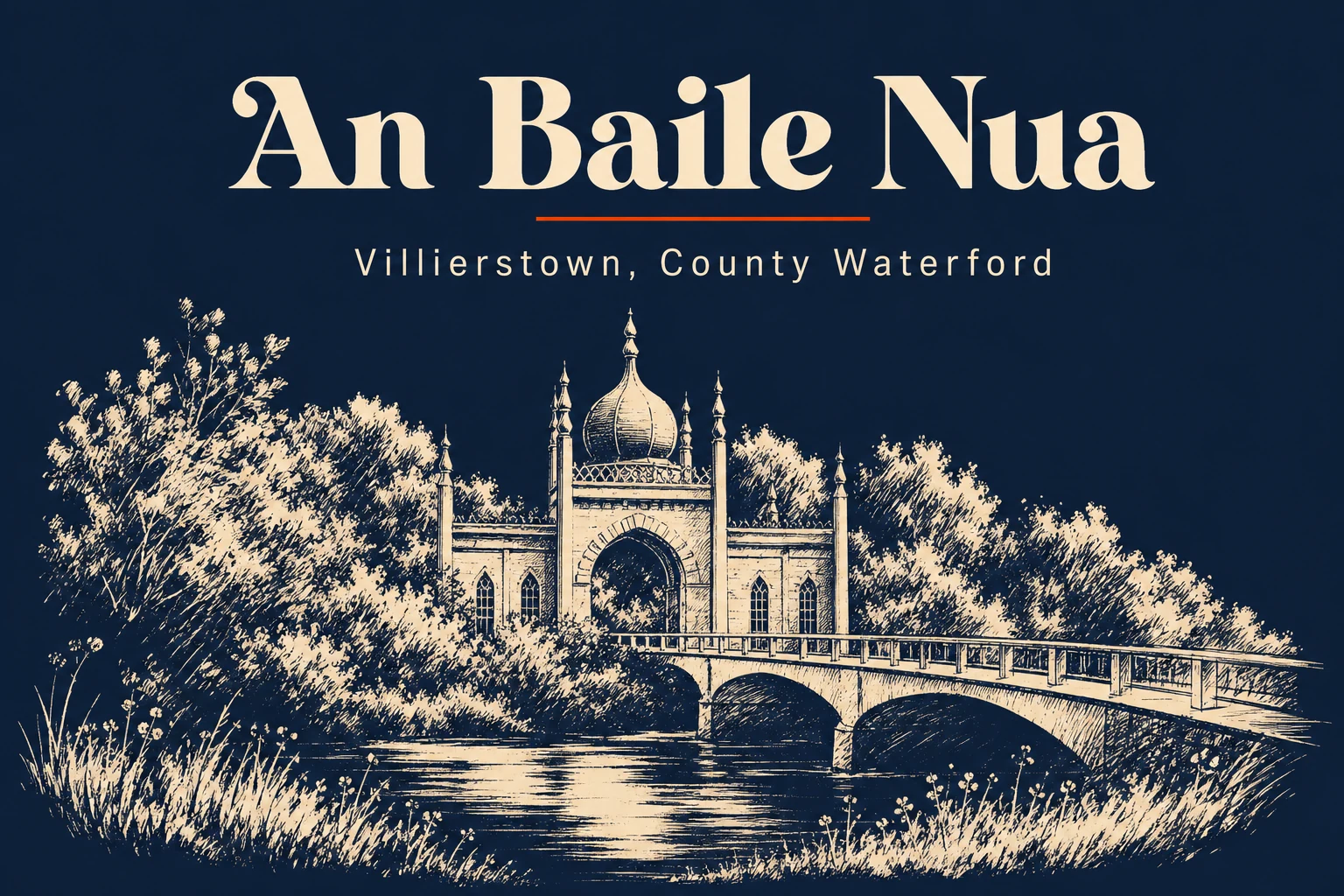
Then there is the gate. In 1826 Henry Villiers-Stuart brought his Austrian bride Theresia home from a honeymoon that had taken in Brighton. The locals, wanting to greet them, built a temporary papier-mâché arch over the bridge into the estate in the style of the Royal Pavilion — onion dome, minarets, ogival windows, the whole oriental fantasy. The couple liked it so much they had Martin Day rebuild it permanently in 1849. It is, as far as anyone has counted, the only Hindu-Gothic gateway in Ireland. You round a bend on a quiet Waterford road and there it is.
Population
276 (2016)
Pubs
1and counting
Walk score
One street, the church, the river — eight minutes end to end
Founded
Planned linen village, 1740s — John Villiers, 1st Earl Grandison
Coords
52.1167° N, 7.7833° W
01 / 07

At a glance.

Three things every local will eventually mention. Read these and you've already understood more than most day-trippers do.

02 / 07

The pubs.

None of these are themed Irish pubs, because they don't need to be. A few that earn the trip:

An Cruiscín Lán

One-room local
Village pub

The pub in Villierstown. Main Street. Open evenings most of the week, lunchtimes at the weekend. Open fire, a few stools, and the kind of conversation that starts in English and drifts wherever it wants.

03 / 07

Stories & lore.

The reason to come back. The things every local will eventually tell you about, usually after the second pint.

A village built to a plan, 1740s

An Baile Nua

John Villiers, 1st Earl Grandison, sat on the Dromana estate and decided in the 1740s that what west Waterford needed was a linen industry. So he built one. He laid out a single street running back from the Blackwater quay, put up a church in 1748, a rectory, a school, a court, a barracks and twenty-four weavers' houses, and shipped in linen-weavers from Lurgan in County Armagh to work the looms. At its peak the Douglas factory was turning out around 75,000 yards of sail-cloth a year. All of the original buildings are still standing.

1826, papier-mâché. 1849, stone.

The Hindu-Gothic gate

Henry Villiers-Stuart married Theresia Pauline Ott in 1826 and brought her home from honeymoon via Brighton, where John Nash's Royal Pavilion was a few years old and very much the thing. The tenants of Dromana, wanting to do something for the new mistress of the estate, built a triumphal arch over the bridge into the demesne in the Pavilion style — onion dome, minarets, ogival arches — out of wood and canvas and papier-mâché. The couple loved it so much they kept it. In 1849 the architect Martin Day rebuilt it in stone and stucco, where it still stands over the River Finisk. The Buildings of Ireland lists it as the only known example of Hindu-Gothic architecture in the country.

Church of Ireland, given to the Catholics, kept by neither

The chapel that changed sides

Lord Grandison's 1748 chapel served as a private Church of Ireland chapel-of-ease for the estate for two centuries. In the 1950s, with the Protestant congregation reduced to almost nobody, an agreement was reached with the Catholic Bishop of Waterford and Lismore to hand it over for use as a Catholic church — the first time, locally at least, that such a transfer had happened. The Catholic side then decided three parish churches were enough and didn't take it up. It closed in 1955. In 1974, President Erskine Childers came down and re-dedicated the building for ecumenical use. It is now the village community centre.

FitzGeralds, Villiers, Villiers-Stuarts

Eight hundred years, one family

Dromana has been held by the same descent line since the FitzGeralds of the Decies built a tower house above the Blackwater in the 1200s. The Villiers came in by marriage in the 1700s — Lady Gertrude Villiers married Lord Henry Stuart, and the surname doubled up into Villiers-Stuart. Henry, of the 1826 honeymoon, was their son. The current generation gives the tours, runs the gardens, and lives in the house. An hour with them is half house-history and half family-history and you mostly can't tell where one stops.

04 / 07

Things to do outside.

Wear waterproofs. Bring a sandwich. Tell someone where you're going if it's the mountain.

Dromana Wood Walks Inside the Dromana demesne, signposted from the village. A network of looped paths through 30 acres of woodland and garden, taking in the Bastion (an old riverside boat-house ruin) and the Rock House. Open daylight hours, modest entry fee at the gate when the office is staffed.
3.5 km of loopsdistance
1–2 hourstime
Villierstown to Dromana Gate Walk out the back road south from the village, follow the river along the Finisk, and the gate appears around a bend as you cross the bridge. The view is best from the north side of the bridge looking back.
3 km returndistance
45 mintime
The Blackwater quay Down from the church to the old linen-barge quay on the river. The water is broad and slow here. Herons most mornings. Salmon anglers in season.
Short strolldistance
20 mintime
05 / 07

When to go.

There is no bad time. There are different times.

Spring
Mar–May

Dromana woods open up, the daffodils run the river path, and the gate looks its best with the woodland behind it greening up. House tours run from May.

◉ Go
Summer
Jun–Aug

Dromana House and gardens are reliably open, the Blackwater valley fills with light, and the village stays quiet because almost nobody passes through by accident.

◉ Go
Autumn
Sep–Oct

The river goes copper, the woods turn, and there is just enough left of the season to catch a house tour before the gates close for winter. The best month for the photograph.

◉ Go
Winter
Nov–Feb

Dromana shut, the wood walks soft underfoot, the pub the only thing open. Fine for a drive-by of the gate. Not a base.

◐ Mind yourself
06 / 07

What to skip.

Honestly? Don't bother.

If a local was sitting beside you, this is the bit where they'd lean in.

×
Turning up at Dromana House without checking the tour schedule

It is a working family home. Tours run on set days in season, given by whichever family member is around. Confirm via dromanahouse.com before driving.

×
Stopping at the gate and skipping the village

The Hindu-Gothic gate is the photograph. The village two minutes up the road — 1748 chapel, weavers' street, the quay — is the story that earns it.

×
Looking for a hotel here

There isn't one, and there hasn't been. Stay in Cappoquin or Lismore and drive out. Eight kilometres each way.

+

Getting there.

By car

Cappoquin is 8 km north on the R671. Dungarvan is 20 km east. Youghal 20 km south-west. The N72 is the spine of the Blackwater valley; turn off at Cappoquin or Aglish.

By bus

No regular service through the village. The closest scheduled stops are at Cappoquin (Local Link 360) and Lismore (Bus Éireann 362). Taxi or lift from there.

By train

No station. Nearest is Dungarvan (no longer a passenger station) or Mallow, an hour west. Most people drive.

By air

Cork (ORK) is 1 hour 15 by car. Waterford airport is closer but mostly seasonal.