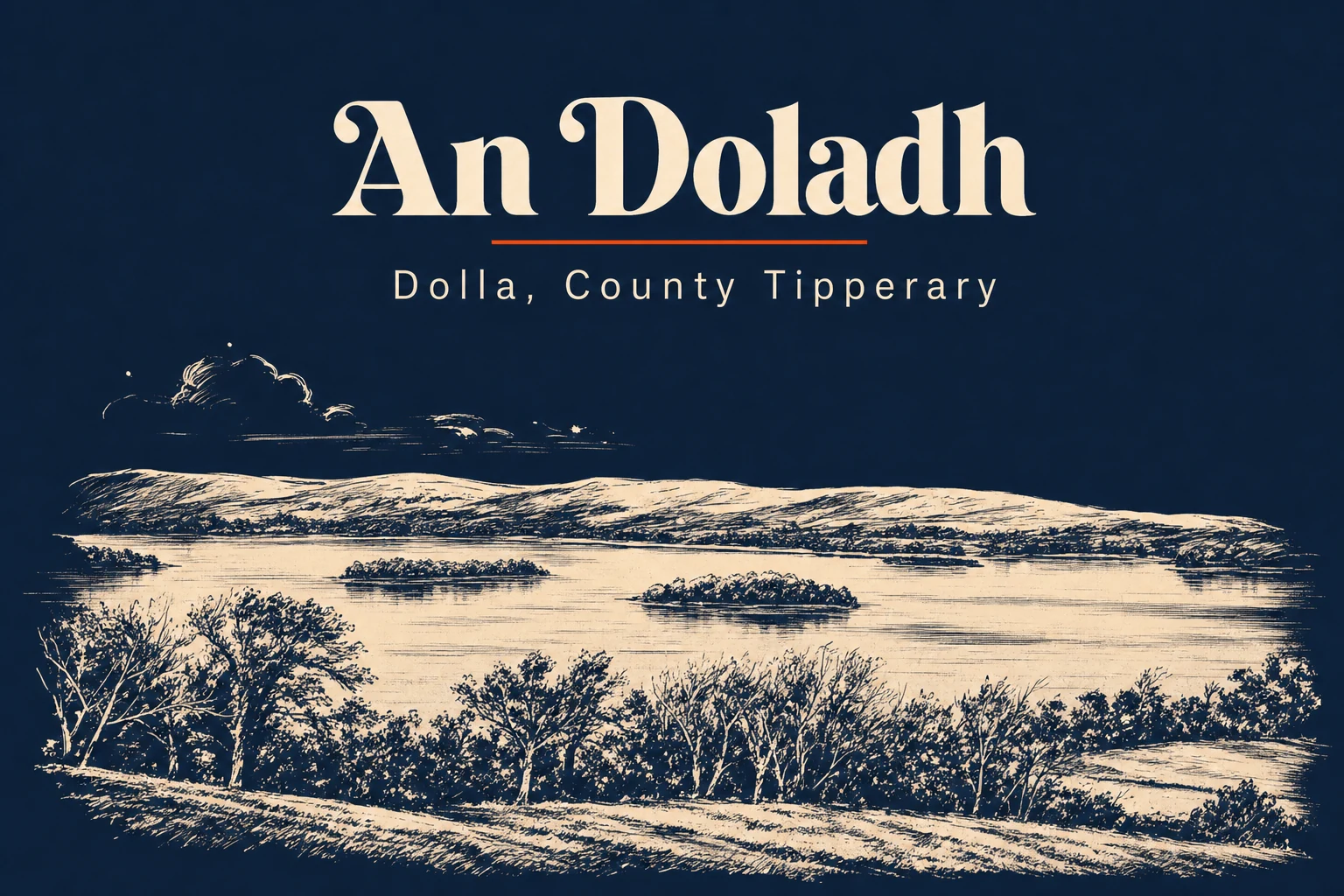
An Doladh · Co. Tipperary
A crossroads in the Silvermines hills, with a lot of history underneath it.
Dolla is a crossroads where the R497 and R499 meet, eight kilometres south of Nenagh at the foot of the Silvermines hills. The 1889 Bassett's Directory described it as 'a rural post office, good dairying land, and a fair trout river through the parish.' That is still a reasonable description. It is not a destination village. It is the kind of place you drive through on the way to a walk, and then find yourself thinking about afterwards.
The hills behind it carry more history than the village itself lets on. Mining here goes back to 1289, when Italian workers from Genoa and Florence arrived under English Crown sponsorship to extract silver. They operated until 1303, when a killing led to an attack on the workers and the mines shut abruptly. What followed over the next seven centuries was a stop-start extraction of silver, lead, zinc, copper and baryte that ended only in 1993. The Mogul mine at its peak was the largest base metal mine in Europe. The tailings ponds on the southern approach to Silvermines village are its legacy - capped, fenced, and being slowly rehabilitated.
Above the crossroads, the ruins of Kilboy Church stand beside an old graveyard. The Kilboy estate behind them was built for the Prittie family - the future Lords Dunalley - around 1780, burned by anti-Treaty forces in 1922, partly demolished in the 1950s, and eventually bought by Tony Ryan, the Thurles-born founder of Ryanair, who set about restoring it. A fire in 2005 undid much of that work. The house was rebuilt again. It is private, and the story is better than the view from the road.