County Tipperary Ireland · Co. Tipperary · Nenagh Save · Share
POSTED FROM
NENAGH
CO. TIPPERARY · IE

Nenagh
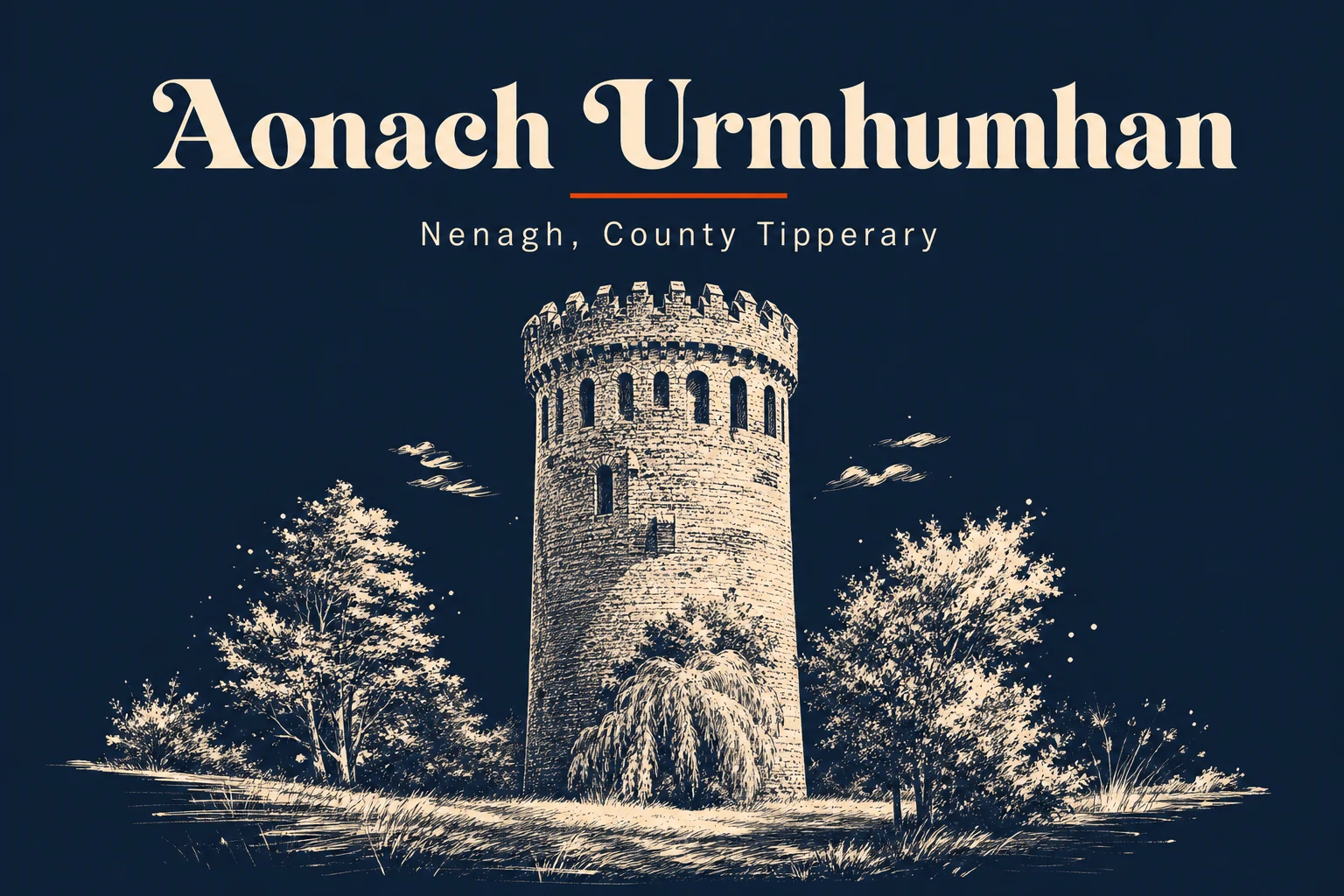
Aonach Urmhumhan

The Ireland's Ancient East
STOP 08 / 08
Aonach Urmhumhan · Co. Tipperary

A market town that built a castle first and asked questions later.

Nenagh sits in the flat middle of North Tipperary, with the Silvermine Mountains rising to the south and Lough Derg ten kilometres to the north-west. It was a market town before it was anything else — its Irish name, Aonach Urmhumhan, means the Fair of Ormond — and the fair instinct has never quite left. Kenyon Street is where commerce has always happened, and commerce still does.

The castle went up around 1200, built by the Butler family who would go on to run a large piece of medieval Ireland from this base. The cylindrical keep they left behind is one of the best-preserved of its kind: 101 steps, free entry, the top quarter added by a bishop in the 1860s who thought it should be taller. He modelled it on Windsor Castle, which is an ambition you have to respect even if the result is slightly improbable above a Tipperary market town.

The town had its darker architecture too. The former gaol — now Nenagh Heritage Centre — was built in 1840 and ran until 1887. The Governor's House and Gatehouse are intact; inside you can read the story of the Cormack brothers, hanged here, and walk the condemned cells. It is not a comfortable hour, which is the point.

What makes Nenagh more than a service town is Country Choice. Peter Ward opened it in 1982 when specialist food retail in provincial Ireland was essentially non-existent. It became a reference point — for producers, for chefs, for anyone who wanted to know what Irish farmhouse cheese and cured meat looked like before the supermarkets got to them. The shop is still there on Kenyon Street. So is the argument.
Population
9,895
Walk score
Town centre in 20 minutes on foot
Founded
c. 1200 (castle and market town)
Coords
52.8614° N, 8.1975° W
01 / 08

At a glance.

Three things every local will eventually mention. Read these and you've already understood more than most day-trippers do.

02 / 08

Where to eat.

PlaceTypeLocal note
Country Choice Deli, café, specialist food shop Peter and Mary Ward's shop on Kenyon Street, open since 1982. Farmhouse cheeses, cured meats, preserves, and a café counter that does lunch properly. Go on a Saturday when the shelves are fullest.
The Peppermill Restaurant and wine bar €€ Robert and Mairead Gill's restaurant at 27 Kenyon Street, open Tuesday to Sunday for dinner (Wednesday to Saturday for lunch too). Irish produce, a serious wine list, local following. Book ahead at weekends.
Abbey Court Hotel bistro Hotel restaurant €€ The hotel dining room on Dublin Road. More reliable than it needs to be for a hotel restaurant of this size. Useful if you're staying and the town is quiet on a midweek night.
03 / 08

Where to sleep.

PlaceTypeLocal note
Abbey Court Hotel Hotel 83 rooms on the Dublin Road, leisure centre with pool, 300 free car spaces. The biggest hotel in North Tipperary by some distance. Functional and well run. Five-minute walk to the castle.
B&Bs around Dromineer B&B / self-catering Drive ten kilometres out to the Lough Derg shoreline at Dromineer and the accommodation options halve in price and double in view. Worth it if you have a car and are staying more than one night.
04 / 08

Stories & lore.

The reason to come back. The things every local will eventually tell you about, usually after the second pint.

A keep that grew taller

The Bishop's ambition

Nenagh Castle's cylindrical donjon was built around 1200, likely by the Butler family. It stood at roughly 75 feet for six centuries. Then in the 1860s the Bishop of Killaloe decided it should be taller — and had the top quarter added in a style he described as inspired by Windsor Castle. The result is a tower that historians can date precisely by looking at the masonry: everything above a certain line is Victorian. The 101-step climb gets you to the parapet either way, and the views across North Tipperary are the same as they always were.

Before the GAA had rules

The first game

Hurling in Nenagh predates the GAA by generations, but the town has a specific claim: the first game played under the new rules after the founding of the GAA in 1884 was contested between a Nenagh team, John Mitchell's, and a Lorrha selection. The game was played on a field, under rules that would be argued about for years afterwards, by men who had never heard of Croke Park. Nenagh Éire Óg have been doing it properly ever since — county finalists as recently as 2025.

Hanged in the Governor yard

The Cormack brothers

The Nenagh gaol records are not comfortable reading. The Governor's House and Gatehouse — now the Heritage Centre — processed prisoners from 1840 to 1887. The Cormack brothers, hanged in the yard, are the case most associated with the building. Their story is told inside the gatehouse, in the condemned cells, in the kind of detail that makes the visit land harder than you expect from a county-town museum.

What the name remembers

The Fair of Ormond

The Irish name Aonach Urmhumhan — the Fair of Ormond — records what Nenagh was before it had a castle: a site of periodic assembly and trade in the territory of the Butlers. The Normans built a castle on top of the fair ground, as Normans tended to do. The market town that grew around the castle kept the fair instinct, and Kenyon Street is still where the trading happens. The name in Irish is more honest about the town's origins than anything built since.

Founded 1252, still standing (partially)

The Franciscan friary

The Franciscan friary was established in Nenagh by 1252 — possibly by Theobald Butler — and became, for a time, the principal Franciscan house in Ireland. A provincial synod was held here in 1344. The Annals of Nenagh, chronicling the deaths of local families, were compiled within its walls between 1336 and 1528. The friary was burned by the O'Carrolls in 1548 and never recovered. What remains — the walls of a 43-metre church on a lane off Friar Street — is not signposted, is not managed by the OPW, and will take you a moment to find. Find it.

05 / 08

Things to do outside.

Wear waterproofs. Bring a sandwich. Tell someone where you're going if it's the mountain.

Dromineer and Lough Derg foreshore Drive the R495 north-west to Dromineer — ten kilometres, fifteen minutes. The Lough Derg Yacht Club has been racing here since 1835. Walk the foreshore, watch the Shannon One Designs come in. Come back to Nenagh for dinner.
10 km from Nenagh (by car), then walk at willdistance
1–2 hours at the loughtime
Knockanroe Woods — Silvermines Loop Drive south on the R500 to Silvermines village, then 2.5 km to the trailhead at Knockanroe. Forest and open hillside, views over the Silvermines area and Keeper Hill. Ten kilometres from Nenagh. Free car park at the trailhead.
4.3 km loopdistance
1.5 hourstime
Nenagh town heritage trail Castle to Heritage Centre to Franciscan friary ruins to the Church of St Mary of the Rosary on O'Rahilly Street. Do it in that order. The friary ruins are the least-signposted stop and the most worth finding.
2 kmdistance
1–2 hours (with stops)time
06 / 08

When to go.

There is no bad time. There are different times.

Spring
Mar–May

Lough Derg comes back to life in April. The Silvermine hills are good walking before the summer ferns grow in. Country Choice is busy on Saturdays.

◉ Go
Summer
Jun–Aug

The LDYC regatta runs in August — the lough at Dromineer is as active as it gets. Nenagh itself is a market town, not a resort; it doesn't overcrowd. The castle is open Tuesday to Saturday.

◉ Go
Autumn
Sep–Oct

The best season for the Silvermine walks. Hurling season wraps up — if Nenagh Éire Óg have made the county final, the town has an opinion about it.

◉ Go
Winter
Nov–Feb

The castle closes. Country Choice still opens. The Peppermill still opens from Tuesday. Not a dead town in winter, but check opening hours before you drive.

◐ Mind yourself
07 / 08

What to skip.

Honestly? Don't bother.

If a local was sitting beside you, this is the bit where they'd lean in.

×
Assuming Lar na Páirce GAA museum is in Nenagh

It's in Thurles, 30 kilometres south. A different town, a different day trip. Don't arrive in Nenagh looking for it.

×
The castle on a wet Monday morning

It's an unguided, unheated stone tower. Worth every minute in good light. In horizontal rain, come back on a dry afternoon. The 101-step staircase is steep and can be slippery.

×
Driving past Dromineer on your way around Lough Derg

Dromineer is ten kilometres from Nenagh and most visitors go straight to Killaloe or Portumna. Stop. Sit at the water for twenty minutes. It costs nothing and the lough at Dromineer is a different thing from the lough at the visitor car parks.

+

Getting there.

By car

Limerick to Nenagh is 40 km on the M7/N52 — under 40 minutes. Dublin is about 2 hours via the M7 to the Nenagh junction. Birr in Offaly is 37 km north on the N52, about 35 minutes.

By bus

Bus Éireann runs the 67 Dublin–Limerick expressway via Nenagh, several times daily. Journey from Limerick is about 50 minutes; from Dublin about 2h 15m. The bus stop is central.

By train

The Limerick–Ballybrophy line stops at Nenagh — one of the quieter rural rail routes in Ireland. From Limerick, around 1 hour. Services are limited; check times before planning around them.