County Tipperary Ireland · Co. Tipperary · Silvermines Save · Share
POSTED FROM
SILVERMINES
CO. TIPPERARY · IE

Silvermines
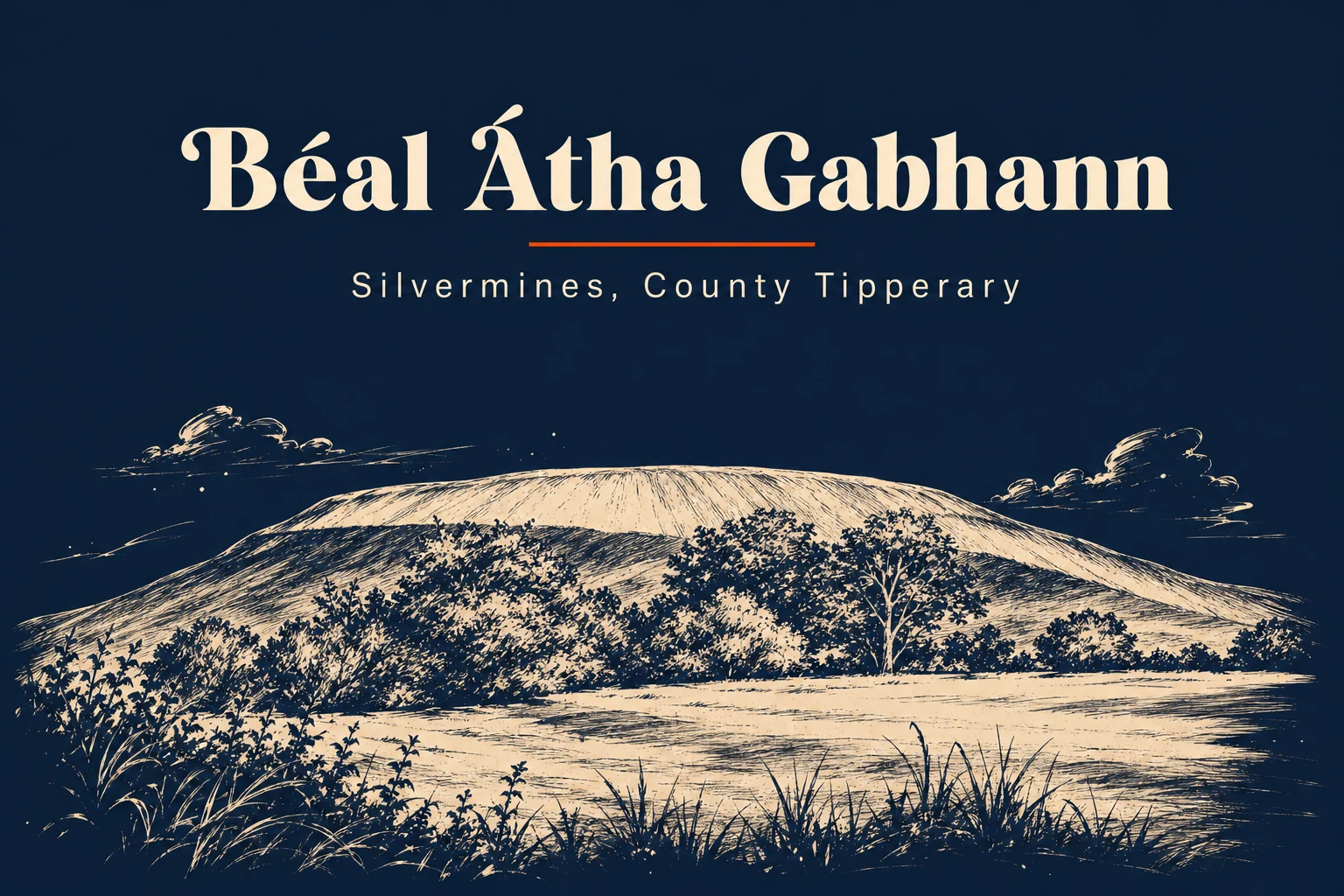
Béal Átha Gabhann, Co. Tipperary

The Ireland's Ancient East
STOP 07 / 07
Béal Átha Gabhann · Co. Tipperary

Seven centuries of metal pulled from one hillside, then silence.

Silvermines is a small north Tipperary village on the R499 between Nenagh and Newport, sitting at the foot of the mountains that share its name. Three hundred people, a pub, a church, a car park for the walking trails. It does not look like a place with a seven-century industrial history. It is one anyway.

The mining ran from 1289 - when Italian merchants from Genoa and Florence came looking for silver under an English crown licence - through to 1993, when the last baryte operation at Macgobar finally closed. In between: lead, zinc, copper, pyrite, baryte. Centuries of intermittent workings, a couple of Victorian booms, and then the big one. The Mogul Mine opened in September 1968 - Taoiseach Jack Lynch cut the ribbon in front of 600 guests - and ran for fourteen years as the largest base metal mine in Europe, shifting 3,000 tonnes of ore a day and employing over 500 people from north Tipperary. When it shut in 1982 the valley felt it.

What the mine left behind took longer to deal with than the mine itself. The 148-acre Gortmore tailings pond - the holding facility for ground-up rock - spent years as an environmental liability, leaching heavy metals into local land and watercourses, fouling the Kilmastulla River. Cattle died. Farms were affected. Remediation took decades to fund and begin. The state eventually put in €10.6m; the pond is now capped. The mountains above it are walking trails. The village carries on.
Population
301
Walk score
Village in two minutes; mountain in two hours
Founded
Mining recorded from 1289
Coords
52.7833° N, 8.2333° W
01 / 07

At a glance.

Three things every local will eventually mention. Read these and you've already understood more than most day-trippers do.

02 / 07

The pubs.

None of these are themed Irish pubs, because they don't need to be. A few that earn the trip:

Hickey's Bar

Quiet, no-nonsense
Local pub

Main Street, Silvermines. The village pub. Not a destination in the tourist sense - the kind of place the Mogul miners drank after shift, and their sons after them. Worth a pint if you are here for the walking.

03 / 07

Stories & lore.

The reason to come back. The things every local will eventually tell you about, usually after the second pint.

Genoa and Florence, 1289

The Italian merchants

In 1289 merchants from the Italian city-states of Genoa and Florence arrived in Tipperary under licence from the English crown to work silver deposits in the Silvermines hills. They operated here until 1303 - fourteen years of medieval extraction at the western edge of Europe, by men who had come further than almost anyone else in Ireland at the time. The silver they found was real. The venture made money. And then they left, and the hills went quiet for a generation.

Largest base metal mine in Europe

The Mogul Mine

The Mogul of Ireland Ltd opened its mine at Garryard, Silvermines, on 11 September 1968 - three marquees, 600 guests, Taoiseach Jack Lynch with the ribbon. At peak it processed 3,000 tonnes of ore per day, employed over 500 people, and was the largest base metal mine in Europe. Ten million tonnes of lead and zinc ore came out of this hill before the resource ran down and prices fell. The underground operation closed in July 1982. The last mine on the site - the Macgobar baryte operation - ran until 1993. Then it was over.

148 acres of aftermath

The tailings pond

The Gortmore tailings management facility - where Mogul deposited the crushed and processed rock - covered 148 acres of the valley floor. After mining ended it became a slow-motion environmental problem: zinc and lead leaching into watercourses, cattle poisoning incidents, farm damage claims, years of arguments about who was responsible. The state allocated €10.6m for rehabilitation in 2005. The pond is now capped. Five historic mine structures were preserved. The Kilmastulla River runs cleaner than it has in decades. What the hill gave out in ore, it extracted again in time and money.

04 / 07

Things to do outside.

Wear waterproofs. Bring a sandwich. Tell someone where you're going if it's the mountain.

Knockanroe Wood Loop Starts at the Knockanroe Woods car park. Forest track gives way to open hillside with views north to Lough Derg and south toward Keeper Hill. Marked with purple National Looped Walk arrows. Waterproof boots - sections of soft ground even in summer.
4.3 km loopdistance
1.5 hourstime
Slieve Felim Way The national waymarked trail passes through Silvermines. Most walkers do it in sections from Silvermines toward Newport or Murroe. The village car park is a standard start point. Full trail guide available from Tipperary Tourism.
43 km waymarked traildistance
Multi-day or sectionaltime
05 / 07

When to go.

There is no bad time. There are different times.

Spring
Mar-May

Best light on the hills, trails drying out. The Silvermines Mountains show well in April and May.

◉ Go
Summer
Jun-Aug

No real crowds. Come for the walking, the long evenings, the quiet. This is not a busy village even in August.

◉ Go
Autumn
Sep-Oct

The hill colour is good from mid-September. Slieve Felim walking conditions at their best.

◉ Go
Winter
Nov-Feb

Trails can be wet and exposed on the open ridge. The village gets quiet. Come in good gear or come back in March.

◐ Mind yourself
06 / 07

What to skip.

Honestly? Don't bother.

If a local was sitting beside you, this is the bit where they'd lean in.

×
Expecting a mining museum

There isn't one. A heritage centre was proposed and planned years ago; it has not materialised. The industrial history is real; the interpretation infrastructure is not. Bring your own knowledge or read ahead.

×
The Knockanroe loop in trail runners

The open hillside section runs wet almost year-round. The forest track drains fine; the ridge does not. Waterproof boots are not optional.

+

Getting there.

By car

Nenagh is 10km north on the R499. Newport is 12km south. From Limerick, allow 50 minutes via the M7 and N52. No meaningful public transport serves the village itself.

By bus

Bus Éireann serves Nenagh from Limerick and Dublin. From Nenagh, Silvermines is a 10km drive or taxi. No scheduled service into the village.

By train

Nearest station is Nenagh (Limerick to Ballybrophy line). Then taxi or prearranged lift - 10km.