County Tipperary Ireland · Co. Tipperary · Grange Save · Share
POSTED FROM
GRANGE
CO. TIPPERARY · IE

Grange
An Ghráinseach, Co. Tipperary

The Ireland's Ancient East
STOP 06 / 06
An Ghráinseach · Co. Tipperary

A hill village that exists because a Cistercian abbey needed a farm.

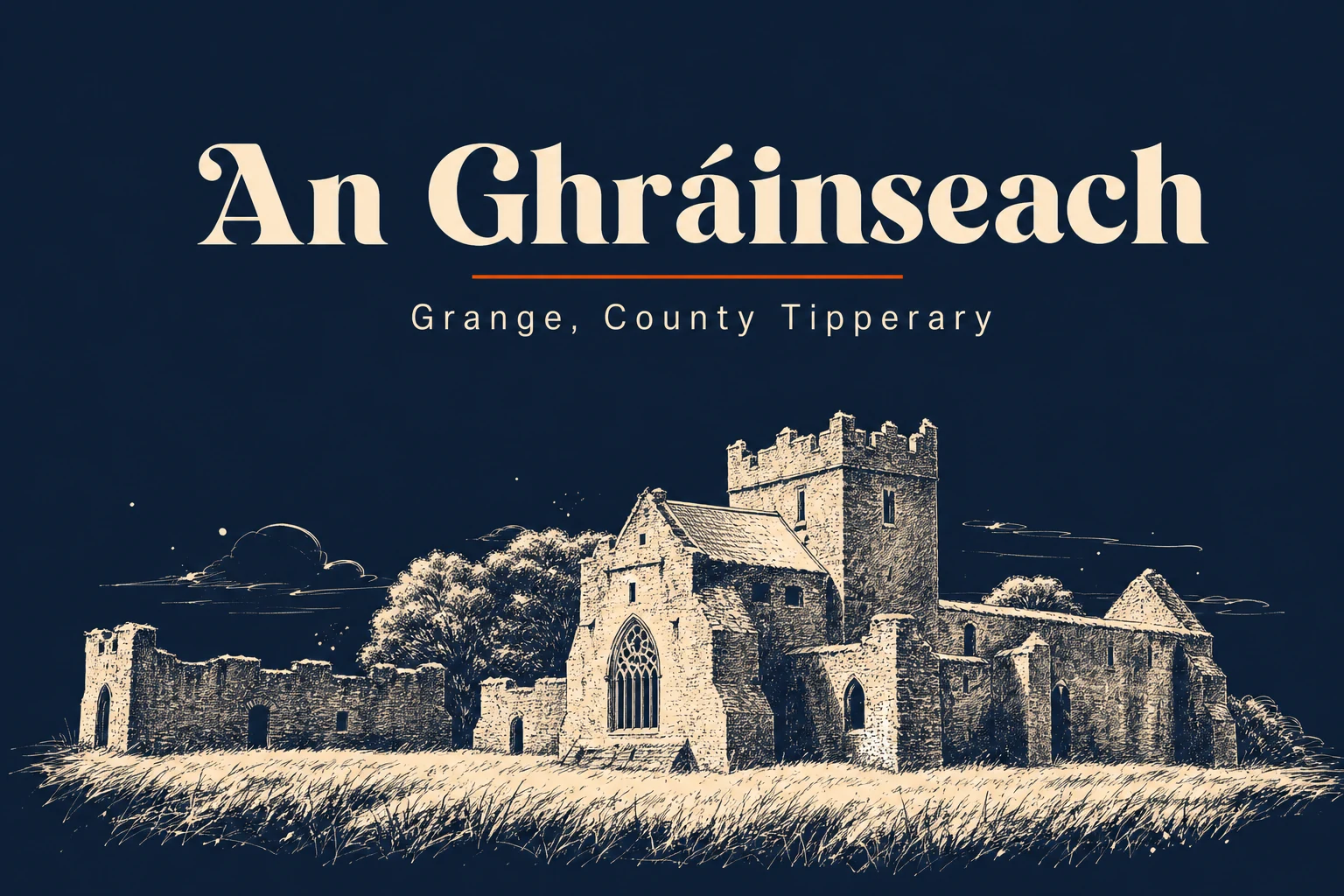
Grange is where the Cistercians kept their farm. The monks at Kilcooley Abbey founded it around 1182 when Donal Mór O'Brien granted them the land, and the village grew up to work the abbey's out-farm - a grange in the medieval sense: a storage and working farm attached to a larger monastic estate. The abbey is still there, half a kilometre away in the trees of the Kilcooley demesne, its carved stonework intact. The farm is long gone. Ten houses, said Bassett's directory in 1889. Not many more today.

The walk up to the Wellington Tower is the reason most people come. Sir William Barker built it in 1817 to mark the second anniversary of Waterloo - he was the landlord of the Kilcooley estate, and it was the sort of thing landlords did. It is technically a folly: it looks like a defensive tower from two sides and has almost nothing behind the facade on the other two. Forestry planted in the twentieth century buried it so thoroughly it disappeared from local memory. When Coillte clear-felled in the early 1990s it reappeared, the dedication stone still legible. A modern steel spiral staircase was added beside it so you can get to the top. The views on a clear day take in the whole of the Tipperary plain.

There is an ice house on the Crag Loop walk - built to store winter ice for the Kilcooley house, a mile away down a cast-iron pipeline. It is now the water filtration station for the estate. The ice house predates the pipeline by perhaps a century. The walk passes it quietly and keeps going. That is the texture of this place: layers of use, centuries of quiet, the ridge above and the abbey below and the plain stretching west until it runs into other counties.
Walk score
Two looped walks; village itself in five minutes
Founded
Out-farm of Kilcooley Abbey, c. 1182
01 / 06

At a glance.

Three things every local will eventually mention. Read these and you've already understood more than most day-trippers do.

02 / 06

Stories & lore.

The reason to come back. The things every local will eventually tell you about, usually after the second pint.

Founded 1182, burned twice, still standing

Kilcooley Abbey

Donal Mór O'Brien, King of Thomond, granted land here to the Cistercians in 1182. The monks came from Jerpoint, the great Cistercian house across the Kilkenny border. They built an abbey dedicated to the Virgin Mary and St Benedict. In 1418 it was burned in a raid. In 1445 it was burned again, almost completely destroyed. The abbot Philip O'Mulwanayn rebuilt it in the years that followed - the stonework you can see today is largely his work. The dissolution came in 1540. The estate passed through several owners: Ormonde, a Norfolk judge named Jerome Alexander, then the Barker family through his daughter's marriage. The Barkers held Kilcooley for nearly two centuries. Sir William Barker - the one who put the tower on the ridge - was the last of the direct line; he died in 1818, the year after he built it.

A folly built for a battle two years past

The Wellington Tower

In 1817, Sir William Barker commissioned a monument on the crag above Grange to mark Wellington's victory at Waterloo. The structure is an architectural trick - from the south and west it reads as a square defensive tower with pointed arch niches and Greek cross loops. From the north and east there is almost nothing behind the facade. It was always meant to be looked at from below. The estate forestry planted in the mid-twentieth century grew up around it and hid it for decades. By the time Coillte clear-felled in the early 1990s, most people had forgotten it was there. The dedication stone on the west face remained legible. A modern steel spiral staircase was installed beside it. You can now stand at the top and see from the Kilcooley demesne all the way west to the Devil's Bit mountain.

An Ghráinseach - the grange of the monks

The name

The village is named for what it was: a grange, an out-farm attached to a monastic estate. The Cistercians at Kilcooley ran Grange as a working farm - storing grain, keeping livestock, supplying the abbey. This was standard practice for Cistercian houses across medieval Ireland and Europe. When the monastery was dissolved in 1540 the farm went with the estate, but the name stayed. It is still listed in the barony of Slieveardagh, in the civil parish of Kilcooly, on the Tipperary side of the hills.

03 / 06

Things to do outside.

Wear waterproofs. Bring a sandwich. Tell someone where you're going if it's the mountain.

Grange Loop The shorter of the two marked walks. Starts at the sign opposite Hogan's Bar and Shop in the village. Easy forestry tracks on the lower slopes. Passes the Kilcooley ice house. Developed and maintained by the Grange Development Group of Slieveardagh Rural Development.
3 km loopdistance
1-1.5 hourstime
Grange Crag Loop The full loop, also starting opposite Hogan's in the village. Climbs through mixed woodland on forestry tracks to the ridge and the Wellington Tower at the summit. Views open up across the Kilcooley demesne and west across the Tipperary plain. The ice house is on the lower section - veer left at it. Moderate, no technical difficulty.
6 km loopdistance
2-2.5 hourstime
04 / 06

When to go.

There is no bad time. There are different times.

Spring
Mar-May

The forestry paths are dry enough, the views sharp. Almost no one else around.

◉ Go
Summer
Jun-Aug

The woodland is full canopy by July. Good shade on the Crag Loop. Still very quiet.

◉ Go
Autumn
Sep-Oct

Best light on the Tipperary plain from the ridge. The forestry turns. The walks are at their best.

◉ Go
Winter
Nov-Feb

The tracks can be muddy after rain. Boots essential. The tower is dramatic in low cloud if you can handle the path.

◐ Mind yourself
05 / 06

What to skip.

Honestly? Don't bother.

If a local was sitting beside you, this is the bit where they'd lean in.

×
Expecting a village with things in it

There is a bar and a shop. That is the village. Grange is a place to walk from, not to tour. If you need lunch and a heritage centre, Thurles is twenty kilometres west.

×
Trying to get inside Kilcooley Abbey

The abbey is inside the private Kilcooley Estate demesne. It is not publicly accessible in the normal way. The walking trails go past the boundary and you can see the ruins from parts of the route, but do not wander into the demesne without permission.

+

Getting there.

By car

Grange sits on a minor road off the R689, roughly 20km northeast of Thurles and 5km south of Urlingford. The walks are signed from the village. There is limited roadside parking near the start point.

By bus

No regular bus service to Grange village. Urlingford (5km north) has more frequent connections to Kilkenny and Thurles.