County Tipperary Ireland · Co. Tipperary · Killenaule Save · Share
POSTED FROM
KILLENAULE
CO. TIPPERARY · IE

Killenaule
Cill Náile, Co. Tipperary

The Ireland's Ancient East
STOP 08 / 08
Cill Náile · Co. Tipperary

Coal, hurling, and a church with a Pearse pulpit.

Killenaule sits at the south-western edge of the Slieveardagh Hills, in a part of Tipperary that most visitors drive straight through on the way to Cashel or Clonmel. That's fair enough. It's a small town with two pubs and one main street. But look at what that street is carrying: a church with a pulpit carved by a man who would die in front of a firing squad fourteen years later, a heritage centre housed in a former Church of Ireland that charts three centuries of coal mining, and a GAA ground where the Robins have been testing themselves against Mullinahone and Fethard since before most European states had functioning constitutions.

The coal is the part that catches you off guard. You don't expect anthracite in Tipperary. The Slieveardagh Hills don't look like a coalfield - they look like every other soft Irish hill - but the seams run underneath them, and men dug into them from at least 1654 until the 1990s. In 1826, the Mining Company of Ireland built Mardyke, two kilometres from Killenaule, as a planned village for their workers. Offices, a police barracks, a school, rows of terraced houses. It became the first industrial mining village in Ireland, and it still exists, though the mine is long gone.

In 1848, with the Young Ireland uprising collapsing across Tipperary, the townspeople of Killenaule put up barricades across the roads to slow the military pursuit of William Smith O'Brien, who was in the area. The town has been called "Killenaule of the barricades" ever since - not by everyone, and not loudly, but the phrase is in the record books. It's the kind of detail that doesn't make the tourist board copy but makes you look at a place differently.
Population
755
Pubs
2and counting
Walk score
Town in 10 minutes; hills take a bit longer
Founded
Monastery of St Naul, 6th c.
Coords
52.5631° N, 7.6731° W
01 / 08

At a glance.

Three things every local will eventually mention. Read these and you've already understood more than most day-trippers do.

02 / 08

The pubs.

None of these are themed Irish pubs, because they don't need to be. A few that earn the trip:

Quinn's Bar and Grocery

Old-style, unhurried
Traditional pub and shop

Over a hundred years on Main Street. Part bar, part grocery - the kind of place that hasn't decided it needs to be one or the other. Open seven days. The Friday and Saturday late bar is the heartbeat of the town's week.

The Bit & Bridle

Community-leaning, weekend-active
Pub and food

On Main Street since 2007. Closed Tuesday and Wednesday. Serves a full Irish at weekends and handles christenings and birthday gatherings. Not a session pub, but it's a real pub - the kind that does the village's social heavy lifting.

03 / 08

Where to sleep.

PlaceTypeLocal note
Ardagh House Guesthouse Five rooms in the centre of town, locally known as "The Hotel" - which tells you something about the scale of Killenaule's accommodation offer. Confirm current status before booking; it has had periods of closure. Twenty minutes from Cashel.
04 / 08

Stories & lore.

The reason to come back. The things every local will eventually tell you about, usually after the second pint.

Ireland's first mining village

Mardyke

In 1826 the Mining Company of Ireland opened collieries at Mardyke, just outside Killenaule, and built a planned village from scratch - engine houses, workers' terraces in three streets, a school, a barracks. It was the first industrial village of its kind in Ireland. Mining in the Slieveardagh Hills carried on, in various forms, under various companies, until the early 1990s. What's left at Mardyke today is quiet farmland with a few stone remnants. The Slieveardagh Heritage Centre in Killenaule keeps the record.

Willie Pearse carved it

The pulpit

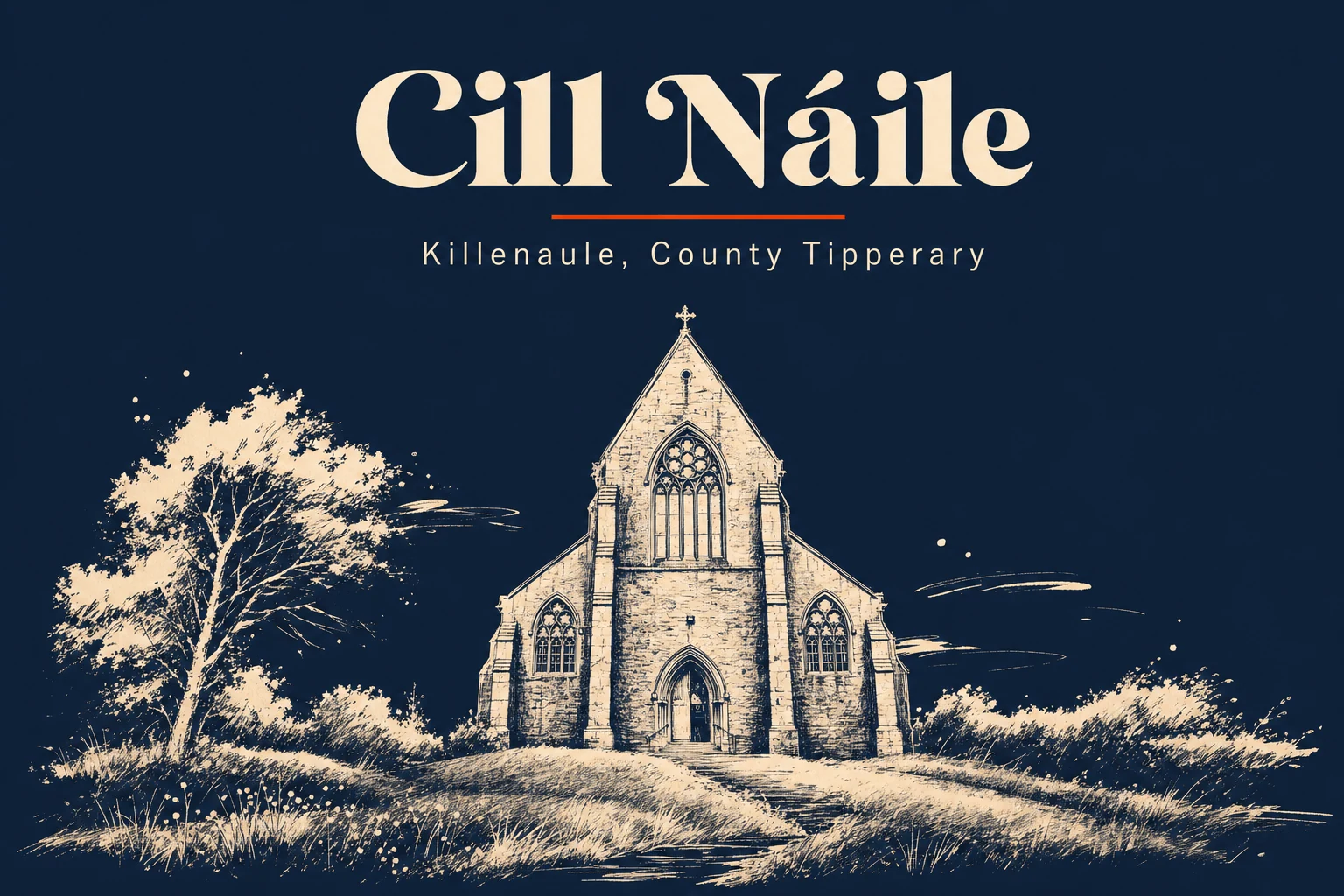
St Mary's Church on Bailey Street was designed by J.J. McCarthy - the architect responsible for Thurles Cathedral among many others - and opened in 1865. The pulpit inside was sculpted by Willie Pearse, younger brother of Patrick, working in the family firm of Pearse & Sons. Both brothers were executed at Kilmainham in May 1916. The church also holds stained glass attributed to Harry Clarke or his studios, and a seven-light altar window described as the largest made since the sixteenth-century Reformation. It's worth the climb up the steps.

1848, and the people moved first

Killenaule of the barricades

When the Young Ireland rebellion collapsed in the summer of 1848, William Smith O'Brien and his companions were moving through Tipperary ahead of the military. In Killenaule, the townspeople put up barricades on the roads to slow the pursuit. It didn't change the outcome - O'Brien was caught, tried and eventually transported - but the gesture stuck. The 1889 county handbook records that 'the town has been called Killenaule of the barricades' ever since.

Hurling since 1885

The Robins

Killenaule GAA was founded in 1885, plays in red and yellow, and answers to the nickname the Robins. The club has won 22 South Senior Hurling titles and produced inter-county players in almost every generation. Declan Fanning won an All Star at full-back in 2007 and an All-Ireland medal with Tipperary in 2010. John "Bubbles" O'Dwyer - centre-forward, All Star 2014 - retired from inter-county hurling in 2023 having scored that famous last-minute free in the drawn All-Ireland final against Kilkenny the previous year. His nine points in the South Tipperary final of 2014 remains the kind of number Killenaule people quote without being asked.

05 / 08

Things to do outside.

Wear waterproofs. Bring a sandwich. Tell someone where you're going if it's the mountain.

Grange Crag Loop Drive four kilometres north to Grange village and pick up the looped trail through mixed forest to the Wellington Monument folly on the summit of Crag Hill. Views across the Slieveardagh Hills to the central plain of Tipperary. Good boots advised - the paths are unpaved.
~7 km loopdistance
2-3 hourstime
Derrynaflan Trail A signed heritage drive linking the Slieveardagh Hills around Killenaule through Littleton Bog to Holycross Abbey on the River Suir. The Derrynaflan Chalice - one of the great treasures of early Christian Ireland, now in the National Museum - was found in a bog just off this route. Drive it slowly.
Driving heritage routedistance
Half daytime
06 / 08

When to go.

There is no bad time. There are different times.

Spring
Mar-May

The hills are green and relatively quiet. The church is open most days. Good light in the mornings.

◉ Go
Summer
Jun-Aug

Warm enough, not overwhelmed. South Tipperary hurling championship runs through July and August - if Killenaule are in the later rounds, the town has a different energy entirely.

◉ Go
Autumn
Sep-Oct

Harvest-time in a farming parish. The Crag Hill loop is good in October light. Quieter than summer without being closed.

◉ Go
Winter
Nov-Feb

Both pubs are open, but there isn't much else running. The church is the main reason to come. Not unwelcoming, just quiet.

◐ Mind yourself
07 / 08

What to skip.

Honestly? Don't bother.

If a local was sitting beside you, this is the bit where they'd lean in.

×
Driving through without stopping

Most people use Killenaule as a junction on the R689. The church alone is worth twenty minutes. Go in, look at the pulpit, look up at the window, come out.

×
Expecting a heritage trail you can walk

The Derrynaflan Trail is a driving route, not a footpath. The Slieveardagh mining sites are scattered and not signed for walkers. The Slieveardagh Heritage Centre on River Street will orient you; turn up there first.

+

Getting there.

By car

Cashel to Killenaule is about 20 minutes on the R689 east. Thurles is the same distance north. Clonmel is 25 minutes south on the R690. The roads are small but not difficult.

By bus

Local Link Tipperary route 896 runs between Ballingarry and Thurles, stopping in Killenaule. Infrequent - check locallinktipperary.ie before you plan around it.

By train

Nearest station is Thurles (Dublin-Cork line), about 15 km north. Then Local Link or taxi.