County Waterford Ireland · Co. Waterford · Passage East Save · Share
POSTED FROM
PASSAGE EAST
CO. WATERFORD · IE

Passage East
An Pasáiste

The Ireland's Ancient East
STOP 03 / 06
An Pasáiste · Co. Waterford

Strongbow stepped off here in 1170. The ferry still hasn't stopped going.

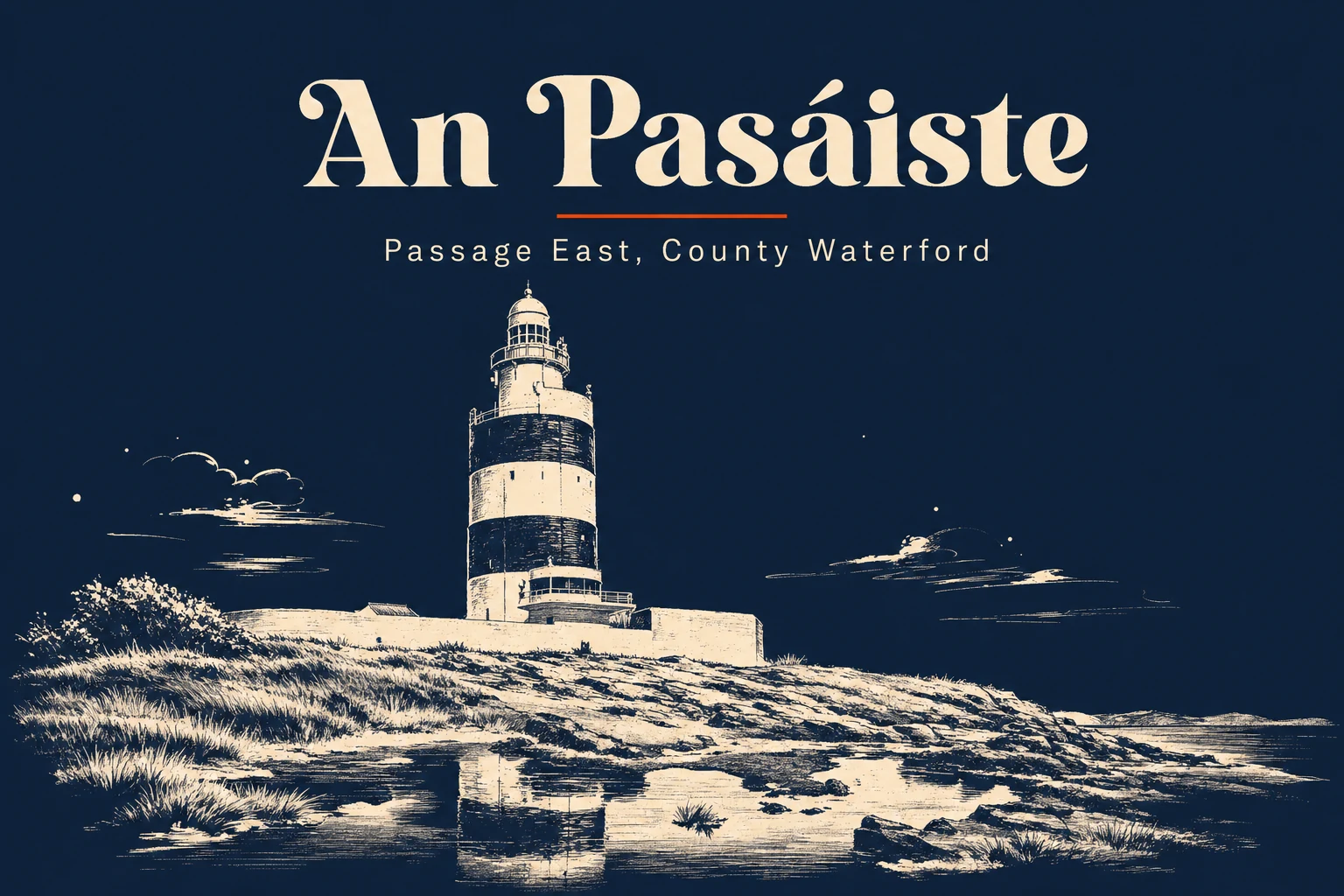
Passage East is a single line of cottages along a quay on the west bank of Waterford Harbour. Six hundred people, give or take. A pier, a slip, a ferry that runs to Wexford and back twelve hours a day. From the seawall you can see Hook Head lighthouse — the second-oldest working lighthouse in the world — winking at you across the estuary. That is most of the village. The rest is history that won't sit still.

On 23 August 1170, Richard de Clare — Strongbow — landed here with two hundred knights and a thousand men-at-arms and walked into Waterford two days later. The Anglo-Norman invasion of Ireland began on this beach. A year on, Henry II turned up with four hundred ships, and the country was annexed by parchment and sword from a slip you can stand on now. There is no fanfare. A small plaque, a quiet field, the ferry loading another car.

Then there's Geneva Barracks. A mile south, a ruined outer wall in a field. Built in 1783 to house Genevan watchmakers fleeing their own failed revolution — the colony collapsed inside a year — and converted to a barracks that became, in 1798, a holding pen and execution yard for thousands of United Irishmen. The Croppy Boy of the song was held here. Most of the prisoners were transported to New South Wales or shot. There is no signage to speak of. Find the road, find the wall, stand for a minute. That is the visit.
Population
~600
Walk score
The whole village in ten minutes along one quay
Founded
Norman landing site, 1170
Coords
52.2406° N, 6.9744° W
01 / 06

At a glance.

Three things every local will eventually mention. Read these and you've already understood more than most day-trippers do.

02 / 06

Stories & lore.

The reason to come back. The things every local will eventually tell you about, usually after the second pint.

23 August 1170

Strongbow's beach

Richard de Clare, second Earl of Pembroke, landed at Crooke just south of Passage East on St Bartholomew's Eve, 1170. Two hundred knights, a thousand foot. He had been promised the daughter of the King of Leinster and half a kingdom in return for an army; he delivered the army. Within forty-eight hours Waterford had fallen and Aoife of Leinster had married him in the burning city. A year later Henry II followed with four hundred ships and made the whole thing official. Eight hundred and fifty years on, you can stand on the slip and watch a Volkswagen drive onto the ferry where the longships used to be.

1783, then 1798

Geneva Barracks and the Croppy Boy

New Geneva was meant to be a utopia. In 1782 a failed Genevan revolution sent watchmakers and printers into exile, and the Irish Parliament — flush with the brief confidence of Grattan's era — voted £50,000 to build them a town near Passage East. They were to bring their crafts and their republican habits to Waterford harbour. They lasted about a year before the project collapsed over governance. The half-built barracks were taken over by the army. In 1798, after the rebellion, it became a prison and a transportation depot. Thousands of croppies were held inside the walls; many were flogged, hanged or shipped to New South Wales. The song "The Croppy Boy" puts its dying narrator inside Geneva Barracks. The walls are still there, in a field a mile south of the village. There is no visitor centre. There probably shouldn't be.

Nine hundred years of crossing

The ferry

A ferry of some kind has been running between Passage East and Ballyhack since the twelfth century — first oared, then sailed, then steamed, now diesel. The current car ferry, run by the Passage East Ferry Company, started in 1982. It carries about 28 cars at a time, takes five minutes, and saves you roughly fifty kilometres of road through Waterford city if you are headed for the Hook peninsula. Sailings every fifteen minutes in the morning rush, then a shuttle the rest of the day. Closed Christmas Day and St Stephen's Day. That is the whole timetable in a sentence.

October 1171

Henry's four hundred ships

Strongbow's invasion alarmed the King of England enough to come over himself. On 17 October 1171, Henry II's fleet of four hundred ships dropped anchor at Crooke and Passage East — five hundred knights, four thousand men-at-arms, thousands of horses. The largest royal expedition to leave England in the medieval period landed on this stretch of harbour. He stayed six months, took the homage of every Irish king who would give it, and left the country a Lordship of England. None of which is on a sign anywhere here.

03 / 06

Things to do outside.

Wear waterproofs. Bring a sandwich. Tell someone where you're going if it's the mountain.

Geneva Barracks site Walk south from the quay along the Crooke road. The barracks wall sits in a field on your right — a long stretch of dressed stone, a corner tower, no gate, no signage to speak of. Bring the story with you because the field will not tell it.
2 km return from villagedistance
30 mintime
Passage East to Crooke church Quiet country lane south to the ruined Crooke Preceptory — a Templar church, founded before 1180, sitting in a graveyard near the shore. Strongbow's actual landing beach is just below. Combine with the barracks walk and you have most of the morning.
3 km returndistance
45 mintime
Cliff path to Woodstown Shore-edge path south toward Woodstown beach — the long sandy strand the locals use when Tramore is full. Path is rough in places; wear boots. You can keep going to Dunmore East from there if the legs hold.
5 km one waydistance
1h 30mtime
The harbour wall Out the slip, along the Middle Quay, past the ferry ramp. Hook lighthouse on the far side, container ships sliding up to Belview, gulls behaving badly. Do it while you wait for a sailing.
1 kmdistance
20 mintime
04 / 06

When to go.

There is no bad time. There are different times.

Spring
Mar–May

Quiet, the ferry queues short, the harbour at its softest light. Fields at Crooke green again.

◉ Go
Summer
Jun–Aug

The ferry queues at weekends. Time it for a weekday morning if you want a calm crossing.

◐ Mind yourself
Autumn
Sep–Oct

The big skies arrive and the harbour stops pretending to be Mediterranean. Storm-watching from the seawall is the local pastime.

◉ Go
Winter
Nov–Feb

The ferry runs every day except Christmas and Stephen's. The village largely shuts. The walk to the barracks is at its bleakest, which is to say its most honest.

◐ Mind yourself
05 / 06

What to skip.

Honestly? Don't bother.

If a local was sitting beside you, this is the bit where they'd lean in.

×
Looking for a strip of pubs and restaurants

There isn't one. Passage East is a quay, a ferry slip, a few cottages and the history. If you want a long lunch, eat in Waterford city or Dunmore East and come here for the crossing.

×
Driving to Hook Head via Waterford city

The whole point of the village is that the ferry exists. Five minutes across, fifty kilometres saved. Use it.

×
Expecting a Geneva Barracks visitor centre

There is a wall in a field. There is no centre, no café, no guide. Read the story before you go or it is just stone.

+

Getting there.

By car

Waterford city to Passage East is 15 minutes on the R683 — a quiet country road along the harbour. From Wexford or the Hook, take the ferry from Ballyhack: five minutes across, every fifteen minutes in the morning, shuttle service the rest of the day, every day bar 25–26 December.

By bus

Local Link route 358 connects Waterford city to Passage East via Dunmore East several times daily. Slow but it works.

By train

No train. Plunkett station in Waterford city is the nearest, then a bus or a 15-minute drive.

By air

Cork (ORK) is 1h 45m by road. Dublin is 2h 15m. Waterford airport stopped commercial flights in 2016.